


New Power Party (NPP) Legislator Chiu Hsien-chih (邱顯智) on Saturday said the party has received what appeared to be wiretap transcripts related to former Cabinet spokesman Chen Tsung-yen’s (陳宗彥) alleged involvement in sex and bribery scandals, adding that the whistle-blower is likely from the nation’s legal circles.
Chen Tsung-yen resigned on Friday night after Taiwan People’s Party (TPP) Legislator Chen Wan-hui (陳琬惠) earlier in the day presented documents allegedly showing that Chen Tsung-yen received the services of sex workers when he was a Tainan City Government official in 2012.
The services were arranged by a close friend of Chen Tsung-yen, Chen Wan-hui said.
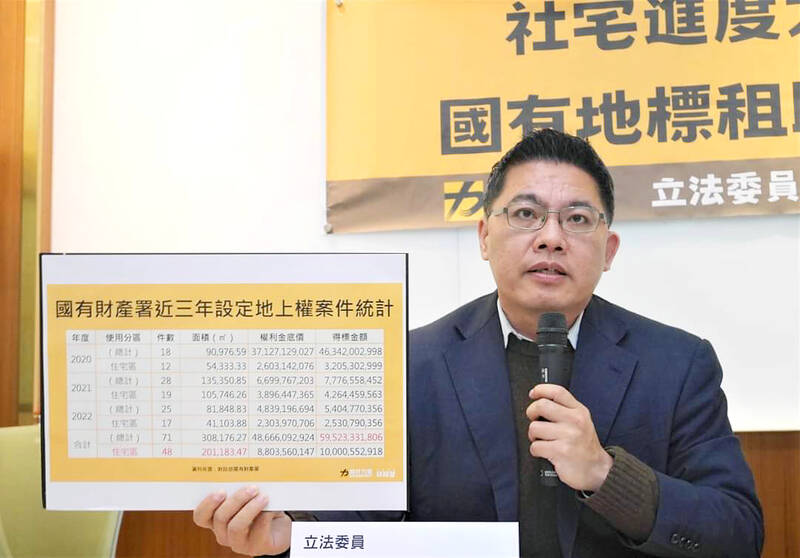
Photo courtesy of Chiu Hsien-chih’s office
News media earlier the same day also reported on Chen Tsung-yen’s alleged misconduct.
Chen Wan-hui at a news conference shared the screenshots of chat messages allegedly showing Chen Tsung-yen’s interactions with a hostess club operator named Wang Hsiao-wei (王孝瑋).
Chen Wan-hui also accused the Tainan District Prosecutors’ Office of covering up an alleged bribery scandal involving Chen Tsung-yen.
Chen Tsung-yen has denied the accusations, saying he had never been interrogated nor investigated by law enforcement officers over the incidents during his time as a city councilor or city government official in Tainan.
Chiu on Saturday said that the wiretap transcripts and signed documents from the Tainan District Prosecutors’ Office, which should be viewed by prosecutors and lawyers only, “were leaked to the public in an unprecedented manner.”
“The whistle-blower carefully selected the materials to be disclosed, and deliberately sent different documents to the Chinese Nationalist Party [KMT], the TPP and the NPP at different times,” he said.
Chiu said the supposedly classified documents were delivered to the NPP in a brown bag.
“The whistle-blower also attached a note, ‘kindly reminding’ the party that it could contravene the Communication Security and Surveillance Act (通訊保障及監察法) if it reveals the contents of the transcripts to the public. This shows that the whistle-blower is an insider from the legal profession,” he said.
Chiu said he was reluctant to use the transcripts for any purpose, as the leak has crossed the boundary between exposing a scandal and serving as a tool for politicians to “crush their opponents.”
“We do not know how these materials were leaked to the public, but one thing we know for sure is that the justice system has become a tool of political struggle,” he said.
The case shows the need for a whistle-blower protection act, Chiu said.
“We need to define in clear terms who qualifies as a whistle-blower and under what circumstances they can be exempted from the legal consequences of leaking classified information,” he said.
“The act should stipulate protection clauses for whistle-blowers,” he added.

Considering that most countries issue more than five denominations of banknotes, the central bank has decided to redesign all five denominations, the bank said as it prepares for the first major overhaul of the banknotes in more than 24 years. Central bank Governor Yang Chin-lung (楊金龍) is expected to report to the Legislative Yuan today on the bank’s operations and the redesign’s progress. The bank in a report sent to the legislature ahead of today’s meeting said it had commissioned a survey on the public’s preferences. Survey results showed that NT$100 and NT$1,000 banknotes are the most commonly used, while NT$200 and NT$2,000

The Centers for Disease Control (CDC) yesterday reported the first case of a new COVID-19 subvariant — BA.3.2 — in a 10-year-old Singaporean girl who had a fever upon arrival in Taiwan and tested positive for the disease. The girl left Taiwan on March 20 and the case did not have a direct impact on the local community, it said. The WHO added the BA.3.2 strain to its list of Variants Under Monitoring in December last year, but this was the first imported case of the COVID-19 variant in Taiwan, CDC Deputy Director-General Lin Ming-cheng (林明誠) said. The girl arrived in Taiwan on

South Korea is planning to revise its controversial electronic arrival card, a step Taiwanese officials said prompted them to hold off on planned retaliatory measures, a South Korean media report said yesterday. A Yonhap News Agency report said that the South Korean Ministry of Foreign Affairs is planning to remove the “previous departure place” and “next destination” fields from its e-arrival card system. The plan, reached after interagency consultations, is under review and aims to simplify entry procedures and align the electronic form with the paper version, a South Korean ministry official said. The fields — which appeared only on the electronic form

The Ministry of Foreign Affairs (MOFA) is suspending retaliation measures against South Korea that were set to take effect tomorrow, after Seoul said it is updating its e-arrival system, MOFA said today. The measures were to be a new round of retaliation after Taiwan on March 1 changed South Korea's designation on government-issued alien resident certificates held by South Korean nationals to "South Korea” from the "Republic of Korea," the country’s official name. The move came after months of protests to Seoul over its listing of Taiwan as "China (Taiwan)" in dropdown menus on its new online immigration entry system. MOFA last week


 RSS
RSS