


Pingtung County plans to allocate more funding to assist local organizers and support activities for Makatao festivals this year to preserve the indigenous group’s culture and traditions, Pingtung County Government officials said.
The increased budgets would help elders and young people pass down and preserve traditional knowledge within Makatao communities, who reside mainly in the county’s rural villages, Pingtung County cultural affairs official Lee Ming-chung (李明忠) said on Thursday last week.
Subsidies are to be allocated to cultural research and field studies, and to record and publish Makatao histories, Lee said after attending the Makatao’s Gabulong Night Festival in Pingtung’s Wanluan Township (萬巒) on Feb. 5.
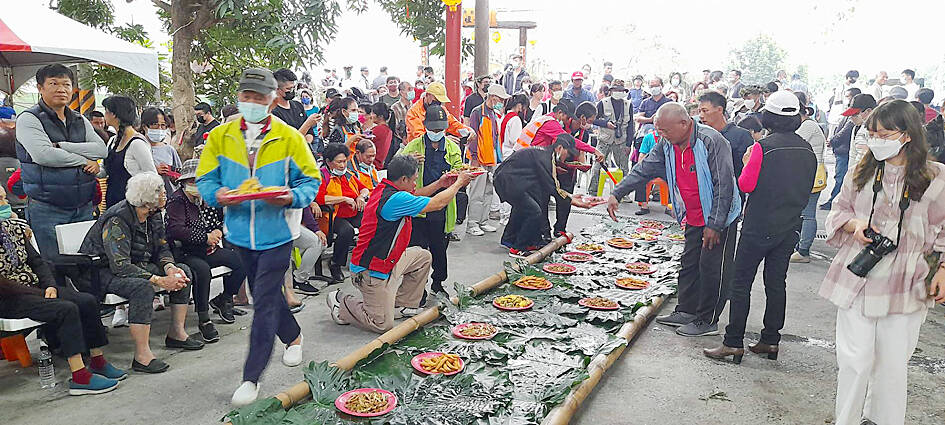
Photo: Jason Pan, Taipei Times
Pingtung County Commissioner Chou Chun-mi (周春米) has pledged to boost funding and expand the programs, Makatao elder Pan An-chuan (潘安全) cited Lee as saying.
The funding would also help the organization of the other two major Makatao cultural events this year — the night festivals in Neipu Township’s (內埔) Laopi Village (老埤) and Gaoshu Township’s (高樹) Ganabo Village (加蚋埔), Pan said.
“It is important to keep our Makatao culture and rituals alive, to teach to our young people so they can pass our traditions and identity to future generations,” Pan said.
“Makatao people, with our Austronesian language and culture, are the original inhabitants, living for thousands of years on Pingtung’s plains and coastal areas,” he added.
The Makatao hold the night festival on the 15th day of first month of the lunar calendar to celebrate the start of the new year.
Village elders have taken part in the tradition, following their ancestors, despite suppression and forced assimilation by the Japanese and the Han Chinese colonial regimes, Pan said.
The Gabulong Night Festival this year took place at the Temple of Immortal Maidens, whose creation myth the Makatao re-enact with the Tale of the Sacred Egg (仙蛋傳奇), which involves a ceremony and ritual dances led by female shamans.
The rituals seek a divine blessing from the maidens, and for timely rain to fall so that farms produce a bountiful harvest, Pan said.
Food offerings to the deities this year consisted of three slaughtered hogs laid in front of the temple, along with traditional Makatao dishes of rice cakes, sweet snacks, yams, clusters of betel nuts, sliced pork, fruit, meat and rice dumplings, and homemade liquor made from a year-long fermentation of glutinous rice, Pan said.
The shamans and Makatao elders invited participants and visitors to drink the liquor from bowls and cups for blessings and good luck for the coming year, Pan said.
Ritual processions and activities occurred throughout the evening as part of the Makatao and other Pingpu traditional celebrations known as night festivals.
Participants were invited to eat traditional rice dishes together, Pan said, adding that the Makatao do not allow visitors to remain hungry.
The Makatao in Pingtung County and the Siraya in Tainan County are among Taiwan’s major Pingpu groups, also known as plains aborigines, along with other groups such as the Ketagalan, Pazeh, Kaxabu, Papora, Taokas, Tavorlong, Hoanya, Babuza and other groups that continue their drive for official recognition as Taiwanese indigenous people.

FUKUOKA SITUATION: Japanese media reported that the pathogen is expected to be identified by the summer, while the CDC downplayed the idea that it was hMPV A “mysterious cold-like illness” reported in Japan’s Fukuoka Prefecture does not seem to be a new disease, but Japanese authorities have been asked about the situation, the Centers for Disease Control (CDC) said yesterday. The Fukuoka Prefectural Medical Association on Wednesday told a news conference that a “mystery cold” that has become a hot topic on social media is “highly likely to be caused by some kind of viral infection,” Japan’s KBC News reported. “Many people are experiencing symptoms starting with a sore throat, followed by a runny nose, phlegm and a severe cough,” KBC News reported, citing association officials. Health authorities are

Nvidia Corp CEO Jensen Huang (黃仁勳) arrived in Taiwan yesterday ahead of upcoming AI and technology events, saying he plans to meet with clients and Taiwan Semiconductor Manufacturing Co Chairman C.C. Wei (魏哲家) during his visit. After landing at Taipei Songshan Airport, Huang posed for photos with fans and handed out Yakult drinks to reporters and supporters waiting at the scene, saying he has “a lot to do” during the trip. Asked about reports that Nvidia’s planned headquarters site in Taipei’s Beitou Shilin Technology Park could break ground on May 27, Huang said that if the company holds an event, he would

The Ministry of Finance this afternoon announced the winning numbers for the March-April uniform invoice lottery. The winning number for the NT$10 million (US$318,060) special prize is 19531471, and the winning number for the NT$2 million grand prize is 85941329. Three numbers were drawn for the NT$200,000 first prize: 07225810, 20231230 and 83518781. Those with receipts matching the last seven digits of any of the first-prize numbers will win the NT$40,000 second prize, while those matching the last six digits will win the NT$10,000 third prize. Those whose receipts match the last five digits of the first-prize numbers can claim the NT$4,000 fourth prize,
Taiwan Travelogue (臺灣漫遊錄), which earlier this week became the first Taiwanese novel to win the International Booker Prize, is to be adapted into a television series through a Taiwan-Japan coproduction, producer Chang Chen-yu (張辰漁) said yesterday. Chang, a producer at World Softest Production Film Co, wrote on Facebook that the company had been searching for projects with international appeal that retain a strong Taiwanese identity after colleagues and Japanese partners strongly recommended the novel. After reading the book, Chang said he immediately decided to pursue the screen rights. “A great story has the power to transcend time and borders, and connect countless people,”


 RSS
RSS