


A magnitude 3.1 earthquake that struck Taipei’s Beitou District (北投) yesterday was related to volcanic activity at Datunshan (大屯山) in Yangmingshan National Park, but was an isolated event and not a cause for concern, the Central Weather Bureau said yesterday.
The earthquake occurred at 9:08am, with an epicenter 14.1km north of Taipei City Hall, at a depth of 4.8km, the bureau said, adding that it was a shallow earthquake and did not cause any reported damage.
The earthquake was not caused by friction of tectonic plates, but by an influx of groundwater into Datunshan’s magma reservoir, the bureau’s Seismological Center Director Chen Kuo-chang (陳國昌) said.
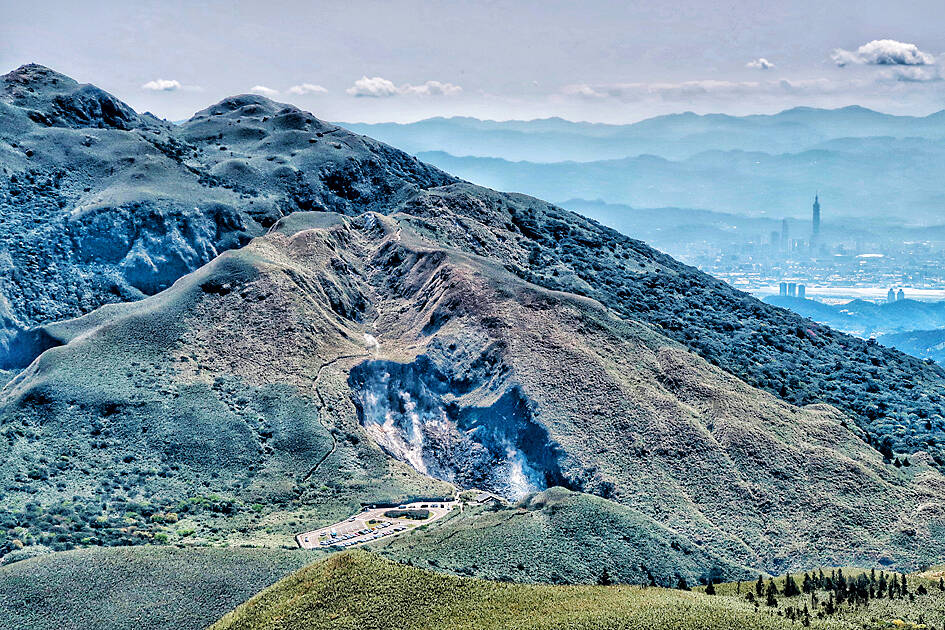
Photo: Lu Chun-wei, Taipei Times
“It also had nothing to do with any eruption. It was a single event, and the public should not worry,” Chen said.
“Our initial speculations are that the rock wall of the magma chamber was broken, which caused the groundwater to leak in and mix with the magma,” he said.
Datunshan is often active, causing about 20 to 30 seismic events per day, but most of the activity registers at about magnitude 1, Chen said, adding that yesterday was the 17th time in the past 20 years that the scale exceeded magnitude 3.
Academia Sinica Institute of Earth Sciences deputy director Lin Cheng-horng (林正洪) said that certain precursors would be observable for up to a month before a major eruption were to occur.
“Precursors of a volcanic eruption include swarms of intensive earthquakes, gases released into the air and deformations of the Earth’s crust,” Lin said.
His team of researchers set up an array of 140 broadband seismic data collection stations after confirming in 2017 that Datunshan has a magma reservoir with the characteristics of an active volcano, he said.
The stations were built across northern Taiwan in Taoyuan, New Taipei City, Taipei, Keelung and Yilan County, Lin said, adding that the team discovered that the volcano’s magma reservoir is about 8km beneath the surface.
The research team believes that possible eruption points are Dayoukeng (大油坑), Qixingshan (七星山) and Huangzuishan (磺嘴山), with Dayoukeng being the most likely to be active, he said.
“If a large-scale eruption were to occur, it would not only affect the Yangmingshan area, but also areas such as Taipei’s Tianmu (天母) and Shilin District (士林),” Lin said.
“However, we can predict a major eruption weeks in advance, and no single earthquake would cause an eruption to occur the day after,” he added.

LOUD AND PROUD Taiwan might have taken a drubbing against Australia and Japan, but you might not know it from the enthusiasm and numbers of the fans Taiwan might not be expected to win the World Baseball Classic (WBC) but their fans are making their presence felt in Tokyo, with tens of thousands decked out in the team’s blue, blowing horns and singing songs. Taiwanese fans have packed out the Tokyo Dome for all three of their games so far and even threatened to drown out home team supporters when their team played Japan on Friday. They blew trumpets, chanted for their favorite players and had their own cheerleading squad who dance on a stage during the game. The team struggled to match that exuberance on the field, with
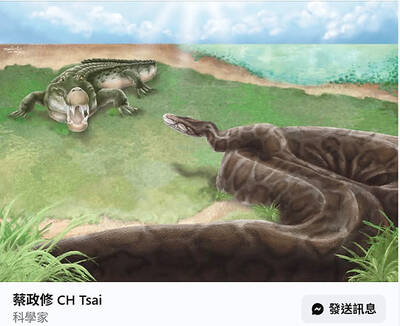
Taiwanese paleontologists have discovered fossil evidence that pythons up to 4m long inhabited Taiwan during the Pleistocene epoch, reporting their findings in the international scientific journal Historical Biology. National Taiwan University (NTU) Institute of Ecology and Evolutionary Biology associate professor Tsai Cheng-hsiu (蔡政修) led the team that discovered the largest snake fossil ever found in Taiwan. The single trunk vertebra was discovered in Tainan at the Chiting Formation, dated to between 400,000 and 800,000 years ago in the Middle Pleistocene, the paper said. The area also produced Taiwan’s first avian fossil, as well as crocodile, mammoth, saber-toothed cat and rhinoceros fossils, it said. Discoveries

Taiwanese paleontologists have discovered fossil evidence that pythons up to 4m long inhabited Taiwan during the Pleistocene epoch, reporting their findings in the international scientific journal Historical Biology. National Taiwan University (NTU) Institute of Ecology and Evolutionary Biology associate professor Tsai Cheng-hsiu (蔡政修) led the team that discovered the largest snake fossil ever found in Taiwan. A single trunk vertebra was discovered in Tainan at the Chiting Formation, dated to between 800,000 to 400,000 years ago in the Middle Pleistocene, the paper said. The area also produced Taiwan’s first avian fossil, as well as crocodile, mammoth, sabre-toothed cat and rhinoceros fossils, it said. Discoveries

Whether Japan would help defend Taiwan in case of a cross-strait conflict would depend on the US and the extent to which Japan would be allowed to act under the US-Japan Security Treaty, former Japanese minister of defense Satoshi Morimoto said. As China has not given up on the idea of invading Taiwan by force, to what extent Japan could support US military action would hinge on Washington’s intention and its negotiation with Tokyo, Morimoto said in an interview with the Liberty Times (sister paper of the Taipei Times) yesterday. There has to be sufficient mutual recognition of how Japan could provide


 RSS
RSS