


Members of the Taiwanese search- and-rescue team on Thursday pulled a woman from a collapsed residential building in the Turkish province of Adiyaman, about 89 hours after a magnitude 7.8 earthquake struck the nation.
Taiwanese rescuers first detected signs of life at 2:37am on Thursday, about 70 hours after the quake flattened thousands of buildings in Turkey and Syria early on Monday, the National Fire Agency said.
The woman was pinned under a fallen concrete pillar, but was conscious and still able to speak, the agency said in a statement.
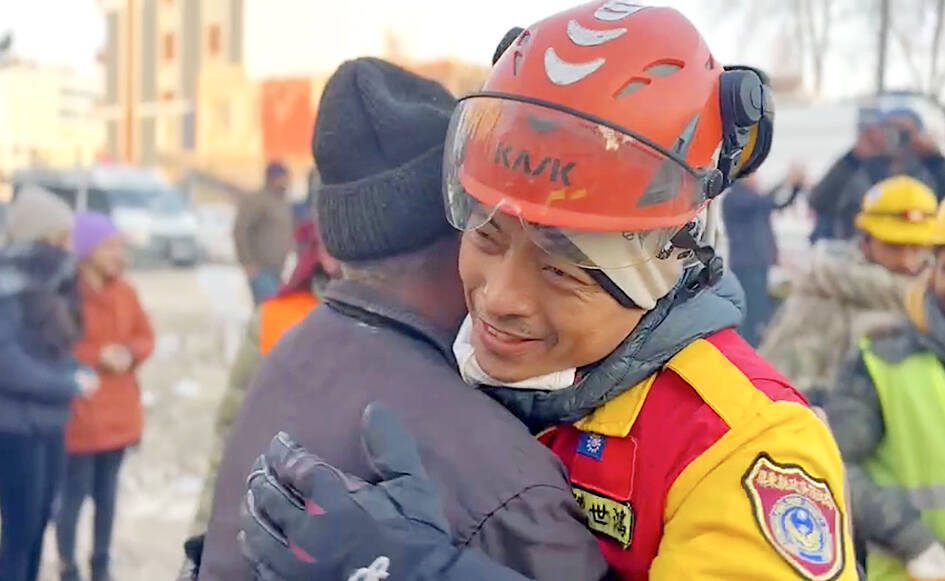
Photo courtesy of the Pingtung County Government
The group used a life detector device to locate the woman, while medical personnel were on standby to provide assistance, it said.
Special tools were used to break up the pillar to let the group get closer to the woman.
At 12:43pm, Taiwanese and Turkish rescuers confirmed her exact location and found other objects, including wrecked floor panels, a mattress and quilts, pinning her down.
The 35-year-old woman was eventually rescued from the wreckage 19 hours and 37 minutes after she was initially found to be alive by the Taiwanese team.
The rescue was a rare moment of good news in the aftermath of the earthquake and major aftershocks that have left more than 20,000 dead in Turkey and Syria, with the toll likely to climb further.
Taiwan has dispatched 130 personnel and five sniffer dogs to Turkey since Monday.
Most of them have arrived in Adiyaman, one of the hardest-hit areas, where they began their search-and-rescue mission soon after their arrival.
The woman rescued on Thursday was the second living person pulled out of the earthquake rubble by the team.
The group pulled another woman from a collapsed building in Adiyaman on Wednesday night, but she died shortly afterward at a local hospital, the Taipei Fire Department said on Thursday.
Meanwhile, items to help survivors of the earthquake deal with winter conditions are the most-needed donations, the Turkish Trade Office in Taipei said yesterday on Facebook, adding that new items are preferred over secondhand ones for sanitary reasons.
Needed winter clothing include coats and warm jackets, raincoats, boots, sweaters, pants, gloves, scarves, winter hats, socks and underwear, it said.
Non-clothing items needed include tents, sleeping bags, foam sleeping mats, thermos bottles, infant diapers and feminine hygiene products, it said.
Items can be dropped off in person until 4pm on Wednesday next week at the Buddhist Compassion Relief Tzu Chi Foundation’s branch at No. 168 Chenggong Road, Sec 5, Neihu District (內湖), Taipei, it said.
The Ministry of Health and Welfare yesterday said it had received more than NT$83.53 million (US$2.77 million) in cash donations for relief efforts in Turkey.
The total received from the donations, numbering 8,148 as of 5pm on Thursday, represented a big jump from the NT$10.33 million that had been collected as of Wednesday.
Starting yesterday, people looking to make donations can do so through kiosks at branches of the four major convenience store chains in Taiwan, said Yang Ya-lan (楊雅嵐), deputy head of the ministry’s Department of Social Assistant and Social Work.
The Bank of Taiwan has also set up a special account (003001727277) and people can make donations at any of its branches, ATM or online, Yang said.

Considering that most countries issue more than five denominations of banknotes, the central bank has decided to redesign all five denominations, the bank said as it prepares for the first major overhaul of the banknotes in more than 24 years. Central bank Governor Yang Chin-lung (楊金龍) is expected to report to the Legislative Yuan today on the bank’s operations and the redesign’s progress. The bank in a report sent to the legislature ahead of today’s meeting said it had commissioned a survey on the public’s preferences. Survey results showed that NT$100 and NT$1,000 banknotes are the most commonly used, while NT$200 and NT$2,000

The Centers for Disease Control (CDC) yesterday reported the first case of a new COVID-19 subvariant — BA.3.2 — in a 10-year-old Singaporean girl who had a fever upon arrival in Taiwan and tested positive for the disease. The girl left Taiwan on March 20 and the case did not have a direct impact on the local community, it said. The WHO added the BA.3.2 strain to its list of Variants Under Monitoring in December last year, but this was the first imported case of the COVID-19 variant in Taiwan, CDC Deputy Director-General Lin Ming-cheng (林明誠) said. The girl arrived in Taiwan on

South Korea is planning to revise its controversial electronic arrival card, a step Taiwanese officials said prompted them to hold off on planned retaliatory measures, a South Korean media report said yesterday. A Yonhap News Agency report said that the South Korean Ministry of Foreign Affairs is planning to remove the “previous departure place” and “next destination” fields from its e-arrival card system. The plan, reached after interagency consultations, is under review and aims to simplify entry procedures and align the electronic form with the paper version, a South Korean ministry official said. The fields — which appeared only on the electronic form

The Ministry of Foreign Affairs (MOFA) is suspending retaliation measures against South Korea that were set to take effect tomorrow, after Seoul said it is updating its e-arrival system, MOFA said today. The measures were to be a new round of retaliation after Taiwan on March 1 changed South Korea's designation on government-issued alien resident certificates held by South Korean nationals to "South Korea” from the "Republic of Korea," the country’s official name. The move came after months of protests to Seoul over its listing of Taiwan as "China (Taiwan)" in dropdown menus on its new online immigration entry system. MOFA last week


 RSS
RSS