


The government yesterday expressed its interest in holding an in-person meeting between President Tsai Ing-wen (蔡英文) and Czech president-elect Petr Pavel after Pavel suggested the idea during a telephone call with Tsai on Monday.
“The president-elect has expressed his willingness [to hold a personal meeting]. The Ministry of Foreign Affairs [MOFA] will do its utmost to support efforts that would deepen the partnership between Taiwan and the Czech Republic,” ministry spokesman Jeff Liu (劉永健) said.
Tsai congratulated Pavel with his election victory during their telephone conversation.
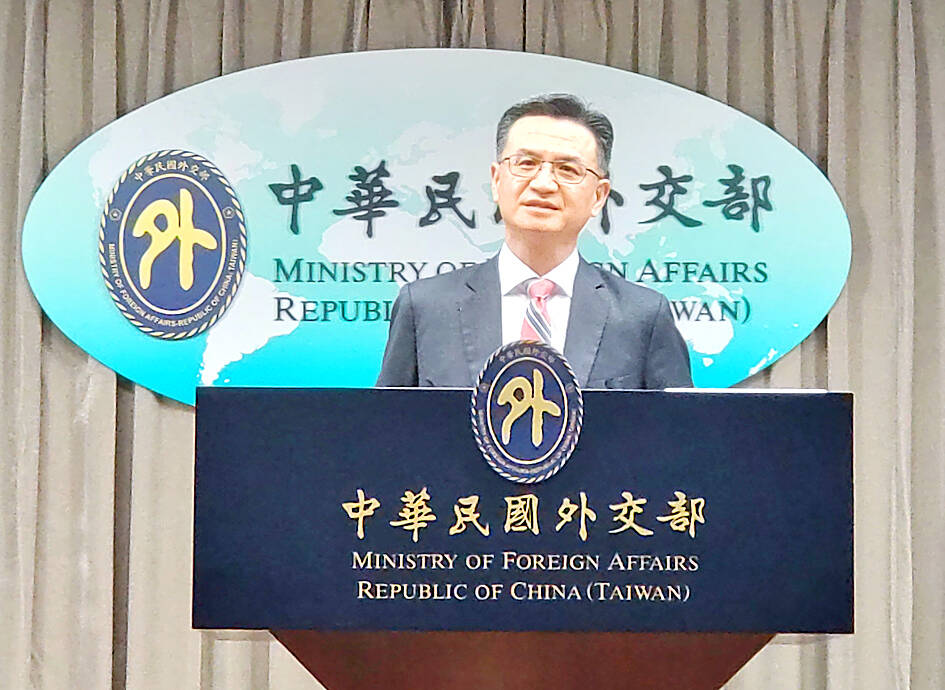
Photo: Yang Cheng-yu, Taipei Times
The call was highly unusual, as Prague does not have official diplomatic ties with Taipei. Leaders of countries that recognize Beijing normally avoid having direct contact with Taiwanese presidents to avoid provoking China.
Tsai previously spoke on the phone with then-US president-elect Donald Trump on Dec. 2, 2016, to congratulate him on his election win.
Liu said that Monday’s call is concrete proof that Taiwan has over the past few years built solid partnerships with central and eastern European countries.
Tsai told Pavel that Taiwanese and Czech have deep ties, and value freedom, democracy and human rights, Presidential Office spokeswoman Lin Yu-chan (林聿禪) said.
Based on these cordial ties, the government looks forward to deepening exchanges and cooperation with the Czech Republic in key areas, including semiconductor design, talent cultivation in cutting-edge technologies and supply chain restructuring, Lin said.
Pavel later on Twitter thanked Tsai for congratulating him during Monday’s call.
“I assured her that Taiwan and the Czech Republic share the values of freedom, democracy, and human rights. We agreed on strengthening our partnership,” Pavel wrote.
“I also expressed hope to have the opportunity to meet President Tsai in person in the future,” he added.
Pavel, a retired general and former chairman of the NATO Military Committee, was elected to the mostly ceremonial post on Saturday. The 61-year-old is to replace Czech President Milos Zeman, whose second term ends next month.
Unlike Zeman, who long pushed for closer relations with China and Russia, Pavel is considered a mainstream pro-Western candidate who backs aid for Ukraine and is supportive of closer ties with Taiwan.
Despite the lack of diplomatic ties, Taiwan and the Czech Republic have maintained cordial relations since the two sides opened representative offices in 1991 and 1993 in Prague and Taipei respectively.
The Chinese Ministry of Foreign Affairs yesterday condemned the phone call between Pavel and Tsai, accusing Pavel of going back on his word and lacking credibility.
Chinese foreign ministry spokesperson Mao Ning (毛寧) said Beijing had made stern representations to the Czech side.
Additional reporting by Reuters

FUKUOKA SITUATION: Japanese media reported that the pathogen is expected to be identified by the summer, while the CDC downplayed the idea that it was hMPV A “mysterious cold-like illness” reported in Japan’s Fukuoka Prefecture does not seem to be a new disease, but Japanese authorities have been asked about the situation, the Centers for Disease Control (CDC) said yesterday. The Fukuoka Prefectural Medical Association on Wednesday told a news conference that a “mystery cold” that has become a hot topic on social media is “highly likely to be caused by some kind of viral infection,” Japan’s KBC News reported. “Many people are experiencing symptoms starting with a sore throat, followed by a runny nose, phlegm and a severe cough,” KBC News reported, citing association officials. Health authorities are

Nvidia Corp CEO Jensen Huang (黃仁勳) arrived in Taiwan yesterday ahead of upcoming AI and technology events, saying he plans to meet with clients and Taiwan Semiconductor Manufacturing Co Chairman C.C. Wei (魏哲家) during his visit. After landing at Taipei Songshan Airport, Huang posed for photos with fans and handed out Yakult drinks to reporters and supporters waiting at the scene, saying he has “a lot to do” during the trip. Asked about reports that Nvidia’s planned headquarters site in Taipei’s Beitou Shilin Technology Park could break ground on May 27, Huang said that if the company holds an event, he would

Carrefour Taiwan is to begin using a new name from the start of July, but it cannot divulge the name until then, the chairman of the supermarket chain's parent company said today. President Chain Store Co chairman Lo Chih-hsien (羅智先) was asked by reporters after a shareholders' meeting to confirm whether the company has settled on a new name for the supermarket brand. In March, the government-registered name of two Carrefour Taiwan branches was quietly changed to "Le Chia Kang" (樂家康) in Chinese, raising speculation that has been selected as the name. Lo said that because of local regulations and contractual obligations, the
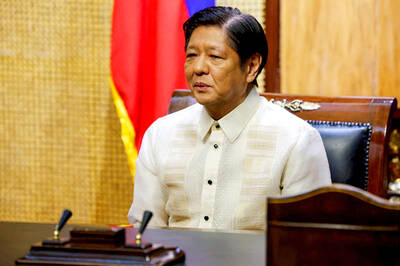
The Philippines would likely be involved in any conflict over Taiwan due to its proximity to the democracy claimed by China, President Ferdinand Marcos Jr said, reiterating a stance that risks angering Beijing. “In the Philippines, we do not have a choice because Taiwan is so close to the Philippines and we have almost 200,000 Filipino nationals living and working in Taiwan,” Marcos said in an interview with Japanese media in Manila on Monday. The Philippine leader’s comments come ahead of a state visit to Japan next week, where he is to meet with Japanese Prime Minister Sanae Takaichi to discuss security


 RSS
RSS