


A five-month-old girl who died last week has been confirmed as the nation’s first fatal case of enterovirus in two years, the Centers for Disease Control (CDC) said on Monday.
CDC Deputy Director Chuang Jen-hsiang (莊人祥) said that the girl was initially treated for a cough and excessive mucus on Dec. 22, and was rushed to a hospital on Dec. 30 after she was found without vital signs.
At the hospital, doctors reported her to the CDC as a possible severe enterovirus case, which was confirmed when she was diagnosed with enterovirus D68 on Jan. 6, Chuang said.
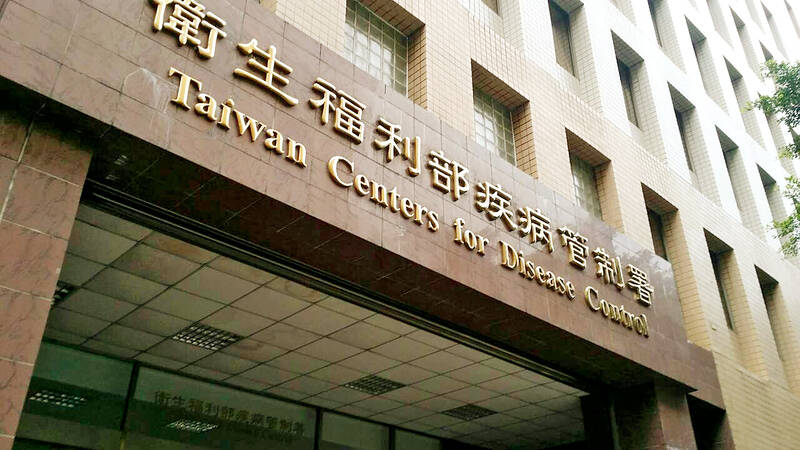
Photo: Lin Hui-chin, Taipei Times
While the girl’s vital signs returned while she was being treated at the hospital’s intensive care unit, she showed signs of brain damage and never regained consciousness, and died on Jan. 12, he said.
Chuang also reported that a man in his 30s from northern Taiwan recently became only the fourth adult in the past 25 years to develop severe symptoms from an enterovirus infection.
The man on Dec. 9 developed a fever, muscle weakness and respiratory difficulties, and on Dec. 19 was admitted to a hospital after outpatient care failed to relieve his symptoms.
On Friday, tests confirmed that the man had coxsackievirus A2 — a type of enterovirus — with severe complications, Chuang said, adding that he is in intensive care.
Enterovirus infections have been rising over the past two weeks, ahead of the virus’ typical peak season in the spring, Chuang said.
As enterovirus cases have been relatively rare over the past three years, many two and three-year-old children have never caught it, and might therefore have an “immunity debt” that makes them more vulnerable to infection, Chuang said.
From Jan. 8 to Saturday, emergency rooms and clinics nationwide reported 1,777 enterovirus cases, an increase of 36.8 percent over the previous week, CDC data showed.
“Enterovirus” is a general name for a group of related viruses that typically cause mild common cold and asthma-like symptoms, but can occasionally lead to more serious complications, particularly in young children.
Practicing good hand hygiene can prevent enterovirus infection, but alcohol-based hand disinfectants are not effective against enteroviruses, so washing hands thoroughly with soap is recommended, the CDC said.
People with symptoms should rest at home or seek medical attention, and avoid gatherings during the holiday, it added.
Additional reporting by Lee I-chia

Considering that most countries issue more than five denominations of banknotes, the central bank has decided to redesign all five denominations, the bank said as it prepares for the first major overhaul of the banknotes in more than 24 years. Central bank Governor Yang Chin-lung (楊金龍) is expected to report to the Legislative Yuan today on the bank’s operations and the redesign’s progress. The bank in a report sent to the legislature ahead of today’s meeting said it had commissioned a survey on the public’s preferences. Survey results showed that NT$100 and NT$1,000 banknotes are the most commonly used, while NT$200 and NT$2,000

The Centers for Disease Control (CDC) yesterday reported the first case of a new COVID-19 subvariant — BA.3.2 — in a 10-year-old Singaporean girl who had a fever upon arrival in Taiwan and tested positive for the disease. The girl left Taiwan on March 20 and the case did not have a direct impact on the local community, it said. The WHO added the BA.3.2 strain to its list of Variants Under Monitoring in December last year, but this was the first imported case of the COVID-19 variant in Taiwan, CDC Deputy Director-General Lin Ming-cheng (林明誠) said. The girl arrived in Taiwan on

South Korea is planning to revise its controversial electronic arrival card, a step Taiwanese officials said prompted them to hold off on planned retaliatory measures, a South Korean media report said yesterday. A Yonhap News Agency report said that the South Korean Ministry of Foreign Affairs is planning to remove the “previous departure place” and “next destination” fields from its e-arrival card system. The plan, reached after interagency consultations, is under review and aims to simplify entry procedures and align the electronic form with the paper version, a South Korean ministry official said. The fields — which appeared only on the electronic form

The Ministry of Foreign Affairs (MOFA) is suspending retaliation measures against South Korea that were set to take effect tomorrow, after Seoul said it is updating its e-arrival system, MOFA said today. The measures were to be a new round of retaliation after Taiwan on March 1 changed South Korea's designation on government-issued alien resident certificates held by South Korean nationals to "South Korea” from the "Republic of Korea," the country’s official name. The move came after months of protests to Seoul over its listing of Taiwan as "China (Taiwan)" in dropdown menus on its new online immigration entry system. MOFA last week


 RSS
RSS