


The Central Epidemic Command Center (CECC) yesterday said that 17.2 percent of people — or 225 out of 1,305 — who arrived on flights from China on Friday tested positive for COVID-19.
The number of imported cases has been high over the past few days, said Centers for Disease Control Deputy Director-General Chuang Jen-hsiang (莊人祥), who is the CECC’s spokesperson.
As China reopened its borders and lifted travel restrictions yesterday, the CECC is continuing to monitor whether the country’s reopening might affect Taiwan, Chuang said.
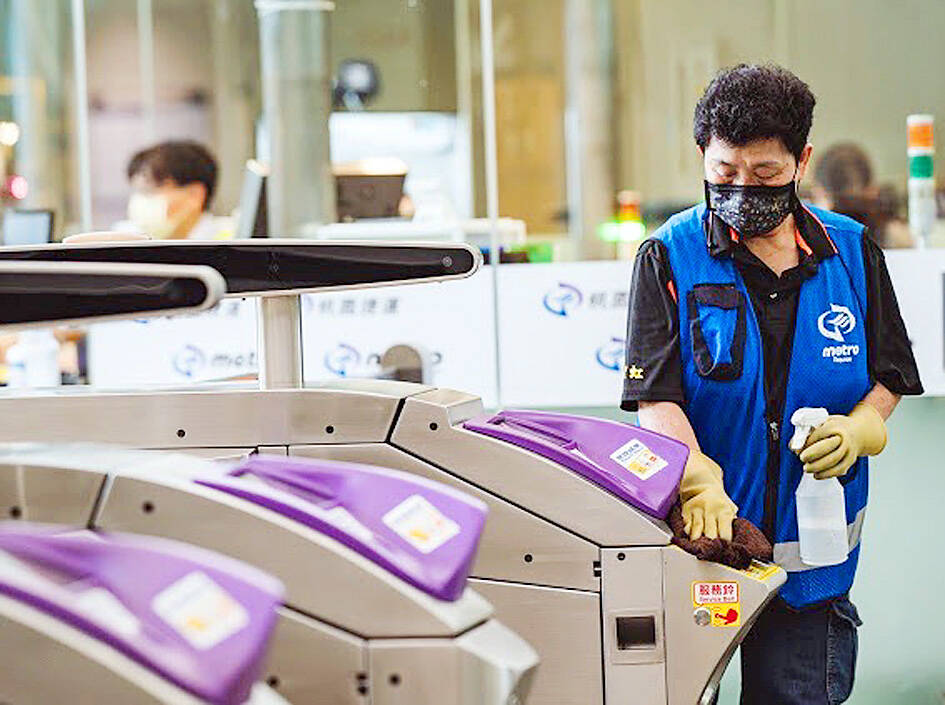
Photo courtesy of the Taiwan Taoyuan International Airport MRT
The “small three links” — direct flights and ferry services linking Taiwan’s outlying islands to China — were partially resumed on Saturday for residents of Kinmen and Lienchiang counties.
Seven of the 37 ferry passengers who arrived in Kinmen from Xiamen, China, were tested for COVID-19 on the first day, the CECC said.
Travelers from Kinmen to Xiamen are required to provide a negative polymerase chain reaction test result within 48 hours before the trip.
Kinmen County Commissioner Chen Fu-hai (陳福海) yesterday said that the same requirement should be applied to travelers from Xiamen to Kinmen.
Separately, the CECC yesterday reported 23,080 new local COVID-19 cases, 331 imported cases and 36 deaths.
Chuang said the local caseload was 8.7 percent lower than the 25,270 cases reported on Sunday last week.
A total of 180,145 local cases were reported from Jan. 1 to Saturday, up 4.4 percent from the previous week’s 172,492, he said.
However, the rate of increase has slowed considerably from the 42.8 percent rise reported between the third and fourth weeks of last month, he added.
Chuang said the daily caseloads have been fluctuating in the third wave of infections driven by the Omicron subvariant of SARS-CoV-2, and the rapid rise in cases last month might have been due to people relaxing their personal preventive measures coupled with more people traveling abroad.
Acquired immunity from infection might have slowed the spread this month, Chuang added.
Of the 36 deaths reported yesterday, the youngest was a man in his 30s who had chronic nervous system disease and was living in a care facility. He had had received five doses of COVID-19 vaccine.
He tested positive on Dec. 30 and on Wednesday died of respiratory failure at a hospital after being diagnosed with pneumonia.
Additional reporting by CNA


Kenting National Park service technician Yang Jien-fon (楊政峰) won a silver award in World Grand Prix Photography Awards Spring Season for his photograph of two male rat snakes intertwined in combat. Yang’s colleagues at Kenting National Park said he is a master of nature photography who has been held back by his job in civil service. The awards accept entries in all four seasons across six categories: architectural and urban photography, black-and-white and fine art photography, commercial and fashion photography, documentary and people photography, nature and experimental photography, and mobile photography. Awards are ranked according to scores and divided into platinum, gold and
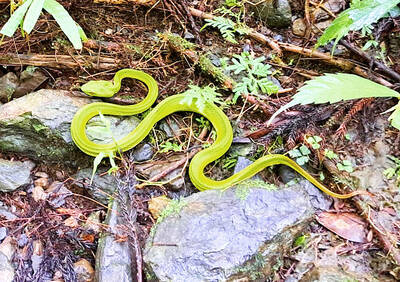
More than half of the bamboo vipers captured in Tainan in the past few years were found in the city’s Sinhua District (新化), while other districts had smaller catches or none at all. Every year, Tainan captures about 6,000 snakes which have made their way into people’s homes. Of the six major venomous snakes in Taiwan, the cobra, the many-banded krait, the brown-spotted pit viper and the bamboo viper are the most frequently captured. The high concentration of bamboo vipers captured in Sinhua District is puzzling. Tainan Agriculture Bureau Forestry and Nature Conservation Division head Chu Chien-ming (朱健明) earlier this week said that the
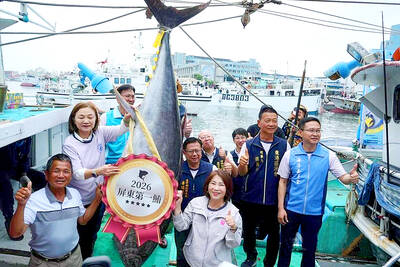
The first bluefin tuna of the season, brought to shore in Pingtung County and weighing 190kg, was yesterday auctioned for NT$10,600 (US$333.5) per kilogram, setting a record high for the local market. The auction was held at the fish market in Donggang Fishing Harbor, where the Siaoliouciou Island-registered fishing vessel Fu Yu Ching No. 2 delivered the “Pingtung First Tuna” it had caught for bidding. Bidding was intense, and the tuna was ultimately jointly purchased by a local restaurant and a local company for NT$10,600 per kilogram — NT$300 ,more than last year — for a total of NT$2.014 million. The 67-year-old skipper
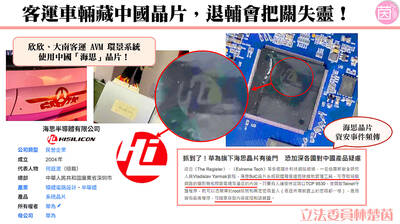
BREACH OF CONTRACT: The bus operators would seek compensation and have demanded that the manufacturer replace the chips with ones that meet regulations Two bus operators found to be using buses with China-made chips are to demand that the original manufacturers replace the systems and provide compensation for breach of contract, the Veterans Affairs Council said yesterday. Democratic Progressive Party Legislator Michelle Lin (林楚茵) yesterday said that Da Nan Bus Co and Shin-Shin Bus Co Ltd have fielded a total of 82 buses that are using Chinese chips. The bus models were made by Tron-E, while the systems provider was CYE Electronics, Lin said. Lin alleged that the buses were using chips manufactured by Huawei subsidiary HiSilicon Co, which presents a national security risk if the


 RSS
RSS