

Goats would no longer need to be vaccinated against the goat pox virus from Jan. 1, as the nation has successfully contained an outbreak that began in 2008, the Council of Agriculture said yesterday.
Taiwan is to notify the World Organization for Animal Health (WOAH) that it is a goat pox-free region after the initial outbreak in 2008 was contained and the country went a decade without a repeat incident.
Taiwan’s goat farming industry mostly satisfies domestic demand, but declined after a goat pox outbreak began in June 2008.

Photo: CNA
The outbreak reached a high in 2010, leading to the sector euthanizing 23,740 goats and sheep across 583 farms, the council said.
The council said that the last case of goat pox was found on Feb. 5, 2012, and there has not been a reported case since.
According to WOAH regulations, if a country has not had an incident for three years since the last reported case, or if the government has continually implemented a slaughter policy for all infected goats, it can apply for disease-free status six months after the last infected sheep or goat has been put down.
The council said that Taiwan meets all conditions for disease-free status, and on Jan. 1 would stop administering the vaccine.
However, a six-month observation period would follow, the council said.
The council said it would keep an inventory of goat pox vaccines in storage during the observation period.
The sheep and goat farming industry in Taiwan is valued at NT$1 billion (US$32.6 million), Goat Farmers’ Association director-general Lin Chun-chen (林浚琛) said.
Farmers have for six years been hoping the government would rescind the vaccine policy, Liu said, adding that rolling back the policy could help grow the industry.
Lin also expressed hope that the industry would grow to include exports, adding that the advantage of Taiwanese mutton is that it does not have a strong smell.
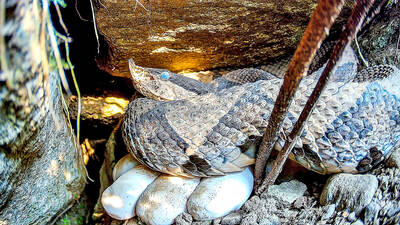
NATURE TAKES ITS COURSE: The agency’s head said he felt a sense of loss watching red-banded snakes eat the babies, as they had decided on non-intervention The Forestry and Nature Conservation Agency yesterday released a documentary on a hundred-pace viper that had incubated 16 eggs, all of which hatched, but only a baby viper escaped after they were attacked by red-banded snakes. The agency’s Taichung branch last year launched the viper reproduction monitoring project soon after forest rangers Lin Chun-yu (林俊佑) and Chou Chia-cheng (周家成) spotted a pregnant hundred-pace viper in a grass-covered burrow near a parking lot in Tbulan Village (松鶴部落). The Atayal village, in Taichung’s Heping District (和平), is headed by Ecyang Yapu, who was positive about the project and assisted in access control and power

The Coast Guard Administration (CGA) yesterday said that it had deployed vessels to “monitor” Chinese ships operating in waters off the east coast. The CGA said it dispatched vessels in response to a China Coast Guard announcement that it had carried out another “routine law-enforcement patrol” in waters off the east coast. “The CGA firmly rejects China’s cognitive warfare campaign of ‘law enforcement in name, jurisdictional expansion in practice,’” it said on X. As of 11am yesterday, two China Coast Guard ships were “loitering and drifting” about 105 nautical miles (195km) and 74 nautical miles east of Green Island (綠島) respectively, it said. It

A Straits Exchange Foundation official today warned that yielding to political pressure in exchange for access to China’s entertainment industry rarely ends well, amid rumors that China is seeking to lure Taiwanese K-pop star Chou Tzu-yu (周子瑜). Chou, more commonly known as Tzuyu, is the only Taiwanese member of the girl group Twice. Her contract with JYP Entertainment is set to expire at the end of this year, and there have been widespread reports that she would not renew it. She is reportedly planning to pursue solo activities under her parents’ agency, Yu Hai Entertainment (瑜海娛樂), although China has also reportedly offered
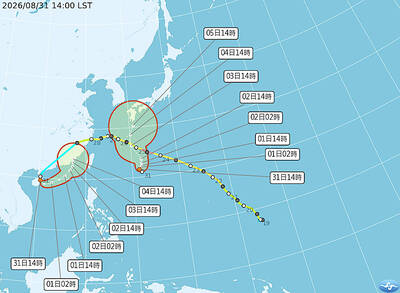
A tropical depression near Hainan that was once Typhoon Saudel may once again strengthen into a tropical storm, the Central Weather Administration (CWA) said yesterday, but a sea warning for waters around Taiwan is unlikely. CWA forecaster Huang En-hung (黃恩鴻) said that Saudel would return to being a weak tropical storm by late yesterday or early this morning. However, as the storm is to gradually weaken again and would head toward China’s Guangdong Province away from Taiwan, the chances that it would affect Taiwan enough for the CWA to issue a sea warning are relatively low,


 RSS
RSS