


The H5N1 avian influenza virus has been found in five more poultry farms, extending an outbreak that marks the first time the strain has made the leap from waterfowl to farmed landfowl in Taiwan, the Council of Agriculture (COA) said yesterday.
The infection clusters were found in one duck and three free-range chicken farms in Erlin Township (二林), and one goose farm in Pusin Township (埔心), all in Changhua County, COA Deputy Minister Huang Chin-cheng (黃金城) said.
The rise in cases shows that avian flu is spreading in Taiwan, although outbreaks have been contained, he said.
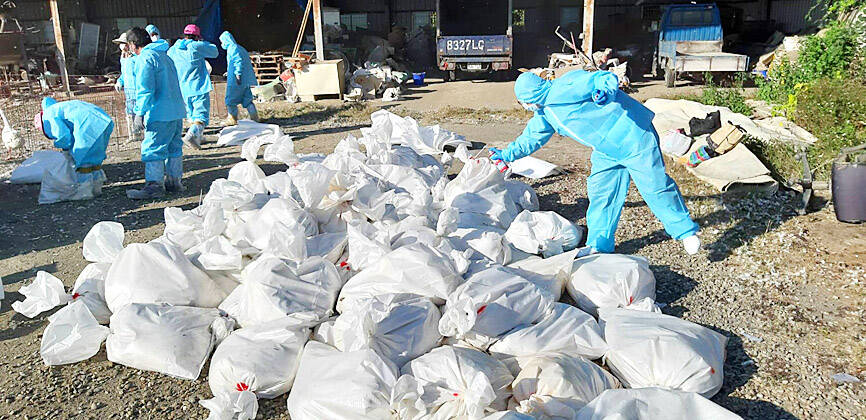
Photo courtesy of the Changhua County Animal Disease Control Center via CNA
Authorities have ruled out the possibility that the latest H5N1 cases were transmitted from a previous cluster in Yilan County, and wild waterfowl remains the most likely vector, Huang said.
The vector for the outbreak in chicken farms was either virus-bearing wild birds that entered the farms through gaps in coop netting or poultry workers who were exposed to the pathogen, he said.
The chicken-raising Erlin and Jhutang (竹塘) townships in Changhua County were flagged as hot zones for increased monitoring and sterilization, he added.
The H5N1 pandemic has impacted the farming of chicken and eggs in the US, Europe and Japan. Last month, Taiwan reported the year’s first cluster of the disease at a duck farm in Yilan County.
The latest outbreak brings the total number of farms affected in Taiwan to 39 — 25 chicken farms, 10 duck farms and four goose farms.
The outbreaks are not expected to impact the supply of chicken meat during the Lunar New Year, as the virus has not spread to broilers and reserves in cold storage are enough to meet demand, Huang said.
Changhua and Yunlin counties have high concentrations of poultry farms, and the emergence of clusters there is concerning, but other affected regions are safe as there have been no reported cases in the two weeks since the initial outbreak, he said.
Farm operators should streamline work processes to reduce the frequency of round-ups, secure their facilities and ensure compliance with sanitation guidelines, he said.
Additional reporting by CNA

Considering that most countries issue more than five denominations of banknotes, the central bank has decided to redesign all five denominations, the bank said as it prepares for the first major overhaul of the banknotes in more than 24 years. Central bank Governor Yang Chin-lung (楊金龍) is expected to report to the Legislative Yuan today on the bank’s operations and the redesign’s progress. The bank in a report sent to the legislature ahead of today’s meeting said it had commissioned a survey on the public’s preferences. Survey results showed that NT$100 and NT$1,000 banknotes are the most commonly used, while NT$200 and NT$2,000

The Centers for Disease Control (CDC) yesterday reported the first case of a new COVID-19 subvariant — BA.3.2 — in a 10-year-old Singaporean girl who had a fever upon arrival in Taiwan and tested positive for the disease. The girl left Taiwan on March 20 and the case did not have a direct impact on the local community, it said. The WHO added the BA.3.2 strain to its list of Variants Under Monitoring in December last year, but this was the first imported case of the COVID-19 variant in Taiwan, CDC Deputy Director-General Lin Ming-cheng (林明誠) said. The girl arrived in Taiwan on

South Korea is planning to revise its controversial electronic arrival card, a step Taiwanese officials said prompted them to hold off on planned retaliatory measures, a South Korean media report said yesterday. A Yonhap News Agency report said that the South Korean Ministry of Foreign Affairs is planning to remove the “previous departure place” and “next destination” fields from its e-arrival card system. The plan, reached after interagency consultations, is under review and aims to simplify entry procedures and align the electronic form with the paper version, a South Korean ministry official said. The fields — which appeared only on the electronic form

The Ministry of Foreign Affairs (MOFA) is suspending retaliation measures against South Korea that were set to take effect tomorrow, after Seoul said it is updating its e-arrival system, MOFA said today. The measures were to be a new round of retaliation after Taiwan on March 1 changed South Korea's designation on government-issued alien resident certificates held by South Korean nationals to "South Korea” from the "Republic of Korea," the country’s official name. The move came after months of protests to Seoul over its listing of Taiwan as "China (Taiwan)" in dropdown menus on its new online immigration entry system. MOFA last week


 RSS
RSS