


The Yonglin Healthcare Foundation is to partner with BioNTech to develop mRNA-based cancer immunotherapies, said Terry Gou (郭台銘), founder of the foundation and manufacturing giant Hon Hai Precision Industry.
BioNTech is also planning to set up a clinical trial hub in Taiwan for mRNA-based cancer immunotherapies as part of its Asia-Pacific expansion, Gou wrote on Facebook on Friday.
The German biotech firm, which developed a widely used mRNA COVID-19 vaccine, said in a separate statement that it would collaborate with Yonglin after signing a memorandum of understanding with Retain Biotech Corp.
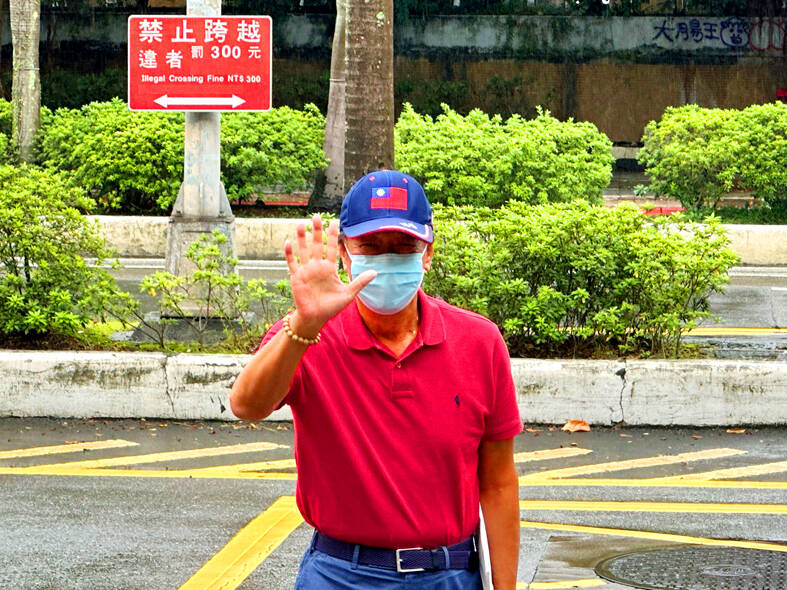
Photo: CNA
Retain Biotech, a Taiwan-based company sponsored by the foundation, is engaged in precision and genomic medicine and cell therapy for treating cancers, BioNTech said.
Gou said the German company has set up an office in Taiwan to perform an initial assessment of its cancer product candidate, BNT113, which is targeted at treating head and neck cancers.
Taiwan is expected to participate in BioNTech’s mRNA-based cancer immunotherapy development, he said.
BioNTech said that BNT113 is expected to be the first of several novel cancer immunotherapies that it anticipates assessing in the region.
Under the memorandum of understanding, Retain is expected to support the clinical evaluation of BNT113 in a randomized phase two clinical trial across the region, BioNTech said.
“BioNTech’s mRNA technology has not only saved the world from the COVID-19 pandemic, but also raised hopes that the technology will help medical circles take a leap in cancer treatment,” Gou said.
“That has been the intention of BioNTech founder and CEO Ugur Sahin, and it is the first time that he believes his wish to beat cancer could come true,” he said.
At Gou’s invitation, BioNTech executives in January visited the National Taiwan University Cancer Center to better understand Taiwan’s cancer treatment environment, its medical equipment and achievements in the biotech field.
While in Taiwan, the executives evaluated Taiwan’s needs in the hopes of creating a blueprint for treating cancer in the country, Gou said.
In July, he led a delegation to BioNTech’s headquarters in Germany to brief Sabin on Taiwan’s plans to work with the company on head and neck cancer, breast cancer and leukemia.
In the Facebook post, Gou praised the partnership, saying that Taiwan could not afford to be left behind in the battle against cancer.
BioNTech chief business officer Sean Marett said his company’s goal with the Retain agreement was to accelerate the development of innovative therapies to help address cancers, which have been highly prevalent in the region.
BioNTech said it planned to evaluate BNT113 in the broader Asia-Pacific region starting with clinical trials in Taiwan and in Australia’s Victoria state.
It will also assess the expansion of clinical activities to Japan, South Korea, Singapore and other economies in the region for cancer-related therapies, which already encompasses 18 product candidates in 23 ongoing clinical trials.

Considering that most countries issue more than five denominations of banknotes, the central bank has decided to redesign all five denominations, the bank said as it prepares for the first major overhaul of the banknotes in more than 24 years. Central bank Governor Yang Chin-lung (楊金龍) is expected to report to the Legislative Yuan today on the bank’s operations and the redesign’s progress. The bank in a report sent to the legislature ahead of today’s meeting said it had commissioned a survey on the public’s preferences. Survey results showed that NT$100 and NT$1,000 banknotes are the most commonly used, while NT$200 and NT$2,000

The Centers for Disease Control (CDC) yesterday reported the first case of a new COVID-19 subvariant — BA.3.2 — in a 10-year-old Singaporean girl who had a fever upon arrival in Taiwan and tested positive for the disease. The girl left Taiwan on March 20 and the case did not have a direct impact on the local community, it said. The WHO added the BA.3.2 strain to its list of Variants Under Monitoring in December last year, but this was the first imported case of the COVID-19 variant in Taiwan, CDC Deputy Director-General Lin Ming-cheng (林明誠) said. The girl arrived in Taiwan on

ANNUAL EVENT: Two massive Pokemon balloons are to be set up in Daan Park, with an event zone operating from 10am to 6pm This year’s Taipei Floral Picnic is to be held at Daan Park today and tomorrow, featuring an exclusive Pokemon Go event, a themed food market, a coffee rave picnic area and stage performances, the Taipei Department of Information and Tourism said yesterday. Two massive Pokemon balloons are to be set up in the park as attractions, with an exclusive event zone operating from 10am to 6pm, it said. Participants who complete designated tasks on-site would have a chance to receive limited-edition souvenirs, it added. People could also try the newly launched game Pokemon Pokopia in the trial area, the department said. Three PokeStops are

South Korea is planning to revise its controversial electronic arrival card, a step Taiwanese officials said prompted them to hold off on planned retaliatory measures, a South Korean media report said yesterday. A Yonhap News Agency report said that the South Korean Ministry of Foreign Affairs is planning to remove the “previous departure place” and “next destination” fields from its e-arrival card system. The plan, reached after interagency consultations, is under review and aims to simplify entry procedures and align the electronic form with the paper version, a South Korean ministry official said. The fields — which appeared only on the electronic form


 RSS
RSS