


The drone prevention system at Taipei International Airport (Songshan airport) helped detect 129 cases of drone activity near its premises over the past two years, with 27 cases leading to fines by the Civil Aeronautics Administration (CAA) for flying a device in a no-fly zone.
The system, which was designed by the National Chungshan Institute of Science and Technology, was launched in 2020 to prevent drones from disrupting the operations at the airport, CAA Deputy Director-General Clark Lin (林俊良) said.
“The system can detect drones as soon as their altitude [is within the range] of the no-fly zone. It is also able to interfere in drone activity through handheld, mobile and long-range devices,” Lin said.
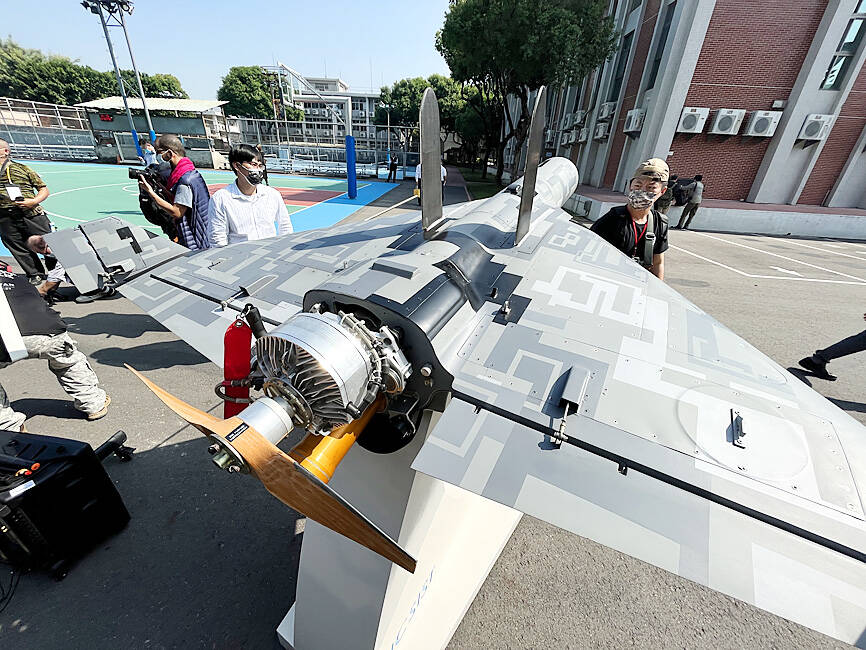
Photo: CNA
From October 2020 to last month, the system detected 129 cases of drone activity, CAA data showed.
Through joint efforts of the CAA and police, 27 illegal drone operators were found, the agency said, adding that the minimum fine for illegally flying a drone is NT$300,000.
In the past, deterring illegal drone activity was difficult, as the CAA was not able to find the operators after drones were detected and hold them to account, the agency said.
The institute is also commissioned to design a drone prevention system for Taiwan Taoyuan International Airport, which is scheduled to become operational by next year or 2024, Lin said.
Another drone prevention system, developed by a group of experts recruited by Kaohsiung International Airport, is scheduled to be operational next year, while a new system at Taichung International Airport is to be built by the Ministry of National Defense, as the military also uses the airport, he said.
The CAA is revising the Regulations of Drones (無人機管理規則), seeking to require drones weighing 250g or more to be equipped with a radio-frequency identification function, Lin said, adding that members of the public would be able to find out whether a drone is registered through a government app.
After the revision, the regulations would also require businesses using drones for delivery services to operate flight management systems through which they would have to monitor the locations of their drones, Lin said.
Different drone management systems would be gradually integrated into a national system, Lin said.
In related news, CAA Director-General Lin Kuo-hsien (林國顯) yesterday said that airlines should not compromise aviation safety to meet the rising demand for air travel after COVID-19 curbs were lifted, including a cap on the number of inbound passengers that was lifted on Monday.
“Amid so-called ‘revenge travel,’ with people being more motivated to travel to make up for the lost time during the COVID-19 pandemic, flight capacity and airport operation could become unstable. Airlines will be under pressure to increase flights, which could place cabin crew under stress as well,” Lin said. “To prevent unexpected harm, airlines are advised to gradually [raise] their capacities to meet rising flight demand.”

Considering that most countries issue more than five denominations of banknotes, the central bank has decided to redesign all five denominations, the bank said as it prepares for the first major overhaul of the banknotes in more than 24 years. Central bank Governor Yang Chin-lung (楊金龍) is expected to report to the Legislative Yuan today on the bank’s operations and the redesign’s progress. The bank in a report sent to the legislature ahead of today’s meeting said it had commissioned a survey on the public’s preferences. Survey results showed that NT$100 and NT$1,000 banknotes are the most commonly used, while NT$200 and NT$2,000

The Centers for Disease Control (CDC) yesterday reported the first case of a new COVID-19 subvariant — BA.3.2 — in a 10-year-old Singaporean girl who had a fever upon arrival in Taiwan and tested positive for the disease. The girl left Taiwan on March 20 and the case did not have a direct impact on the local community, it said. The WHO added the BA.3.2 strain to its list of Variants Under Monitoring in December last year, but this was the first imported case of the COVID-19 variant in Taiwan, CDC Deputy Director-General Lin Ming-cheng (林明誠) said. The girl arrived in Taiwan on

South Korea is planning to revise its controversial electronic arrival card, a step Taiwanese officials said prompted them to hold off on planned retaliatory measures, a South Korean media report said yesterday. A Yonhap News Agency report said that the South Korean Ministry of Foreign Affairs is planning to remove the “previous departure place” and “next destination” fields from its e-arrival card system. The plan, reached after interagency consultations, is under review and aims to simplify entry procedures and align the electronic form with the paper version, a South Korean ministry official said. The fields — which appeared only on the electronic form

The Ministry of Foreign Affairs (MOFA) is suspending retaliation measures against South Korea that were set to take effect tomorrow, after Seoul said it is updating its e-arrival system, MOFA said today. The measures were to be a new round of retaliation after Taiwan on March 1 changed South Korea's designation on government-issued alien resident certificates held by South Korean nationals to "South Korea” from the "Republic of Korea," the country’s official name. The move came after months of protests to Seoul over its listing of Taiwan as "China (Taiwan)" in dropdown menus on its new online immigration entry system. MOFA last week


 RSS
RSS