


Taipei is unlikely to consider resuming diplomatic relations with Managua unless its “authoritarian” leader, Nicaraguan President Daniel Ortega, steps down, Vice Minister of Foreign Affairs Alexander Yui (俞大㵢) said yesterday.
Chinese Nationalist Party (KMT) Legislator Liao Wan-ju (廖婉汝) at the legislature in Taipei asked Yui whether there was a possibility that ties with the Central American nation could be resumed after Nicaragua in December last year established formal ties with Beijing.
Taipei cut its diplomatic relationship with Managua shortly afterward.
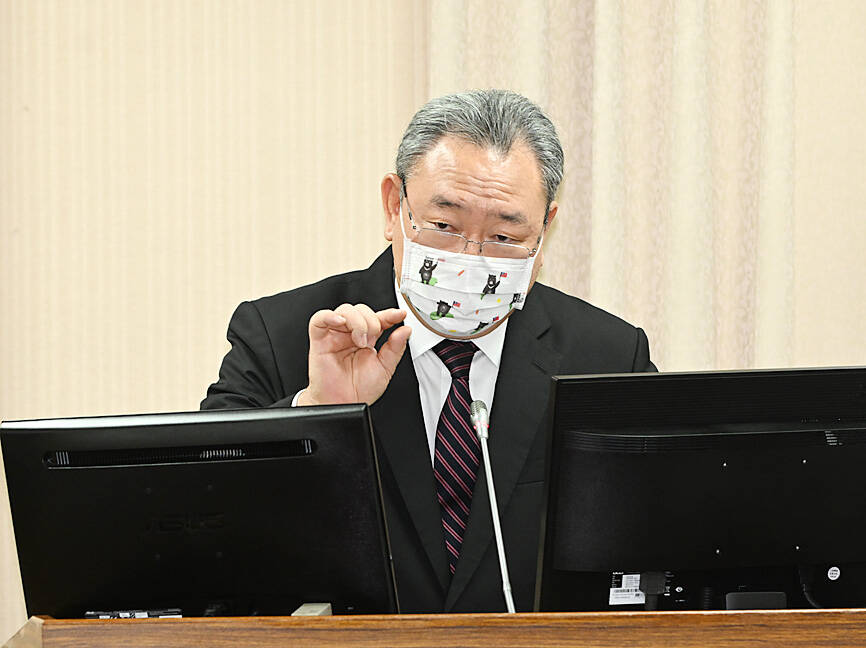
Photo: Tien Yu-hua, Taipei Times
“There is no possibility unless there is a change of regime” in Nicaragua, Yui said. “After all, [Ortega] also severed ties with us during his previous administration.”
In 1985, Ortega’s government ended 55 years of formal links with Taipei and switched recognition to Beijing.
After Violeta Barrios Torres de Chamorro replaced him as president in 1990, ties with Taiwan resumed.
Ortega had maintained ties with Taipei after he returned to office in 2007 until last year.
Taipei has attributed the latest change of diplomatic recognition to geopolitics.
Minister of Foreign Affairs Joseph Wu (吳釗燮) last year said that the intensifying conflict between the US-led democracy camp and the China-Russia-led authoritarian camp was the main reason for Taiwan’s loss of the Central American country as an ally.
Ortega in November last year won a fourth consecutive term in an election that was seen by some as controversial.
In response to Ortega’s win, Washington sanctioned Nicaragua, which was probably why Ortega allied himself with China and Russia, Wu said.
At yesterday’s Foreign and National Defense Committee hearing in Taipei, lawmakers reviewed documents concerning Taiwan’s decision to cease its free-trade agreement with Nicaragua.
Bilateral trade between Taiwan and Nicaragua totaled US$166.5 million last year, with exports to the former ally totaling US$22.94 million, government data showed.
That accounted for a mere 0.01 percent of Taiwan’s total exports last year, so ending the agreement had little effect on foreign trade, Ministry of Economic Affairs officials said.
The termination of ties with Nicaragua left the nation with 14 diplomatic allies worldwide.
Since President Tsai Ing-wen (蔡英文) took office in 2016, Taiwan has lost eight diplomatic allies.

Considering that most countries issue more than five denominations of banknotes, the central bank has decided to redesign all five denominations, the bank said as it prepares for the first major overhaul of the banknotes in more than 24 years. Central bank Governor Yang Chin-lung (楊金龍) is expected to report to the Legislative Yuan today on the bank’s operations and the redesign’s progress. The bank in a report sent to the legislature ahead of today’s meeting said it had commissioned a survey on the public’s preferences. Survey results showed that NT$100 and NT$1,000 banknotes are the most commonly used, while NT$200 and NT$2,000

The Centers for Disease Control (CDC) yesterday reported the first case of a new COVID-19 subvariant — BA.3.2 — in a 10-year-old Singaporean girl who had a fever upon arrival in Taiwan and tested positive for the disease. The girl left Taiwan on March 20 and the case did not have a direct impact on the local community, it said. The WHO added the BA.3.2 strain to its list of Variants Under Monitoring in December last year, but this was the first imported case of the COVID-19 variant in Taiwan, CDC Deputy Director-General Lin Ming-cheng (林明誠) said. The girl arrived in Taiwan on

South Korea is planning to revise its controversial electronic arrival card, a step Taiwanese officials said prompted them to hold off on planned retaliatory measures, a South Korean media report said yesterday. A Yonhap News Agency report said that the South Korean Ministry of Foreign Affairs is planning to remove the “previous departure place” and “next destination” fields from its e-arrival card system. The plan, reached after interagency consultations, is under review and aims to simplify entry procedures and align the electronic form with the paper version, a South Korean ministry official said. The fields — which appeared only on the electronic form

The Ministry of Foreign Affairs (MOFA) is suspending retaliation measures against South Korea that were set to take effect tomorrow, after Seoul said it is updating its e-arrival system, MOFA said today. The measures were to be a new round of retaliation after Taiwan on March 1 changed South Korea's designation on government-issued alien resident certificates held by South Korean nationals to "South Korea” from the "Republic of Korea," the country’s official name. The move came after months of protests to Seoul over its listing of Taiwan as "China (Taiwan)" in dropdown menus on its new online immigration entry system. MOFA last week


 RSS
RSS