


The National Space Organization (NSPO) is to become a public foundation from the beginning of next month, the National Science and Technology Council said on Thursday, as the legislature passed a development budget of NT$5.53 billion (US$180.6 million) for the revamped space center.
Council Minister Wu Tsung-tsong (吳政忠) made the announcement at a review of next year’s council budget at the legislature.
While legislators passed the NT$5.53 billion budget for the NSPO, several raised concerns about the pace of its transition into the nondepartmental National Space Center.
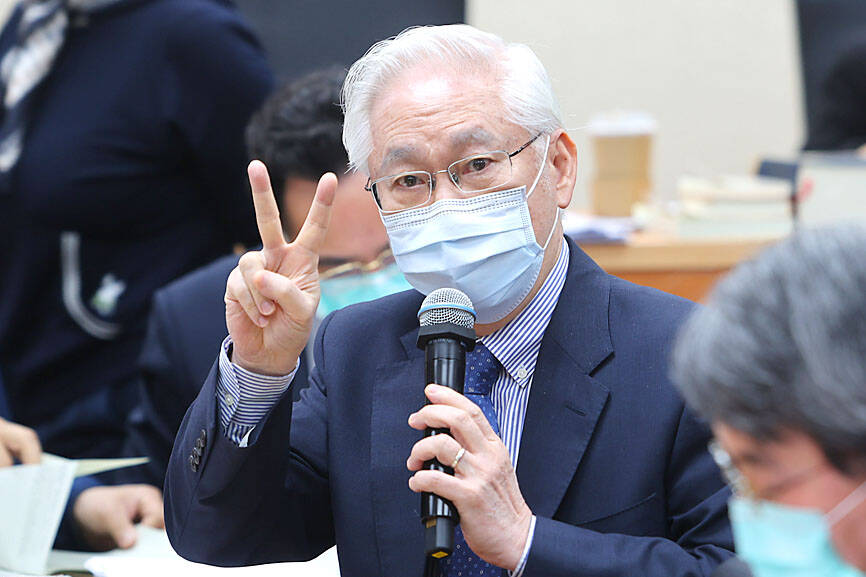
Photo: CNA
The reorganization was mandated in the Space Development Act (太空發展法), passed into law in January.
The new space center is to be a public body overseen by the council.
As an independent, dedicated body, it would aim to facilitate the development of the nation’s space industry by adding more responsibilities to the NSPO’s original mission, including cultivating talent, managing technologies, facilitating international exchanges and developing policies to boost competitiveness.
Wu told legislators that the National Space Center is on track to officially open on Jan. 1, with a plaque unveiling ceremony to be held early next month.
Lawmakers also raised concerns about the progress of its low Earth orbit satellite project, delays in the Formosat-8 satellite launch and selection of a domestic launch site, as well as lagging talent recruitment.
NSPO Director-General Wu Jong-shinn (吳宗信) said that recruitment responsibility is spread across agencies.
The council hires personnel to handle international collaborations, while the Ministry of Economic Affairs cultivates engineering talent, and the Ministry of Education is to recruit a first batch of systems engineering graduate students next year, he said.
A national launch site selection process is to begin next year, with plans to enter operation in 2025, he added.
The launch of Formosat-8 is behind schedule because of delayed component shipments due to the COVID-19 pandemic, he said, adding that the agency is looking at the end of 2024 or 2025 for the launch.
As for the low Earth orbit communications satellite project, Wu Jong-shinn said that more than 20 contractors are involved in setting up the complex system.
He estimated that the first satellite would launch in 2025, followed by another in 2026, while industry partners plan to launch one each in 2027 and 2028.
Given the concerns, lawmakers decided to freeze NT$50 million of the budget pending a detailed report.

Considering that most countries issue more than five denominations of banknotes, the central bank has decided to redesign all five denominations, the bank said as it prepares for the first major overhaul of the banknotes in more than 24 years. Central bank Governor Yang Chin-lung (楊金龍) is expected to report to the Legislative Yuan today on the bank’s operations and the redesign’s progress. The bank in a report sent to the legislature ahead of today’s meeting said it had commissioned a survey on the public’s preferences. Survey results showed that NT$100 and NT$1,000 banknotes are the most commonly used, while NT$200 and NT$2,000

The Centers for Disease Control (CDC) yesterday reported the first case of a new COVID-19 subvariant — BA.3.2 — in a 10-year-old Singaporean girl who had a fever upon arrival in Taiwan and tested positive for the disease. The girl left Taiwan on March 20 and the case did not have a direct impact on the local community, it said. The WHO added the BA.3.2 strain to its list of Variants Under Monitoring in December last year, but this was the first imported case of the COVID-19 variant in Taiwan, CDC Deputy Director-General Lin Ming-cheng (林明誠) said. The girl arrived in Taiwan on

South Korea is planning to revise its controversial electronic arrival card, a step Taiwanese officials said prompted them to hold off on planned retaliatory measures, a South Korean media report said yesterday. A Yonhap News Agency report said that the South Korean Ministry of Foreign Affairs is planning to remove the “previous departure place” and “next destination” fields from its e-arrival card system. The plan, reached after interagency consultations, is under review and aims to simplify entry procedures and align the electronic form with the paper version, a South Korean ministry official said. The fields — which appeared only on the electronic form

The Ministry of Foreign Affairs (MOFA) is suspending retaliation measures against South Korea that were set to take effect tomorrow, after Seoul said it is updating its e-arrival system, MOFA said today. The measures were to be a new round of retaliation after Taiwan on March 1 changed South Korea's designation on government-issued alien resident certificates held by South Korean nationals to "South Korea” from the "Republic of Korea," the country’s official name. The move came after months of protests to Seoul over its listing of Taiwan as "China (Taiwan)" in dropdown menus on its new online immigration entry system. MOFA last week


 RSS
RSS