


The government aims to attract 6 million international tourists next year after easing COVID-19 border controls, Minister of Transportation and Communications Wang Kwo-tsai (王國材) told legislators in Taipei yesterday.
At a meeting of the legislature’s Transportation Committee, Chinese Nationalist Party (KMT) Legislator Hung Meng-kai (洪孟楷) asked Wang whether his ministry could still reach its goal of attracting 16 million international visitors per year to Taiwan by 2030.
Wang said the government would reach its goal of 700,000 international tourists by the end of this year.
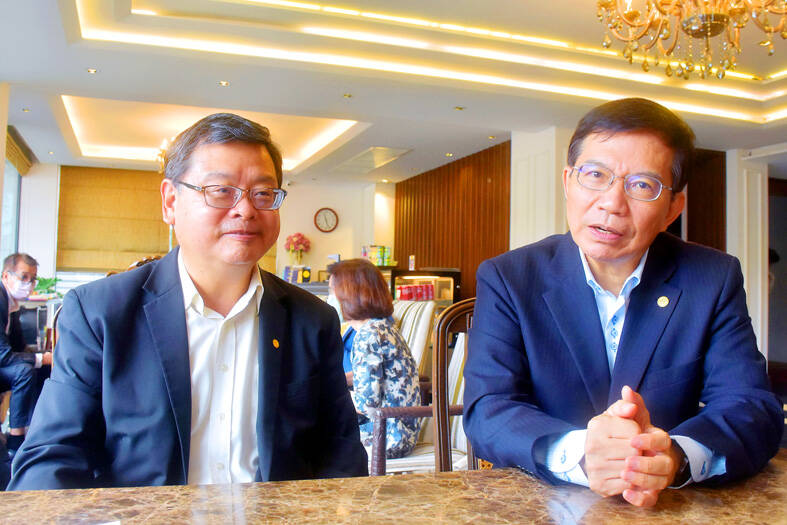
Photo: CNA
“For next year, we aim to have 6 million international tourists,” he said. “It would take two to three years for the tourism industry to recover to pre-pandemic levels, but we should have no problem reaching our goal set for 2030.”
Taiwan has since Oct. 13 waived a quarantine requirement for all inbound travelers. The government on Saturday is to lift a cap on inbound travelers.
Hung and Democratic Progressive Party (DPP) Legislator Chen Su-yueh (陳素月) said that reopening borders has only allowed Taiwanese to travel abroad more freely, but has not attracted international tourists to Taiwan.
In October, 172,319 Taiwanese traveled overseas, while 903,206 international tourists arrived, they said, citing statistics from the National Immigration Agency.
Meanwhile, 36,000 Taiwanese traveled to Japan in October, while 9,625 Japanese visited Taiwan, they said.
A record-high 11.86 million foreign tourists visited Taiwan in 2019, with 2.71 million coming from China, 2.16 million from Japan, and 1.75 million from Hong Kong and Macau, Tourism Bureau data showed.
“In the post-pandemic era, we will focus on attracting tourists from Japan, South Korea and nations targeted by the government’s New Southbound Policy,” Wang said.
Tourism Bureau Director-General Chang Shi-chung (張錫聰) acknowledged that there is a tourism deficit.
“Like other countries, Taiwan is experiencing a surge of outbound travelers since the borders were reopened on Oct. 13. However, the same phenomenon in other countries occurred earlier because their borders opened in the first half of this year,” Chang said.
He told legislators that the surge this year in outbound travelers worldwide did not last long due to inflation, which has caused global travel costs to rise dramatically.
“Some tourists, particularly those from Japan, remain concerned about COVID-19 outbreaks in other countries,” he said.
Even though Japan also reopened its borders in October, only about 300,000 Japanese have traveled overseas each month so far, Chang said, adding that Japan has a population of about 125 million.
About 60 percent of Taiwanese have passports, while only one-quarter of Japanese do, he said.
The Tourism Bureau said it plans to roll out a series of incentives to attract individual and group tourists.
These include a voucher for a box of Taiwanese fresh fruit, a five-day 4G SIM card and a one-way ticket on the Taoyuan International Airport MRT Line, it said.
International travelers heading to destinations in central and southern Taiwan can buy two high-speed rail tickets for the price of one, it added.

Considering that most countries issue more than five denominations of banknotes, the central bank has decided to redesign all five denominations, the bank said as it prepares for the first major overhaul of the banknotes in more than 24 years. Central bank Governor Yang Chin-lung (楊金龍) is expected to report to the Legislative Yuan today on the bank’s operations and the redesign’s progress. The bank in a report sent to the legislature ahead of today’s meeting said it had commissioned a survey on the public’s preferences. Survey results showed that NT$100 and NT$1,000 banknotes are the most commonly used, while NT$200 and NT$2,000

The Centers for Disease Control (CDC) yesterday reported the first case of a new COVID-19 subvariant — BA.3.2 — in a 10-year-old Singaporean girl who had a fever upon arrival in Taiwan and tested positive for the disease. The girl left Taiwan on March 20 and the case did not have a direct impact on the local community, it said. The WHO added the BA.3.2 strain to its list of Variants Under Monitoring in December last year, but this was the first imported case of the COVID-19 variant in Taiwan, CDC Deputy Director-General Lin Ming-cheng (林明誠) said. The girl arrived in Taiwan on

ANNUAL EVENT: Two massive Pokemon balloons are to be set up in Daan Park, with an event zone operating from 10am to 6pm This year’s Taipei Floral Picnic is to be held at Daan Park today and tomorrow, featuring an exclusive Pokemon Go event, a themed food market, a coffee rave picnic area and stage performances, the Taipei Department of Information and Tourism said yesterday. Two massive Pokemon balloons are to be set up in the park as attractions, with an exclusive event zone operating from 10am to 6pm, it said. Participants who complete designated tasks on-site would have a chance to receive limited-edition souvenirs, it added. People could also try the newly launched game Pokemon Pokopia in the trial area, the department said. Three PokeStops are

South Korea is planning to revise its controversial electronic arrival card, a step Taiwanese officials said prompted them to hold off on planned retaliatory measures, a South Korean media report said yesterday. A Yonhap News Agency report said that the South Korean Ministry of Foreign Affairs is planning to remove the “previous departure place” and “next destination” fields from its e-arrival card system. The plan, reached after interagency consultations, is under review and aims to simplify entry procedures and align the electronic form with the paper version, a South Korean ministry official said. The fields — which appeared only on the electronic form


 RSS
RSS