


As Taiwan hurtles toward becoming a super-aged society, a new political party has emerged with an unusual and somewhat singular platform — making mahjong great again.
While playing the centuries-old game is legal, it has been treated with suspicion by authorities for its association with gambling in public gaming rooms, which is prohibited.
Organized crime groups have long maintained a lucrative side hustle by hosting illegal betting matches, while gaming parlors — some legitimate, some not — often find themselves raided or inspected by police.
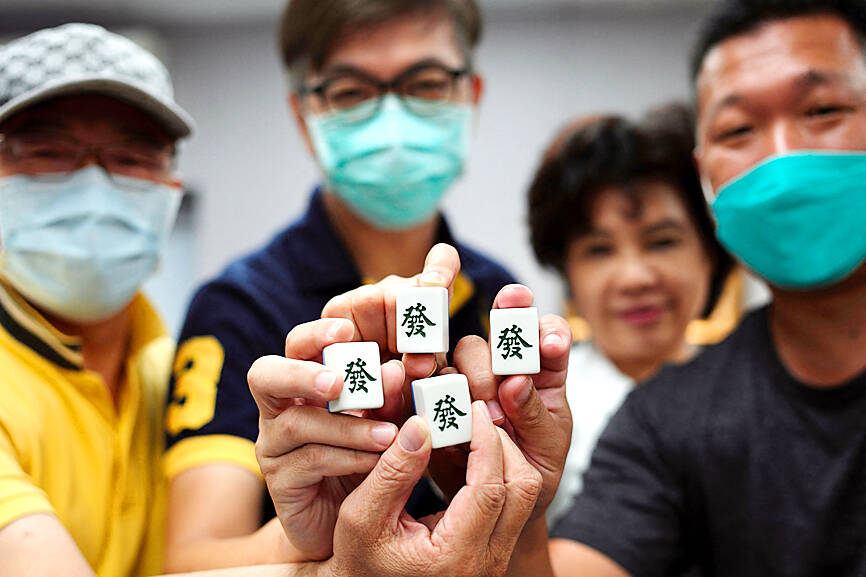
Photo: Sam Yeh, AFP
Kuo Hsi (郭璽), a 65-year-old owner of a mahjong parlor in Kaohsiung, has decided it is time to allow betting on mahjong games, and launched a new party toward that goal.
The Mahjong the Greatest Party wants the game declared a “legitimate recreation,” and for gambling and prize money to be allowed.
“Let’s be frank. You can put a bet on anything if you want to gamble. Even rock, paper, scissors,” he said in an interview at his parlor. “Why do we insist on branding mahjong as a form of gambling?”
“Any form of competition — gaming, golf, tennis, badminton — they all have some form of prize in the end. They all do. When there are prizes, competitors will do their best to train themselves physically and mentally. Mahjong playing is exactly the same,” he said.
Max Chang, 31, a gaming consultant who has been playing mahjong with his family since he was young, is among the party’s first members.
“I identify very much with Kuo’s ideals. As a young man who plays mahjong frequently, I am always wary about people calling the police on us,” he said.
Echoing that sentiment, 62-year-old housewife and party member Amy Huang said: “I look forward to playing mahjong openly and not having to hide.”
Huang said her mother-in-law, who taught her how to play, was taken to a police station once for betting in a game with friends, an incident she described as “ridiculous.”
Kuo knows he has some way to go to break into Taiwan’s political mainstream.
The current membership of the party, which was founded last month, is 120 people, but he said he is optimistic that he can get 10,000 registered party members by the end of this year.
Kuo has applied to authorities to register the party and is hopeful that it can be approved soon.
He aims to get enough political momentum going to secure a referendum next year to amend the law.
Kuo also hopes to secure at least one lawmaker-at-large seat in national elections in 2024.
As a parlor owner, Kuo has strong business reasons to see mahjong gambling allowed and regulated, but he also has a more altruistic goal, believing that bringing mahjong out of a gray area could help Taiwan’s elderly people live happier, more sociable lives.
Nearly 17 percent of Taiwan’s population is over 65.
The nation is projected to join Japan and reach “super-aged” status in 2025, when that proportion reaches 20 percent.
“Taiwan is an aging society with more and more senior citizens, especially in remote areas, and they mostly stay at home watching TV,” Kuo said.
“If they can get together with people of their age to play mahjong, to chat with others, it will help improve their quality of life and bring happiness,” Kuo said. “This is a good activity for them.”
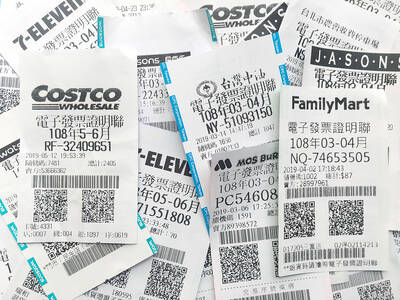
A NT$39 receipt for two bottles of tea at a FamilyMart was among the NT$10 million (US $312,969) special prize winners in the January-February uniform invoice lottery. FamilyMart said that two NT$10 million-winning receipts were issued at its stores, as well as two NT$2 million grand prizes and three NT$200,000 first prizes. The two NT$10 million receipts were issued at stores in Pingtung County and Yilan County’s Dongshan Township (冬山). One winner spent just NT$39 on two bottles of tea, while another spent NT$80 on water, tea and coffee, the company said. Meanwhile, 7-Eleven reported three NT$10 million winners — in New Taipei

Considering that most countries issue more than five denominations of banknotes, the central bank has decided to redesign all five denominations, the bank said as it prepares for the first major overhaul of the banknotes in more than 24 years. Central bank Governor Yang Chin-lung (楊金龍) is expected to report to the Legislative Yuan today on the bank’s operations and the redesign’s progress. The bank in a report sent to the legislature ahead of today’s meeting said it had commissioned a survey on the public’s preferences. Survey results showed that NT$100 and NT$1,000 banknotes are the most commonly used, while NT$200 and NT$2,000

The Centers for Disease Control (CDC) yesterday reported the first case of a new COVID-19 subvariant — BA.3.2 — in a 10-year-old Singaporean girl who had a fever upon arrival in Taiwan and tested positive for the disease. The girl left Taiwan on March 20 and the case did not have a direct impact on the local community, it said. The WHO added the BA.3.2 strain to its list of Variants Under Monitoring in December last year, but this was the first imported case of the COVID-19 variant in Taiwan, CDC Deputy Director-General Lin Ming-cheng (林明誠) said. The girl arrived in Taiwan on

ANNUAL EVENT: Two massive Pokemon balloons are to be set up in Daan Park, with an event zone operating from 10am to 6pm This year’s Taipei Floral Picnic is to be held at Daan Park today and tomorrow, featuring an exclusive Pokemon Go event, a themed food market, a coffee rave picnic area and stage performances, the Taipei Department of Information and Tourism said yesterday. Two massive Pokemon balloons are to be set up in the park as attractions, with an exclusive event zone operating from 10am to 6pm, it said. Participants who complete designated tasks on-site would have a chance to receive limited-edition souvenirs, it added. People could also try the newly launched game Pokemon Pokopia in the trial area, the department said. Three PokeStops are


 RSS
RSS