


Triton, Taiwan’s first locally built weather satellite, is provisionally scheduled to launch on March 10 next year, National Space Organization (NSPO) Director Wu Jong-shinn (吳宗信) said on Monday.
Wu made the announcement during a visit to the NSPO’s Hsinchu headquarters by Premier Su Tseng-chang (蘇貞昌), in which Su checked on progress on the satellite’s construction.
The Triton, which is primarily to be used for sea surface observation, represents “a new milestone” in the development of Taiwan’s space industry, Wu said.
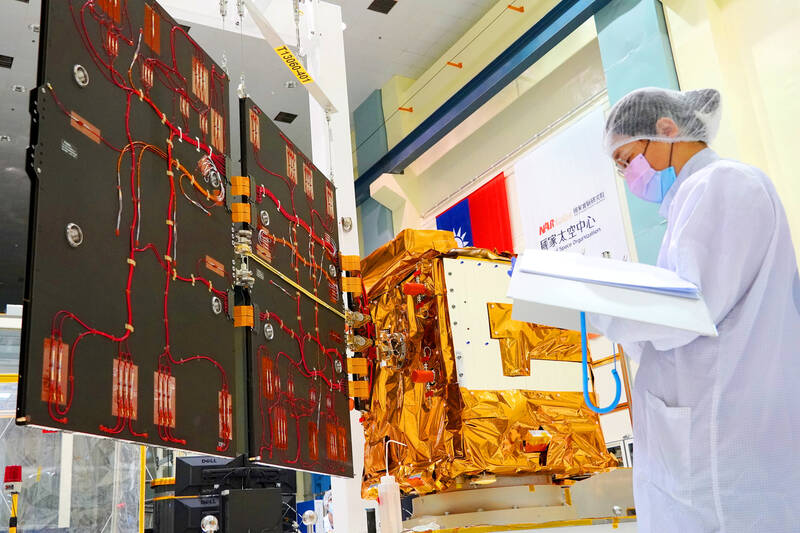
Photo courtesy of the National Applied Research Laboratories
“Eighty-two percent of the Triton satellite’s parts and components were designed and manufactured locally, in a process that involved collaboration with more than 20 Taiwanese companies,” Wu said.
After it is fully equipped, Triton — also known as “Wind Hunter” (獵風者) in Chinese — must undergo testing before its launch from the Guiana Space Centre in French Guiana, he said.
Su touted the government’s efforts to develop the local space industry, saying that it would help Taiwan reach the goal of joining the nine nations able to independently launch spacecraft.
Taiwan already has many of the necessary capabilities to produce rockets and satellites, such as its advanced semiconductor, information and communications technology and precision machinery industries, he said.
“I hope that in the near future, Taiwan will be able to defend itself from space, and will have a seat at the table” among spacefaring nations, Su added.
There are nine countries and one international organization that can independently launch spacecraft into orbit: China, India, Iran, Israel, Japan, Russia, North Korea, South Korea, the US and the European Space Agency.
Triton would be Taiwan’s first locally built weather satellite and its second indigenous satellite, after Earth observation satellite Formosat-5 was launched in 2017.
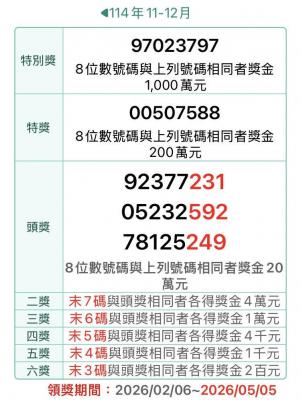
Seven of the 17 NT$10 million (US$311,604) winning receipts from the November-December uniform invoice lottery remain unclaimed as of today, the Ministry of Finance said, urging winners to redeem their prizes by May 5. The reminder comes ahead of the release of the winning numbers for the January-February lottery tomorrow. Among the unclaimed receipts was one for a NT$173 phone bill in Keelung, while others were for a NT$5,913 purchase at Costco in Taipei's Neihu District (內湖), a NT$49 purchase at a FamilyMart in New Taipei City's Tamsui District (淡水), and a NT$500 purchase at a tea shop in New Taipei City's
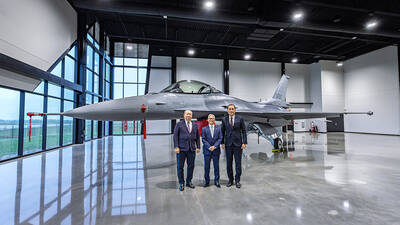
Taiwanese officials were shown the first of 66 F-16V fighter jets purchased by Taiwan from the United States, the Ministry of National Defense said yesterday, adding the aircraft has completed an initial flight test and is expected to be delivered later this year. A delegation led by Deputy Minister of National Defense Hsu Szu-chien (徐斯儉) visited Lockheed Martin’s F-16 C/D Block 70 (also known as F-16V) assembly line in South Carolina on March 16 to view the aircraft. The jet will undergo a final acceptance flight in the US before being delivered to Taiwan, the
Deliveries of delayed F-16V jets are expected to begin in September, Minister of National Defense Wellington Koo (顧立雄) said today, after senior defense officials visited the US last week. The US in 2019 approved a US$8 billion sale of Lockheed Martin F-16 jets to Taiwan, a deal that would take the nation’s F-16 fleet to more than 200 jets, but the project has been hit by issues including software problems. Koo appeared today before a meeting of the legislature’s Foreign Affairs and National Defense Committee, which is discussing different versions of the special defense budget this week. The committee is questioning officials today,
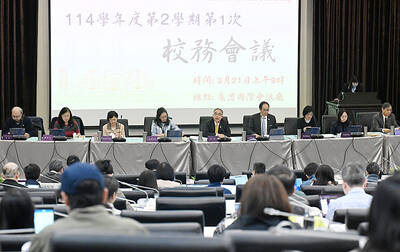
TALENT SCOUTING: The university is investing substantial funds in its future to bring in the kind of researchers that would keep the college internationally competitive National Taiwan University (NTU) plans to invest NT$2 billion (US$62.6 million) to launch two programs aimed at attracting and retaining top research talent, university president Chen Wen-chang (陳文章) said yesterday. The funding would support the “Palm Grove Scholars Project,” which targets academics aged 40 to 55. Up to 20 scholars would be selected, each receiving as much as NT$10 million annually, Chen said. The initiative is designed to attract leading researchers to Taiwan and strengthen NTU’s global competitiveness by fostering a more research-friendly environment and expanding international collaboration, he said. NTU is also introducing a “Hong Hu” chair grant, which would provide Palm


 RSS
RSS