


The Central Epidemic Command Center (CECC) yesterday confirmed that the average per-dose purchase price of the Taiwan-developed Medigen COVID-19 vaccine was NT$840 (US$26), adding that it was cheaper than two other brands.
Medigen Vaccine Biologics Corp yesterday said it revealed the contract price for its vaccine to dispel rumors, which it said were causing social conflict.
Deputy Minister of Health and Welfare Victor Wang (王必勝), who heads the CECC, said Medigen informed the Centers for Disease Control (CDC) that it would reveal the price and agreed to allow the center to further explain the disclosed information.
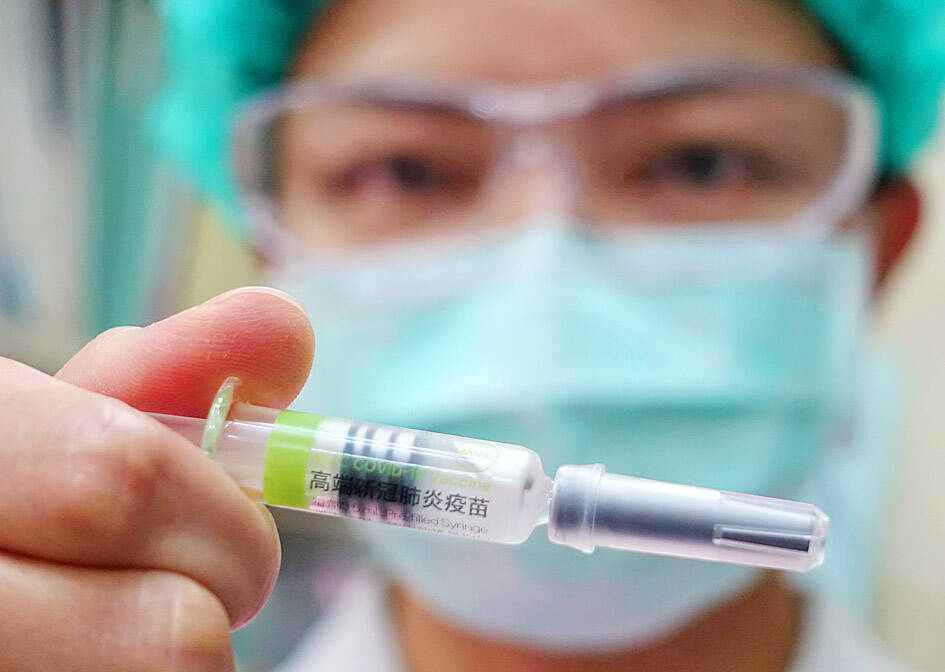
Photo: Liu Hsin-de, Taipei Times
The total cost for 5 million doses of the vaccine was NT$4.03 billion, including 200,000 doses donated to the CDC for its help funding the vaccine’s development, Medigen said in a statement.
The company said it provided two types of the vaccine, including 2 million single-dose prefilled syringes, which cost NT$881 per dose; 2.8 million doses in multi-dose vials, which cost NT$810 per dose; and 200,000 doses donated in multi-dose vials.
Using the 4.8 million doses to calculate the average price of each dose, the average contract price was about NT$840 per dose, it said.
Medigen said that the figures in a financial statement showed there was no price difference from the contract nor were there commission fees.
Its net sales of NT$3.62 billion in the financial statement was calculated from the total contract price of NT$4.03 billion, subtracting taxes and “penalties for delayed delivery of partial batches,” it said, adding that the contract was signed directly with the CDC.
Wang said the prices and the numbers of doses revealed by Medigen were correct and based on the contract.
Although the CECC cannot reveal the purchase prices for the Moderna and Pfizer-BioNTech vaccines, the average price for the Medigen vaccine was cheaper, he added.
Medigen on Friday submitted its vaccine efficacy report.
Wang said he asked the Food and Drug Administration to call a specialist meeting to review the report as soon as possible, the outcome of which would be publicized.
Medigen is offering free polymerase chain reaction (PCR) tests to people who received its vaccine and are traveling to Japan, which does not recognize the vaccine and requires a negative pre-arrival PCR test for entry.
Wang said that 128 people had so far received a free PCR test from Medigen.
Yesterday, he received his second booster shot with the Medigen vaccine, he added.

Considering that most countries issue more than five denominations of banknotes, the central bank has decided to redesign all five denominations, the bank said as it prepares for the first major overhaul of the banknotes in more than 24 years. Central bank Governor Yang Chin-lung (楊金龍) is expected to report to the Legislative Yuan today on the bank’s operations and the redesign’s progress. The bank in a report sent to the legislature ahead of today’s meeting said it had commissioned a survey on the public’s preferences. Survey results showed that NT$100 and NT$1,000 banknotes are the most commonly used, while NT$200 and NT$2,000

The Centers for Disease Control (CDC) yesterday reported the first case of a new COVID-19 subvariant — BA.3.2 — in a 10-year-old Singaporean girl who had a fever upon arrival in Taiwan and tested positive for the disease. The girl left Taiwan on March 20 and the case did not have a direct impact on the local community, it said. The WHO added the BA.3.2 strain to its list of Variants Under Monitoring in December last year, but this was the first imported case of the COVID-19 variant in Taiwan, CDC Deputy Director-General Lin Ming-cheng (林明誠) said. The girl arrived in Taiwan on

South Korea is planning to revise its controversial electronic arrival card, a step Taiwanese officials said prompted them to hold off on planned retaliatory measures, a South Korean media report said yesterday. A Yonhap News Agency report said that the South Korean Ministry of Foreign Affairs is planning to remove the “previous departure place” and “next destination” fields from its e-arrival card system. The plan, reached after interagency consultations, is under review and aims to simplify entry procedures and align the electronic form with the paper version, a South Korean ministry official said. The fields — which appeared only on the electronic form

The Ministry of Foreign Affairs (MOFA) is suspending retaliation measures against South Korea that were set to take effect tomorrow, after Seoul said it is updating its e-arrival system, MOFA said today. The measures were to be a new round of retaliation after Taiwan on March 1 changed South Korea's designation on government-issued alien resident certificates held by South Korean nationals to "South Korea” from the "Republic of Korea," the country’s official name. The move came after months of protests to Seoul over its listing of Taiwan as "China (Taiwan)" in dropdown menus on its new online immigration entry system. MOFA last week


 RSS
RSS