


New Taipei City Mayor Hou You-yi (侯友宜) is focusing on next month’s elections instead of caring for New Taipei City residents who have been severely affected by Typhoon Nesat, Democratic Progressive Party (DPP) Legislator Michelle Lin (林楚茵) said yesterday.
“New Taipei City should not just be a stepping stone for Hou’s political ambitions,” Lin told a news conference.
Disasters are critical moments that put a political figure and their capabilities to the test, she said.

Photo: CNA
Hou rallied support for candidates in Hsinchu City during the flooding in his city, which shows that his claims of being a mayor who “gets things done” and “brings about prosperity” for residents are empty words, Lin said.
The flooding also showed that the New Taipei City Government had achieved little in terms of boosting the city’s disaster resilience, Lin said.
It is impossible to prevent natural disasters, but governments can avoid human-made ones, Lin said, adding that Hou should shoulder all responsibility for damage caused during his absence, especially as the storm was forecast at least a week in advance.
Lin said that Hou’s experience as deputy New Taipei City mayor should have taught him that negligence exacerbates the effects of a disaster.
Hou’s actions suggest that he seeks to run for president, Lin said.
DPP Legislator Lai Pin-yu (賴品妤) said city mayors should stay in their cities when disaster strikes instead of attending election campaign events elsewhere.
The New Taipei City Government claims that it has “detected multiple areas of possible flooding” as early as in April, but it has failed to improve those areas, Lai said.
Lai also criticized Hou for not living up to his promises of “getting things done,” saying Hou was only concerned with paving his way to the presidency.
Lai said there was traffic congestion in New Taipei City’s Sijhih District (汐止) the day after the flooding.
The government did not attempt to improve the situation, but instead blamed traffic police, Lai said.
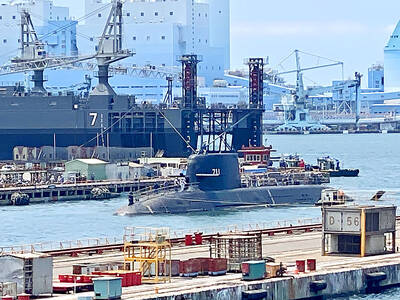
AGING: While Japan has 22 submarines, Taiwan only operates four, two of which were commissioned by the US in 1945 and 1946, and transferred to Taiwan in 1973 Taiwan would need at least 12 submarines to reach modern fleet capabilities, CSBC Corp, Taiwan chairman Chen Cheng-hung (陳政宏) said in an interview broadcast on Friday, citing a US assessment. CSBC is testing the nation’s first indigenous defense submarine, the Hai Kun (海鯤, Narwhal), which is scheduled to be delivered to the navy next month or in July. The Hai Kun has completed torpedo-firing tests and is scheduled to undergo overnight sea trials, Chen said on an SET TV military affairs program. Taiwan would require at least 12 submarines to establish a modern submarine force after assessing the nation’s operational environment and defense
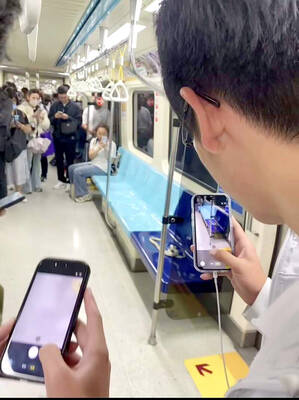
A white king snake that frightened passengers and caused a stir on a Taipei MRT train on Friday evening has been claimed by its owner, who would be fined, Taipei Rapid Transit Corp (TRTC) said yesterday. A person on Threads posted that he thought he was lucky to find an empty row of seats on Friday after boarding a train on the Bannan (Blue) Line, only to spot a white snake with black stripes after sitting down. Startled, he jumped up, he wrote, describing the encounter as “terrifying.” “Taipei’s rat control plan: Release snakes on the metro,” one person wrote in reply, referring
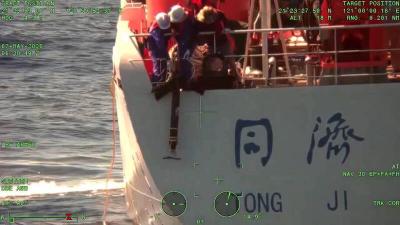
The coast guard today said that it had disrupted "illegal" operations by a Chinese research ship in waters close to the nation and driven it away, part of what Taipei sees a provocative pattern of China's stepped up maritime activities. The coast guard said that it on Thursday last week detected the Chinese ship Tongji (同濟號), which was commissioned only last year, 29 nautical miles (54km) southeast of the southern tip of Taiwan, although just outside restricted waters. The ship was observed lowering ropes into the water, suspected to be the deployment of scientific instruments for "illegal" survey operations, and the coast
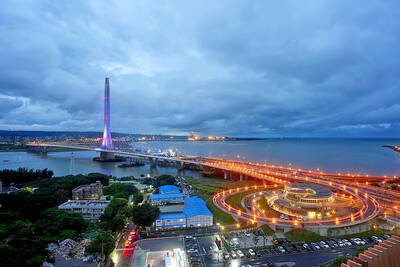
An inauguration ceremony was held yesterday for the Danjiang Bridge, the world’s longest single-mast asymmetric cable-stayed bridge, ahead of its official opening to traffic on Tuesday, marking a major milestone after nearly three decades of planning and construction. At the ceremony in New Taipei City attended by President William Lai (賴清德), Premier Cho Jung-tai (卓榮泰), Minister of Transportation and Communications Chen Shih-kai (陳世凱) and New Taipei City Mayor Hou Yu-ih (侯友宜), the bridge was hailed as both an engineering landmark and a long-awaited regional transport link connecting Tamsui (淡水) and Bali (八里)


 RSS
RSS