


The Democratic Progressive Party (DPP) yesterday called for an investigation into allegations of fraud and money laundering involving Chinese Nationalist Party (KMT) Keelung mayoral candidate Hsieh Kuo-liang (謝國樑).
At a news conference, Keelung City Councilor Chang Hao-han (張顥瀚) presented materials alleging that Hsieh had transferred US$3.2 million from three companies under his control to the accounts of Lin Kuan-pai (林冠百), former chairman of Taipei-based Reliance Securities.
Chang, together with DPP Legislator Kuo Kuo-wen (郭國文), said that based on the financial transaction records, Hsieh had contravened the Company Act (公司法), and was involved in money laundering, tax evasion, fraudulent asset transfers, forgery and using shell companies to gain illegal benefits.
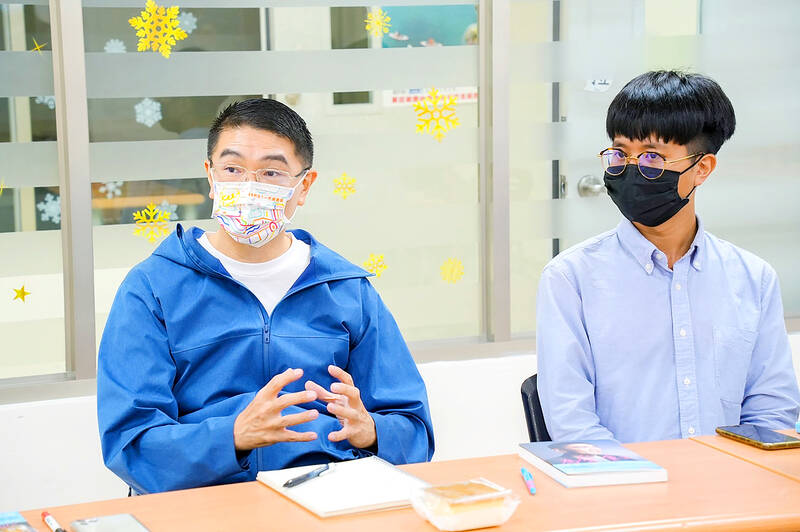
Photo courtesy of Hsieh Kuo-liang via CNA
The records show Hsieh’s close links to the Reliance Securities scandal, Chang said.
Taipei prosecutors last month indicted Lin and two other business associates on money laundering and breach of trust charges for illegally transfering NT$152.5 million (US$4.8 million at the current exchange rate).
The scandal took place in 2018, with Lin allegedly using several companies to evade taxes and hide his assets from regulators, while Hsieh allegedly colluded with by lending him US$3.2 million and later collecting a NT$3 million interest payment, Chang said.
Initial reports on the report said that Hsieh admitted that he had lent money in US checks issued by Keelung-based Gold Star International Co. Hsieh used to control Gold Star, but its ownership registration was earlier this year changed to that of his mother, Lin Man-li (林曼麗).
Hsieh has refused to name the two other family-owned companies involved in questionable money transfers, Chang said.
However, Chang said he had received documents from concerned citizens, saying the two entities are Vantage Metro and Kong Cheng Enterprise, both of which are linked to San Kong International, which is owned by the Hsieh family.
Hsieh rejected the accusatons, saying that all the financial transactions were legal and that he would sue Chang and other DPP politicians for defamation and contravening election laws.
Chang said he had run a check on the companies owned by the Hsieh family, including Gold Star, Vantage Metro, Kong Cheng and San Kong, which all have one registered address.
“In fact, a total of 15 companies are registered at this same address in Keelung,” he said.
“Records show that Hsieh owned most of these companies, but this year he had them registered under his mother’s name. We suspect that he did so to evade judicial investigation ... as he planned to join the mayoral election, and wanted to avoid media attention and negative publicity,” Chang said.
“Hsieh also allegedly had registered other overseas shell companies, in the Cayman Islands and the Virgin Islands. These are well-known havens for evading taxes and for money laundering,” he said.
Kuo said Hsieh comes from a political dynasty in Keelung, with his father, Hsieh Hsiu-ping (謝修平), serving as a city councilor in the 1970s and council speaker in the 1980s.
Hsieh’s family have used their political clout and connections to build a local business empire, Kuo said.

Considering that most countries issue more than five denominations of banknotes, the central bank has decided to redesign all five denominations, the bank said as it prepares for the first major overhaul of the banknotes in more than 24 years. Central bank Governor Yang Chin-lung (楊金龍) is expected to report to the Legislative Yuan today on the bank’s operations and the redesign’s progress. The bank in a report sent to the legislature ahead of today’s meeting said it had commissioned a survey on the public’s preferences. Survey results showed that NT$100 and NT$1,000 banknotes are the most commonly used, while NT$200 and NT$2,000

The Centers for Disease Control (CDC) yesterday reported the first case of a new COVID-19 subvariant — BA.3.2 — in a 10-year-old Singaporean girl who had a fever upon arrival in Taiwan and tested positive for the disease. The girl left Taiwan on March 20 and the case did not have a direct impact on the local community, it said. The WHO added the BA.3.2 strain to its list of Variants Under Monitoring in December last year, but this was the first imported case of the COVID-19 variant in Taiwan, CDC Deputy Director-General Lin Ming-cheng (林明誠) said. The girl arrived in Taiwan on

South Korea is planning to revise its controversial electronic arrival card, a step Taiwanese officials said prompted them to hold off on planned retaliatory measures, a South Korean media report said yesterday. A Yonhap News Agency report said that the South Korean Ministry of Foreign Affairs is planning to remove the “previous departure place” and “next destination” fields from its e-arrival card system. The plan, reached after interagency consultations, is under review and aims to simplify entry procedures and align the electronic form with the paper version, a South Korean ministry official said. The fields — which appeared only on the electronic form

The Ministry of Foreign Affairs (MOFA) is suspending retaliation measures against South Korea that were set to take effect tomorrow, after Seoul said it is updating its e-arrival system, MOFA said today. The measures were to be a new round of retaliation after Taiwan on March 1 changed South Korea's designation on government-issued alien resident certificates held by South Korean nationals to "South Korea” from the "Republic of Korea," the country’s official name. The move came after months of protests to Seoul over its listing of Taiwan as "China (Taiwan)" in dropdown menus on its new online immigration entry system. MOFA last week


 RSS
RSS