


Taiwan’s indigenous peoples are the true owners of the land, Premier Su Tseng-chang (蘇貞昌) said on Friday at an event marking the 35th founding anniversary of the Taiwan Indigenous Peoples Culture Park in Pingtung County’s Majia Township (瑪家).
The event was titled “Kemasi Maza,” meaning “starting here” in the Paiwan language.
Su said he attended the opening of the park as a member of the now-defunct Taiwan Provincial Consultative Council and witnessed the righting of historical wrongs that unfolded in the nation.
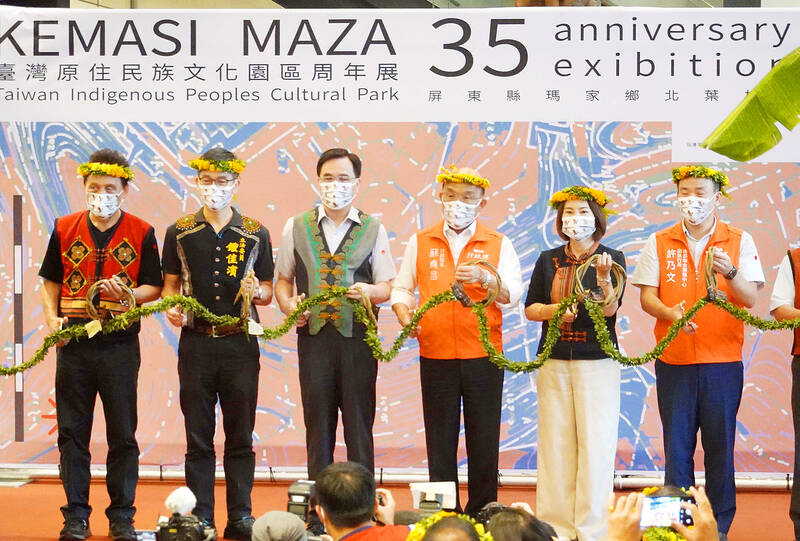
Photo: CNA
Then-president Lee Teng-hui (李登輝) at the opening ceremony started the process of equality for indigenous communities when he used the term “indigenous peoples” instead of “mountain compatriots” for the first time as the nation’s leader, Su said.
The Constitution has since been amended to mandate that the term “indigenous peoples” be used for official matters, and President Tsai Ing-wen (蔡英文) in 2016 issued an apology to indigenous people on behalf of Taiwan, he said.
Su said his daughter married into an Amis family from Taitung County and his granddaughter was only named in Amis.
Taiwan protects the cultural heritage of indigenous peoples to ensure they become the masters of their own land, and not to generate tourism revenue, he said.
Culture must be nurtured at the grassroots before it can be developed or internationalized, Council of Indigenous Peoples Minister Icyang Parod told the event.
Icyang said he was initially opposed to the cultural park over fears that it might serve to commercialize and stereotype indigenous cultures, adding that establishing a park for indigenous peoples without protecting their linguistic rights was particularly problematic for him at the time.
However, his fears were alleviated after the Tsai administration implemented the Indigenous Languages Development Act (原住民族語言發展法), which affirmed the right of indigenous Taiwanese to use their native languages, he said.
In January, the Executive Yuan established the national languages development forum with Su at the helm, Icyang said.
The Cabinet announced a NT$30 billion (US$976.9 million) budget covering the next five years to preserve indigenous languages and increased the council’s budget from NT$500,000 million to NT$1.3 billion, he said.
A plan to renovate the park is also being put into motion that would improve the facilities and fund the reconstruction of 25 traditional-style structures on campus, thanks to special budgets approved by the Executive Yuan in April, he added.

Considering that most countries issue more than five denominations of banknotes, the central bank has decided to redesign all five denominations, the bank said as it prepares for the first major overhaul of the banknotes in more than 24 years. Central bank Governor Yang Chin-lung (楊金龍) is expected to report to the Legislative Yuan today on the bank’s operations and the redesign’s progress. The bank in a report sent to the legislature ahead of today’s meeting said it had commissioned a survey on the public’s preferences. Survey results showed that NT$100 and NT$1,000 banknotes are the most commonly used, while NT$200 and NT$2,000

The Centers for Disease Control (CDC) yesterday reported the first case of a new COVID-19 subvariant — BA.3.2 — in a 10-year-old Singaporean girl who had a fever upon arrival in Taiwan and tested positive for the disease. The girl left Taiwan on March 20 and the case did not have a direct impact on the local community, it said. The WHO added the BA.3.2 strain to its list of Variants Under Monitoring in December last year, but this was the first imported case of the COVID-19 variant in Taiwan, CDC Deputy Director-General Lin Ming-cheng (林明誠) said. The girl arrived in Taiwan on

South Korea is planning to revise its controversial electronic arrival card, a step Taiwanese officials said prompted them to hold off on planned retaliatory measures, a South Korean media report said yesterday. A Yonhap News Agency report said that the South Korean Ministry of Foreign Affairs is planning to remove the “previous departure place” and “next destination” fields from its e-arrival card system. The plan, reached after interagency consultations, is under review and aims to simplify entry procedures and align the electronic form with the paper version, a South Korean ministry official said. The fields — which appeared only on the electronic form

The Ministry of Foreign Affairs (MOFA) is suspending retaliation measures against South Korea that were set to take effect tomorrow, after Seoul said it is updating its e-arrival system, MOFA said today. The measures were to be a new round of retaliation after Taiwan on March 1 changed South Korea's designation on government-issued alien resident certificates held by South Korean nationals to "South Korea” from the "Republic of Korea," the country’s official name. The move came after months of protests to Seoul over its listing of Taiwan as "China (Taiwan)" in dropdown menus on its new online immigration entry system. MOFA last week


 RSS
RSS