


While welcoming Taiwan Semiconductor Manufacturing Co’s (TSMC) expansion, environmental campaigners yesterday called on the Central Taiwan Science Park Administration in Taichung to raise the proportion of renewable energy use at the park by 10 percent each year to reach 100 percent by 2030.
TSMC has applied for a phase 6 expansion plan for its facility in Taichung to build a 2-nanometer fab, which is to undergo a second phase of environmental impact assessment next month after being required to submit more documents, Air Clean Taiwan executive secretary Chao Hui-lin (趙慧琳) said.
“We represent many mothers with their families in Taichung, and we support TSMC’s new plan, as the company is the ‘silicon shield’ protecting our nation. However, at the same time, we also want zero carbon emissions to protect our city and our children’s future,” Chao said at a rally in front of the Taichung City Government.
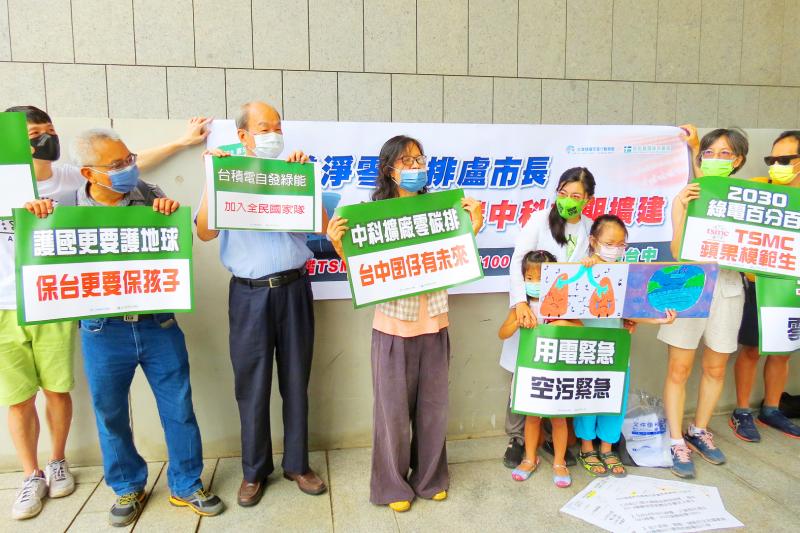
Photo: Su Chin-feng, Taipei Times
“So we request Taichung Mayor Lu Shiow-yen (盧秀燕) to work with TSMC to safeguard Taichung residents in joint efforts to combat global climate change and mitigate local air pollution,” she said.
Chao listed three major demands by environmental advocates: first, slow the pace of the development of its park, which currently producees about 3.51 tonnes of greenhouse gas emissions per year; second, require that at least 40 percent of the energy at the park be derived from renewable resources by 2024, with the ratio increasing by 10 percent each until it reaches 100 percent by 2030; and third, Taichung must join national energy-saving, renewable energy and energy storage efforts, while requiring TSMC to supply all its own energy needs from renewable resources.
“Taichung has experienced power and water shortages in the past few years, which show that all resources are finite, and unlimited production expansion is not possible,” Chao said.
“It is time for the government to guide changes to transform high-investment, high-energy, high-polluting industries, such as steel, to make them more efficient,” said Lai Yi-chun (賴怡均), board member of Taichung Dadu Mountain Air Pollution Clean-Up Association.
The Taichung Environmental Protection Bureau said that at a meeting with TSMC officials at the end of last year, the city government had emphasized the need for the company to have in place more environmentally friendly, renewable energy and recycling programs to manage its water and power supply needs.
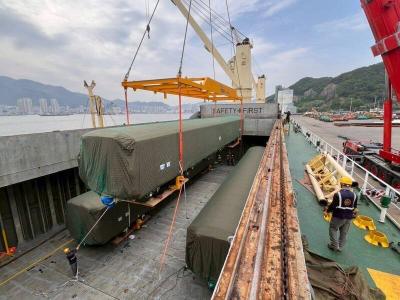
The first of 10 new high-capacity trains purchased from South Korea’s Hyundai Rotem arrived at the Port of Taipei yesterday to meet the demands of an expanding metro network, Taipei Rapid Transit Corp (TRTC) said yesterday. The train completed a three-day, 1,200km voyage from the Port of Masan in South Korea, the company said. Costing NT$590 million (US$18.79 million) each, the new six-carriage trains feature a redesigned interior based on "human-centric" transportation concepts, TRTC said. The design utilizes continuous longitudinal seating to widen the aisles and optimize passenger flow, while also upgrading passenger information displays and driving control systems for a more comfortable
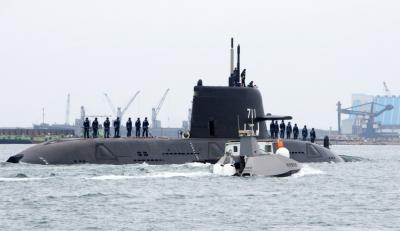
Taiwan's first indigenous defense submarine, the SS-711 Hai Kun (海鯤, or Narwhal), departed for its 13th sea trial at 7am today, marking its seventh submerged test, with delivery to the navy scheduled for July. The outing also marked its first sea deployment since President William Lai (賴清德) boarded the submarine for an inspection on March 19, drawing a crowd of military enthusiasts who gathered to show support. The submarine this morning departed port accompanied by CSBC Corp’s Endeavor Manta (奮進魔鬼魚號) uncrewed surface vessel and a navy M109 assault boat. Amid public interest in key milestones such as torpedo-launching operations and overnight submerged trials,
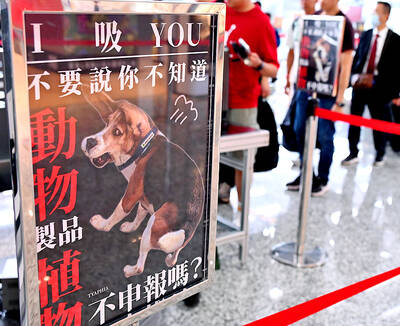
Quarantine awareness posters at Taiwan Taoyuan International Airport have gone viral for their use of wordplay. Issued by the airport branch of the Animal and Plant Health Inspection Agency, the posters feature sniffer dogs making a range of facial expressions, paired with advisory messages built around homophones. “We update the messages for holidays and campaign needs, periodically refreshing materials to attract people’s attention,” quarantine officials said. “The aim is to use the dogs’ appeal to draw focus to quarantine regulations.” A Japanese traveler visiting Taiwan has posted a photo on X of a poster showing a quarantine dog with a
SECURITY RISK: A university student sent a general alarm signal to THSRC’s control center on April 5, causing four operating trains to temporarily halt services The Ministry of Transportation and Communications yesterday pledged to submit a report on ways to harden the communication security of railway systems after a university student hacked into Taiwan High Speed Rail Corp’s (THSRC) radio communications system and disrupted operations of four high-speed rail trains last month. Investigation by the police and prosecutors found that the university student and radio enthusiast, surnamed Lin (林), first used a software-defined radio (SDR) filter to analyze THSRC signals, downloaded the data to a computer, cracked the parameters and then programmed the codes into his radio devices. Lin then sent a general alarm signal to


 RSS
RSS