


Taiwan is set to take delivery of the Pfizer-BioNTech COVID-19 vaccine for children aged from 6 months to 5 years old by the end of this month, the Central Epidemic Command Center (CECC) said yesterday.
The doses could help ensure that children are better protected at school, the CECC said, adding that it the three required shots are to be administered over a three-month period.
Taiwan last month granted emergency use authorization (EUA) for the Pfizer-BioNTech vaccine to be used for young children, as infants and young children face a risk of severe illness or death amid the spread of COVID-19.
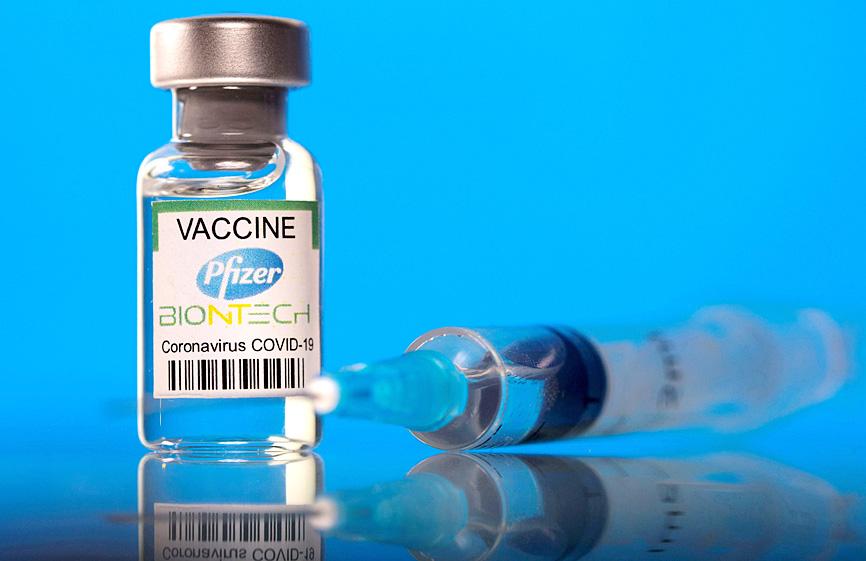
Photo: Reuters
The vaccine for the age group will be administered in three 0.2 milliliter doses, each containing 3 micrograms of mRNA, with a minimum interval of 21 days for the first two doses and a period of at least eight weeks before the third shot.
Taiwan began offering the Moderna COVID-19 vaccine to children aged 6-11 on May 2 and started the rollout of the Pfizer-BNT COVID-19 vaccine for children aged 5-11 on May 25.
Separately, five million doses of the locally produced Medigen COVID-19 vaccine were purchased by the government, the Central Epidemic Command Center (CECC) said in response to opposition lawmakers who questioned the government’s accounting of the shots.
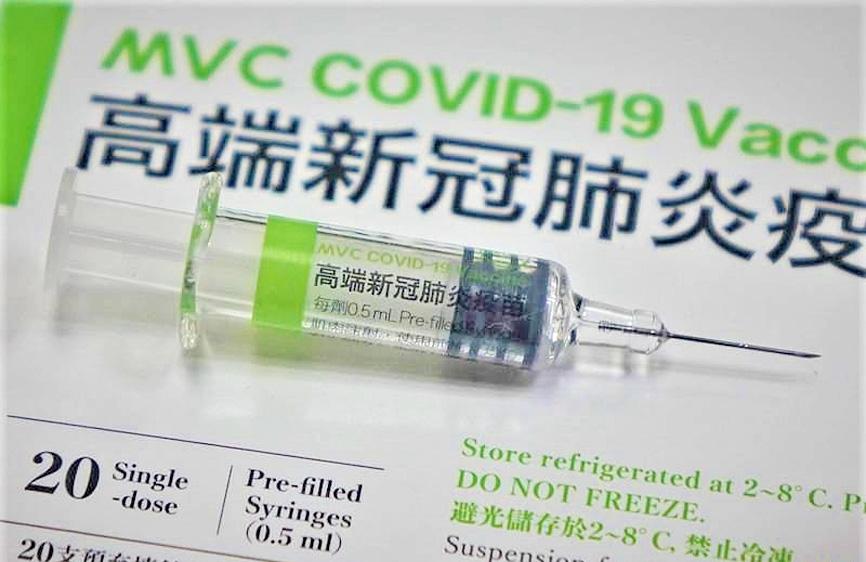
Photo: Tsai Szu-pei, Taipei Times
Chinese Nationalist Party (KMT) lawmakers Yosi Takun and Wan Mei-ling (萬美玲) said that about 780,000 doses are unaccounted for, after requesting Food and Drug Administration (FDA) data regarding government supplies of the Medigen vaccine, a local newspaper reported on Saturday.
The report said that the FDA’s Web site showed that Medigen Vaccine Biologics Corp delivered 5,664,743 doses to the FDA for lot-release testing.
The company said it had provided 200,000 free doses to the government before it gained emergency use authorization in June last year, so based on the contract, the company owed the government about 5.2 million doses, it said.
The report said that 2,967,109 doses of the Medigen vaccine were administered as of Aug. 8, while 150,000 doses were donated to the Republic of Somaliland, 1,757,321 doses are in stock, and 7,324 doses were disposed of after expiration, for a total of 4,881,754 doses.
Wan questioned the whereabouts of the 782,989 shortfall, based on the difference between the delivered doses and those that have been accounted for.
The government purchased and received 5 million doses of the Medigen vaccine, while the FDA conducted lot release testing on about 5.66 million doses, the CECC said.
As of Thursday, 2,972,281 doses were administered, while 1,749,914 doses are in stock, and 127,805 doses were spoiled. That includes 7,324 doses disposed of after expiration, others that were damaged, and 150,000 donated to the Republic of Somaliland, it said.
The 666,000 doses that underwent lot release testing were not given to the Centers for Disease Control, but used by Medigen privately, the CECC said.
Additional reporting by CNA

LOUD AND PROUD Taiwan might have taken a drubbing against Australia and Japan, but you might not know it from the enthusiasm and numbers of the fans Taiwan might not be expected to win the World Baseball Classic (WBC) but their fans are making their presence felt in Tokyo, with tens of thousands decked out in the team’s blue, blowing horns and singing songs. Taiwanese fans have packed out the Tokyo Dome for all three of their games so far and even threatened to drown out home team supporters when their team played Japan on Friday. They blew trumpets, chanted for their favorite players and had their own cheerleading squad who dance on a stage during the game. The team struggled to match that exuberance on the field, with
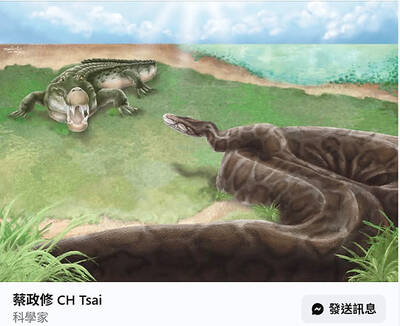
Taiwanese paleontologists have discovered fossil evidence that pythons up to 4m long inhabited Taiwan during the Pleistocene epoch, reporting their findings in the international scientific journal Historical Biology. National Taiwan University (NTU) Institute of Ecology and Evolutionary Biology associate professor Tsai Cheng-hsiu (蔡政修) led the team that discovered the largest snake fossil ever found in Taiwan. The single trunk vertebra was discovered in Tainan at the Chiting Formation, dated to between 400,000 and 800,000 years ago in the Middle Pleistocene, the paper said. The area also produced Taiwan’s first avian fossil, as well as crocodile, mammoth, saber-toothed cat and rhinoceros fossils, it said. Discoveries

Taiwanese paleontologists have discovered fossil evidence that pythons up to 4m long inhabited Taiwan during the Pleistocene epoch, reporting their findings in the international scientific journal Historical Biology. National Taiwan University (NTU) Institute of Ecology and Evolutionary Biology associate professor Tsai Cheng-hsiu (蔡政修) led the team that discovered the largest snake fossil ever found in Taiwan. A single trunk vertebra was discovered in Tainan at the Chiting Formation, dated to between 800,000 to 400,000 years ago in the Middle Pleistocene, the paper said. The area also produced Taiwan’s first avian fossil, as well as crocodile, mammoth, sabre-toothed cat and rhinoceros fossils, it said. Discoveries

Whether Japan would help defend Taiwan in case of a cross-strait conflict would depend on the US and the extent to which Japan would be allowed to act under the US-Japan Security Treaty, former Japanese minister of defense Satoshi Morimoto said. As China has not given up on the idea of invading Taiwan by force, to what extent Japan could support US military action would hinge on Washington’s intention and its negotiation with Tokyo, Morimoto said in an interview with the Liberty Times (sister paper of the Taipei Times) yesterday. There has to be sufficient mutual recognition of how Japan could provide


 RSS
RSS