


A majority of Taiwanese consider traditional marriage expectations to be stress-inducing and demand greater marriage equality, a poll conducted by the Childcare Policy Alliance has shown.
Traditional views on marriage and family, where women are expected to shoulder all of the housework, are among the factors affecting young people’s willingness to marry, alliance convener Liu Yu-hsiu (劉毓秀) said.
The poll introduced seven statements and asked whether respondents agreed with them: that there should be no dowries or bride price; couples should not consider buying a house upon getting married; parents should not be in charge of the wedding; an equal ceremony should be held; cohabitation is acceptable; the husband and wife should both work; and couples should share child-rearing and housework duties.
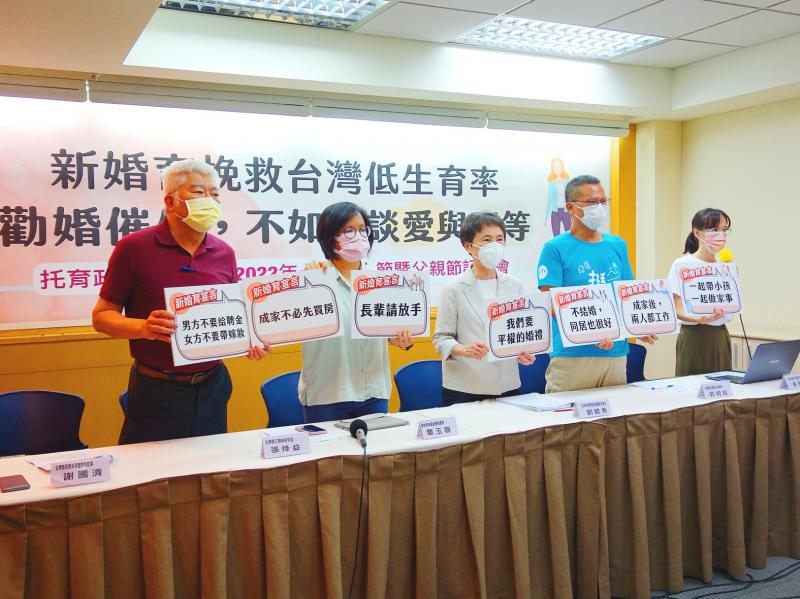
Photo: Wu Po-hsuan, Taipei Times
The poll found that 92.6 percent of respondents agreed that parents should not be in charge of the wedding, while 70 percent said there should be no dowries or bride price.
According to the survey, 96.3 percent of respondents agreed that the husband and wife should share child-rearing and housework duties, while 69.2 percent agreed that cohabitation is acceptable.
Society has a set definition for “having a family and raising kids” and “a happy life,” but the poll shows that values are changing, and the definition is no longer the accepted norm, alliance spokesperson Huang Chiao-ling (黃喬玲) said.
Taiwan Parents Education Alliance standing supervisor Hsieh Kuo-ching (謝國清) said that marriage customs, especially bride prices, are sources of anxiety and stress that contribute to young people’s unwillingness to marry.
Taiwan Labor Front researcher Chang Feng-yi (張烽益) said the tradition of buying a home upon marriage should be done away with, as it forces newlyweds into the housing market when they are not prepared for it.
Among the 38 members of the Organisation for Economic Co-operation and Development, the average percentage of couples who have children without being married is 41 percent, Liu said.
This is not due to promiscuity, but rather systems that support the practice, Liu said.
In contrast, in Southeast and East Asian countries, including Taiwan, the percentage is only 2 percent, Liu said, adding that if there are no changes, Taiwan would continue to experience a low birthrate.
“We must change the general environment and social perceptions about marriage so young people will not be overstressed about marriage and having children,” Liu said.
The poll, conducted online from July 5 to Tuesday, collected 895 valid responses. More than 85.1 percent of respondents were women and people aged 25 to 29 accounted for 17.7 percent of respondents, with married couples accounting for more than half of all respondents.
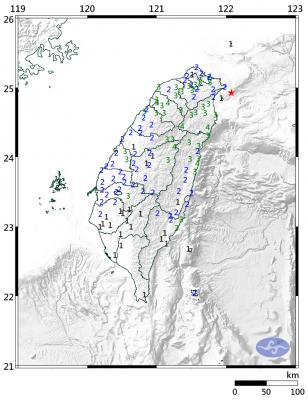
A magnitude 6.1 earthquake struck off the coast of Yilan County at 8:39pm tonight, the Central Weather Administration (CWA) said, with no immediate reports of damage or injuries. The epicenter was 38.7km east-northeast of Yilan County Hall at a focal depth of 98.3km, the CWA’s Seismological Center said. The quake’s maximum intensity, which gauges the actual physical effect of a seismic event, was a level 4 on Taiwan’s 7-tier intensity scale, the center said. That intensity level was recorded in Yilan County’s Nanao Township (南澳), Hsinchu County’s Guansi Township (關西), Nantou County’s Hehuanshan (合歡山) and Hualien County’s Yanliao (鹽寮). An intensity of 3 was
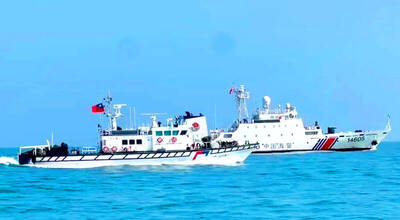
Instead of focusing solely on the threat of a full-scale military invasion, the US and its allies must prepare for a potential Chinese “quarantine” of Taiwan enforced through customs inspections, Stanford University Hoover fellow Eyck Freymann said in a Foreign Affairs article published on Wednesday. China could use various “gray zone” tactics in “reconfiguring the regional and ultimately the global economic order without a war,” said Freymann, who is also a nonresident research fellow at the US Naval War College. China might seize control of Taiwan’s links to the outside world by requiring all flights and ships entering or leaving Taiwan
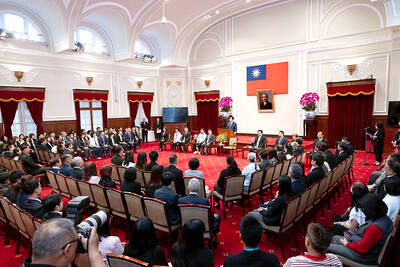
The next minimum wage hike is expected to exceed NT$30,000, President William Lai (賴清德) said yesterday during an award ceremony honoring “model workers,” including migrant workers, at the Presidential Office ahead of Workers’ Day today. Lai said he wished to thank the awardees on behalf of the nation and extend his most sincere respect for their hard work, on which Taiwan’s prosperity has been built. Lai specifically thanked 10 migrant workers selected for the award, saying that although they left their home countries to further their own goals, their efforts have benefited Taiwan as well. The nation’s industrial sector and small businesses lay
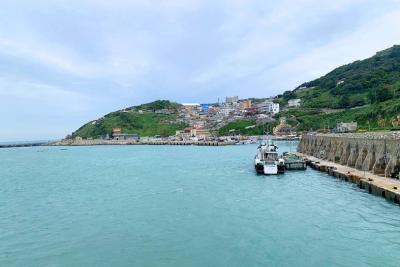
Taiwan has activated backup communications for its northernmost territory, the remote and strategically located island of Dongyin (東引), after poor weather conditions apparently shifted the wreckage of a ship onto an undersea cable causing it to break. The vulnerability of undersea communication cables linking Taiwan with its outlying islands has been a persistent cause of concern for Taipei, whose government has on several occasions blamed Chinese ships for intentionally causing damage. Dongyin, home to about 1,500 people, sits in a strategic position at the top of the Taiwan Strait and the island has a heavy military presence. It does not have an


 RSS
RSS