


China yesterday put two Taiwanese non-profit organizations and several companies on a “secessionist” blacklist as US House of Representatives Speaker Nancy Pelosi made a historic visit to Taiwan.
Pelosi landed in Taipei on Tuesday evening, despite a series of increasingly stark threats from Beijing.
China’s Taiwan Affairs Office spokesman Ma Xiaoguang (馬曉光) told a news conference yesterday that punitive measures would be initiated against the Taiwan Democracy Foundation (TDF), the International Cooperation and Development Fund (ICDF) and “diehard Taiwan secessionists.”
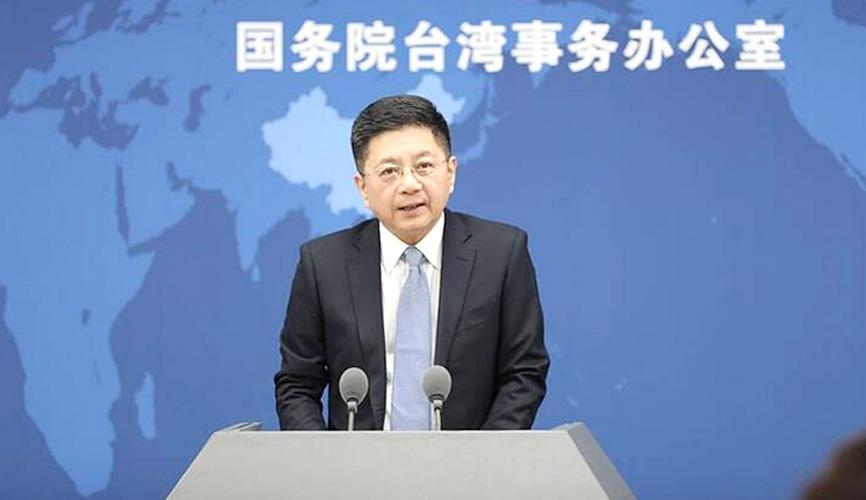
Taipei Times file photo
The TDF and the ICDF are affiliated with Taiwan’s Ministry of Foreign Affairs.
Ma said the funds and their alleged donors — including Speedtech Energy, Hyweb Technology, Skyla Corp and Skyeyes GPS Technology — would be banned from engaging in any transaction or cooperating with organizations, enterprises or people in China.
The TDF and the ICDF are engaged in “secessioninst [sic] activities” around the world under the “guise of democracy and development” in a bid to expand Taiwan’s “so-called international space,” he was paraphrased by China’s state-owned Global Times as saying.
Democratic Progressive Party (DPP) deputy-secretary general Lin Fei-fan (林飛帆), who also chairs the TDF, said Beijing has no say in the fund’s operations and its hasty comments are proof of its desperation.
“The TDF will not yield to China,” he said. “The public is called upon to support the foundation to show that bullying will never be accepted.”
The TDF and the ICDF are organizations that serve as conduits for Taiwan to conduct diplomacy and promote international cooperation, and Ma’s comments about the funds are not based on logic or facts, DPP Legislator Lai Jui-lung (賴瑞隆) said.
“Beijing’s bullying would achieve nothing except arouse the antipathy of Taiwanese toward China,” he said. “We urge the communist regime in China to stop before it falls into an abyss.”
Chinese Nationalist Party (KMT) Culture and Communications Committee deputy director Lin Chia-hsing (林家興) said the punitive measures would not promote the welfare of people on the two sides of the Taiwan Strait, and Chinese authorities should stop inappropriate policies that harm the relationship between Taiwan and China.
The TDF and the ICDF are bipartisan entities that represent the government and not a single party or faction, he said, adding that half of the TDF’s board were appointed by political parties, including the KMT.
“They cannot be said to be an association composed of die-hard Taiwanese secessionists and do not deserve punitive measures,” Lin added.
Meanwhile, a Skyla spokesman said the company has ever never donated to the ICDF.
While an investigation found that a former employee had made a NT$3,000 contribution to the fund’s medical charity in 2018, the check was issued from the former employee’s personal account and Skyla was not involved in any way, the spokesman said.
Speedtech Energy director Chu Yen-ting (巨彥霆) said he was prompted to contribute “a sum too petty to note” to the ICDF by a friend four or five years ago, adding that he is “pissed off” about being labeled a secessionist in Beijing.
“My company does no business in China. If China wants to call me a die-hard pro-Taiwanese independence, then I will be one,” he said.
Additional reporting by Chen Yun, Fang Wei-chieh, Hsieh Wu-hsiung and Lin Liang-sheng


UPGRADE: The Kang Ding-class frigate is replacing its Chaparall missiles with Tien Chien II and Hua Yang VLS, which would provide it with long-range, 360° air defense Taiwan plans to produce 1,200 to 1,376 Hai Chien II missiles (海劍二, Sea Sword II) — also known as TC-2N — to serve as the standard air defense system of the navy’s surface combatant fleet, a source said yesterday. Last week, the Hai Chien II, the naval version of the Tien Kung II missile (天劍二, Sky Sword II), completed a live-fire test in waters off the National Chungshan Institute of Science and Technology’s Jiupeng facility (九鵬) in Pingtung County’s Manjhou Township (滿州). The MIM72 Chaparral and other dated air defense missiles that currently arm Taiwanese ships have inadequate range to combat Chinese

REASONS FOR TRAVEL: An assistant professor said that proposed amendments to penalize drivers if they used drugs overseas would not deter people from traveling People who operate a motor vehicle under the influence of marijuana would have their driver’s license revoked, even if they used the substance while overseas, the Ministry of Transportation and Communications said yesterday, citing proposed amendments to the Road Traffic Management and Penalty Act (道路交通管理處罰條例). The amendments would also authorize the government to revoke the licenses of people determined to have used Category 1 or Category 2 narcotics, even if they were not operating a vehicle while under the influence of drugs, as well as ban them from taking the license test for three years, the ministry said. People aged 18 or
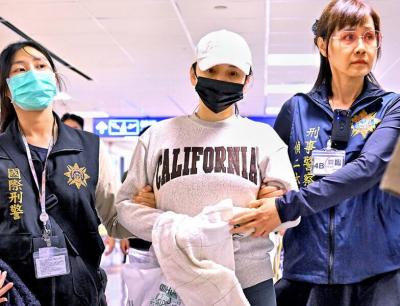
Johanne Liou (劉喬安), a Taiwanese woman who shot to unwanted fame during the Sunflower movement protests in 2014, returned to Taiwan last night after being deported from the US. She is to stand trial in Taiwan for charges involving embezzlement, fraud and drug crimes. The Criminal Investigation Bureau (CIB) said it took her into custody at Taiwan Taoyuan International Airport and would first question her before transferring her to the New Taipei District Prosecutors’ Office. She was arrested upon disembarking a flight from San Francisco that landed shortly before 7pm. Liou absconded to the US in 2019 after jumping bail
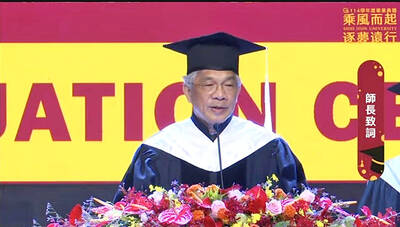
Shih Hsin University President Chen Ching-he (陳清河) yesterday issued a public apology for comments made in his commencement speech last week, stating that he has asked the school to suspend his duties and halt his wages for two months as a show of contrition. At the commencement ceremony on May 30, Chen said, “If you don’t manage your time well, or your own emotions, or your health, then I am telling every one of you — put a quick end to ‘you,’ because the world has no need for ‘you.’” The comments have sparked significant controversy online, and Chen through an open


 RSS
RSS