


The Taiwan Alliance to Promote Civil Partnership Rights (TAPCPR), along with legislators and human rights groups, yesterday called for freedom of marriage for all cross-national same-sex couples, instead of each case being decided by the courts.
The Taipei High Administrative Court on July 21 ruled that same-sex partners Lu Yin-jen (盧盈任), a Taiwanese, and Eizaburo Ariyoshi, a Japanese, should not have been barred from registering their marriage at a local household registration office.
The court revoked a decision by the office to reject an application that the couple had filed on May 7 last year, citing Article 8 of the Act Governing the Choice of Law in Civil Matters Involving Foreign Elements (涉外民事法律適用法), which stipulates that a foreign law is not applicable if it violates the public order or good morals of Taiwan.
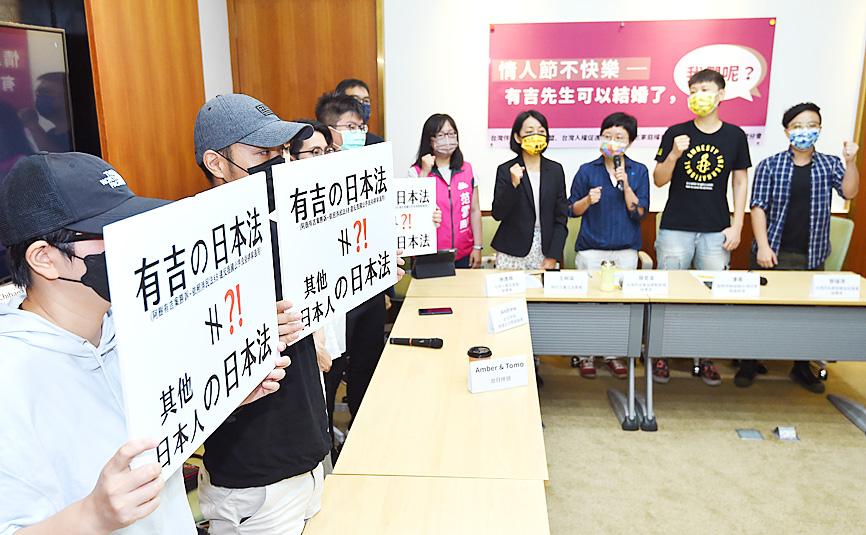
Photo: Liao Chen-hui, Taipei Times
TAPCPR secretary-general Chien Chih-chieh (簡至潔) said it was the fourth case in which the court has ruled in favor of cross-national same-sex couples.
However, the Ministry of the Interior still says that according to Article 46 of the act, the formation of a marriage is governed by the law of each party’s country of nationality, she said.
Based on the precedent set by Lu and Ariyoshi and the three earlier cases, all cross-national same-sex couples’ marriage registrations should be accepted, Chien said.
New Power Party Legislator Claire Wang (王婉諭) said if the court has ruled that local household registration offices should accept same-sex marriage applications, even if they involve a national from a state in which same-sex marriage is not recognized, then the contradicting article of the act should be amended.
Before the amendment is passed, the ministry should notify the offices that they should accept such applications, she added.
Allison, a Taiwanese who is working in Japan and living with her Japanese partner and their eight-month-old child, said that she and her partner hope to settle down in Taiwan, but their right to residency is not protected, as they cannot register their marriage in either country.
The future of their family is filled with uncertainty, and she is afraid that they might be separated at any moment, she said.
Amnesty International Taiwan campaign manager Pan Yi (潘儀) shared her own experience of being unable to get married with her Malaysian partner, who she has been with for seven years.
She said that hundreds of cross-national same-sex couples live with the fear of suddenly being forced to separate.
As Taiwan is the first country in Asia to legalize same-sex marriage, many supporters around the world are following developments in the nation, so the government should choose love over hatred and discrimination, and allow people to get married, irrespective of their nationality, she said.
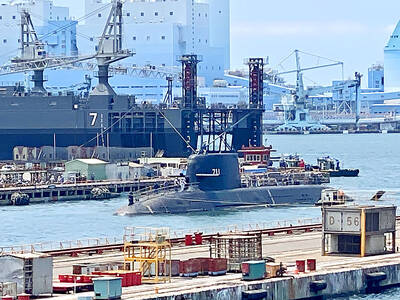
AGING: While Japan has 22 submarines, Taiwan only operates four, two of which were commissioned by the US in 1945 and 1946, and transferred to Taiwan in 1973 Taiwan would need at least 12 submarines to reach modern fleet capabilities, CSBC Corp, Taiwan chairman Chen Cheng-hung (陳政宏) said in an interview broadcast on Friday, citing a US assessment. CSBC is testing the nation’s first indigenous defense submarine, the Hai Kun (海鯤, Narwhal), which is scheduled to be delivered to the navy next month or in July. The Hai Kun has completed torpedo-firing tests and is scheduled to undergo overnight sea trials, Chen said on an SET TV military affairs program. Taiwan would require at least 12 submarines to establish a modern submarine force after assessing the nation’s operational environment and defense

A white king snake that frightened passengers and caused a stir on a Taipei MRT train on Friday evening has been claimed by its owner, who would be fined, Taipei Rapid Transit Corp (TRTC) said yesterday. A person on Threads posted that he thought he was lucky to find an empty row of seats on Friday after boarding a train on the Bannan (Blue) Line, only to spot a white snake with black stripes after sitting down. Startled, he jumped up, he wrote, describing the encounter as “terrifying.” “Taipei’s rat control plan: Release snakes on the metro,” one person wrote in reply, referring
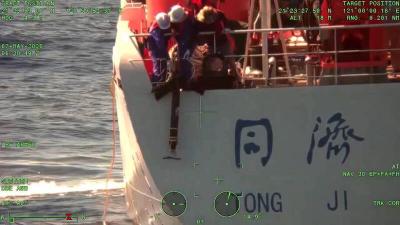
The coast guard today said that it had disrupted "illegal" operations by a Chinese research ship in waters close to the nation and driven it away, part of what Taipei sees a provocative pattern of China's stepped up maritime activities. The coast guard said that it on Thursday last week detected the Chinese ship Tongji (同濟號), which was commissioned only last year, 29 nautical miles (54km) southeast of the southern tip of Taiwan, although just outside restricted waters. The ship was observed lowering ropes into the water, suspected to be the deployment of scientific instruments for "illegal" survey operations, and the coast
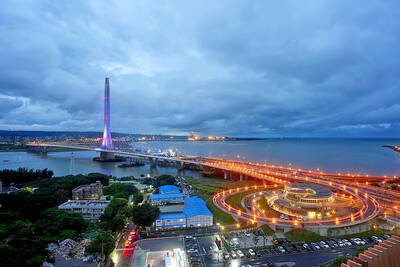
An inauguration ceremony was held yesterday for the Danjiang Bridge, the world’s longest single-mast asymmetric cable-stayed bridge, ahead of its official opening to traffic on Tuesday, marking a major milestone after nearly three decades of planning and construction. At the ceremony in New Taipei City attended by President William Lai (賴清德), Premier Cho Jung-tai (卓榮泰), Minister of Transportation and Communications Chen Shih-kai (陳世凱) and New Taipei City Mayor Hou Yu-ih (侯友宜), the bridge was hailed as both an engineering landmark and a long-awaited regional transport link connecting Tamsui (淡水) and Bali (八里)


 RSS
RSS