


Japan, the US and like-minded nations should make China realize that a coercive annexation of Taiwan cannot be achieved within an acceptable cost and timeframe, Taro Kono, a member of the Japanese House of Representatives, said yesterday at the annual Ketagalan Forum.
The Ketagalan Forum — 2022 Indo-Pacific Security Dialogue, cohosted by the Ministry of Foreign Affairs and the Prospect Foundation, was held in Taipei yesterday.
Kono, who has also served as Japanese minister of foreign affairs and minister of defense, gave an online keynote speech about the security situation in the Indo-Pacific region from his office in Tokyo, as his plan to visit Taiwan fell through after he contracted COVID-19 two weeks ago.
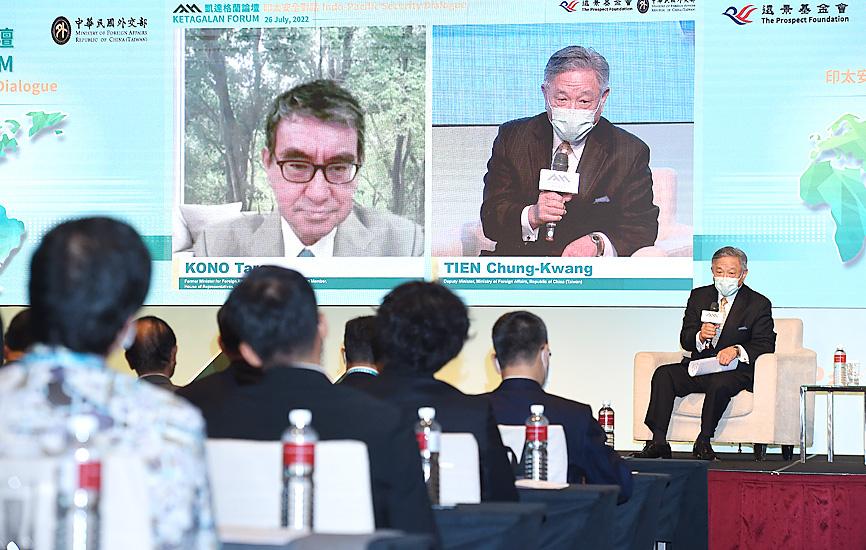
Photo: Liao Chen-hui, Taipei Times
“The biggest variable of the security to the region is China,” he said.
China is rapidly expanding its military, making assertive and coercive attempts to change the “status quo” in the region, overturn international norms and undermine the rules-based international order and if the international community overlooks this, the devastating consequences would not be limited to the Indo-Pacific region, but would reach across the world, Kono said.
“The CCP [Chinese Communist Party] is aiming to build a strong military to realize its ‘China dream,’” he said.
China’s military spending has increased 43-fold in 30 years, and its forces have expanded from no modern submarines and no fighter jets in 1991 to 52 submarines and nearly 1,200 fourth and fifth-generation fighter jets today, he added.
China has frequently been sending coast guard vessels into Japanese territorial waters near the Diaoyutai Islands (釣魚台) — known as the Senkakus in Japan — since 2012, militarized three islands in the South China Sea and necessitated Japan’s Air Self-Defense Force scrambling fighter jets 698 times in response to its incursions last year, Kono said.
Taiwan, China and Japan all claim the islands.
While China is unilaterally trying to change the “status quo,” “the global community must strongly oppose these actions and make the aggressor pay a high cost for them,” he said.
As the possibility of China using force against Taiwan is rising, the US and like-minded nations must consider how they could defend Taiwan from China’s aggression, he added.
“If China uses force against Taiwan, Japan will be affected,” Kono said. “So now Japan needs to show its resolve to act with the global community to defend liberty and democracy. If the US and its allies show determination, it will send a strong message to Beijing.”
“Our goal is to show the resolve of our alliance to defend and protect our common values such as liberty, democracy, human rights and rule of law, and to make China realize that a coercive annexation of Taiwan cannot be achieved within an acceptable cost and timeframe,” he said.
Citing the situation in Europe, Kono said democratic nations must stand united behind Ukraine against the brutal aggressor Russia, because “if the global community lets Putin go unpunished, it would send a wrong signal to dictatorships that they can also get away unscathed and repeat such an atrocity. Then every country and everyone could become a victim.”
Like-minded nations must also be prepared for economic warfare, as some dictators are now in possession of huge destructive power with missiles and nuclear weapons, and could attack civilians, destroy cities and economic activity quite easily, but democratic governments are less intolerant of casualties and suffering from war, and could resort to economic sanctions, he said.
Dictators can also wage economic warfare, such as Beijing using China’s imports and exports as leverage to influence other nations, including banning Taiwan’s pineapple exports to China last year, he added.
“We need to build resilient supply chains for food, energy and other strategic products, not depend on possible aggressors,” Kono said. “It might divide the global economy into blocs and reduce possible economic returns, but that is the cost of our security.”
Kono proposed creating a “United Nations 2.0,” in which no nation has a veto, so that it could become a system in which the international community can take collective action against aggression by dictators, such as establishing global peacekeeping operations.
In addition, Kono said like-minded nations in Asia need a NATO-like mechanism or to set up security arrangements to defend their common values.
That could be done by expanding existing frameworks, such as the AUKUS security pact between Australia, the UK and the US, to include Asian nations, he said.
Functional mechanisms for cooperation on trade, economics, the environment, healthcare and other aspects are also important, he said, adding that the Comprehensive and Progressive Agreement for Trans-Pacific Partnership is a good regional mechanism which Taiwan should be allowed to join, and hopefully the US would soon realize its importance and rejoin.

UPGRADE: The Kang Ding-class frigate is replacing its Chaparall missiles with Tien Chien II and Hua Yang VLS, which would provide it with long-range, 360° air defense Taiwan plans to produce 1,200 to 1,376 Hai Chien II missiles (海劍二, Sea Sword II) — also known as TC-2N — to serve as the standard air defense system of the navy’s surface combatant fleet, a source said yesterday. Last week, the Hai Chien II, the naval version of the Tien Kung II missile (天劍二, Sky Sword II), completed a live-fire test in waters off the National Chungshan Institute of Science and Technology’s Jiupeng facility (九鵬) in Pingtung County’s Manjhou Township (滿州). The MIM72 Chaparral and other dated air defense missiles that currently arm Taiwanese ships have inadequate range to combat Chinese

REASONS FOR TRAVEL: An assistant professor said that proposed amendments to penalize drivers if they used drugs overseas would not deter people from traveling People who operate a motor vehicle under the influence of marijuana would have their driver’s license revoked, even if they used the substance while overseas, the Ministry of Transportation and Communications said yesterday, citing proposed amendments to the Road Traffic Management and Penalty Act (道路交通管理處罰條例). The amendments would also authorize the government to revoke the licenses of people determined to have used Category 1 or Category 2 narcotics, even if they were not operating a vehicle while under the influence of drugs, as well as ban them from taking the license test for three years, the ministry said. People aged 18 or
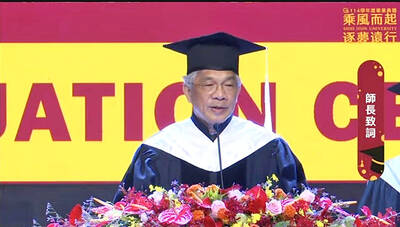
Shih Hsin University President Chen Ching-he (陳清河) yesterday issued a public apology for comments made in his commencement speech last week, stating that he has asked the school to suspend his duties and halt his wages for two months as a show of contrition. At the commencement ceremony on May 30, Chen said, “If you don’t manage your time well, or your own emotions, or your health, then I am telling every one of you — put a quick end to ‘you,’ because the world has no need for ‘you.’” The comments have sparked significant controversy online, and Chen through an open

Johanne Liou (劉喬安), a Taiwanese woman who shot to unwanted fame during the Sunflower movement protests in 2014, returned to Taiwan last night after being deported from the US. She is to stand trial in Taiwan for charges involving embezzlement, fraud and drug crimes. The Criminal Investigation Bureau (CIB) said it took her into custody at Taiwan Taoyuan International Airport and would first question her before transferring her to the New Taipei District Prosecutors’ Office. She was arrested upon disembarking a flight from San Francisco that landed shortly before 7pm. Liou absconded to the US in 2019 after jumping bail


 RSS
RSS