


The Central Epidemic Command Center (CECC) yesterday reported two local cases of the Omicron subvariant BA.5 of SARS-CoV-2.
Genome sequencing of 54 imported cases last week yielded 38 cases of BA.5, six cases of BA.4 and one case of BA.2.75 reported on Friday last week, said Centers for Disease Control (CDC) Deputy Director-General Philip Lo (羅一鈞), deputy head of the CECC’s medical response division.
He added that 87 percent of the sequenced imported cases were infected with new Omicron subvariants, indicating that the dominant strain is being replaced.
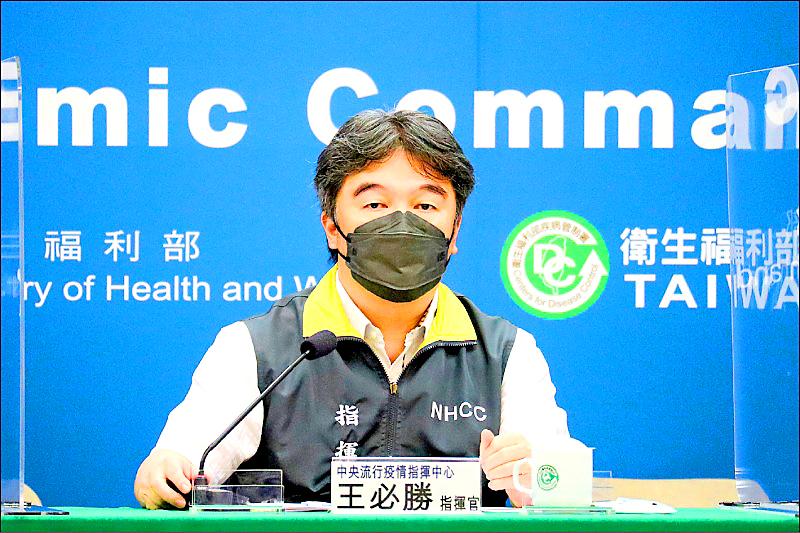
Photo provided by CECC
“On a cumulative basis, the most number of cases of BA.5 detected in Taiwan are from the US, followed by Germany, France, Singapore and the UK,” Lo said. “However, the highest number of cases last week were from Germany and Thailand, followed by South Korea, Japan and the US, implying that the virus is spreading to Asian countries.”
One of the two local BA.5 cases is a man in his 60s, who had picked up two family members at the airport, he said.
The two family members returned from Germany on July 5, with one testing positive on arrival at the airport. After the person was confirmed to have the BA.5 subvariant, the other family member and the man were tested, and both came back positive for the BA.5 subvariant.
Tests of 12 close contacts of the family cluster resulted in 10 negative and two positive cases.
The two positive cases had high cycle threshold (Ct) values, which are likely from their previous infections in May and last month, Lo said.
The other confirmed local BA.5 case yesterday was a man in his 50s who works at a shipyard in southern Taiwan. It was the second case of local community infection with the BA.5 subvariant as well as the second case of reinfection with BA.5 in Taiwan, he said.
The man first contracted COVID-19 on May 18. Earlier this month he developed a cough, sore throat and sore muscles, and on July 13 tested positive again for COVID-19.
The man’s polymerase chain reaction test resulted in a low CT value of 17, indicating a recent infection, and genome sequencing confirmed him to be infected with BA.5, so he is also a case of COVID-19 reinfection, Lo said.
Among the man’s close contacts, Lo said two family members have tested positive, and genome sequencing is ongoing to identify the virus strain.
Ten coworkers have also tested positive, including two who are considered previous infections, and genome sequencing on seven cases with lower Ct values is being conducted, Lo added.
The situation is likely a cluster of infections among a family and a workplace, but further analysis will be done after the sequencing results come back, he added.
Deputy Minister of Health and Welfare Victor Wang (王必勝), who heads the CECC, said that with COVID-19 vaccination for children aged six months to five years starting on Thursday last week, the center encourages parents to have their children vaccinated as soon as possible.
A wave of BA.5 infections is expected, and more than 60 percent of the severe COVID-19 cases in children so far were younger than six, he said.
Young children need two doses of the Moderna COVID-19 vaccine to develop full protection, which would take about a month, so getting vaccinated earlier can offer better protection faster, he added.
CDC Deputy Director-General Chuang Jen-hsiang (莊人祥), the CECC’s spokesman, said that so far, 44,894 doses of the Moderna vaccine for young children have been administered, accounting for 5.6 percent of the eligible age population.
He also urged people aged 65 or older to get vaccinated earlier, as government incentives — NT$500 in cash and two rapid test kits — for each dose of COVID-19 vaccine received are to last only until the end of this month.
Taiwan yesterday reported 16,921 new local COVID-19 cases and 53 deaths, the CECC said.
Additional reporting by CNA
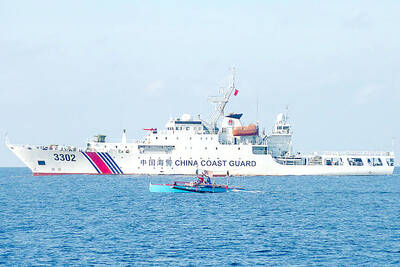
EXPANSIONIST: China deploys an average of 40 to 50 warships and coast guard vessels daily in the South China Sea, despite pledges not to militarize the region, an official said China is attempting to expand its influence across the First Island Chain and increase pressure on Japan by sending coast guard vessels into waters off of Taiwan under the pretext of maritime negotiations with Japan and the Philippines, a national security official said yesterday. China’s recent actions in the waters east of Taiwan and Japan and the Philippines’ exclusive economic zones (EEZ) are attempts to establish dominance in First Island Chain waters, said the official who declined to be named, adding that this is “expansion disguised as law enforcement.” Framing China’s actions solely as a cross-strait issue is a serious misjudgment that
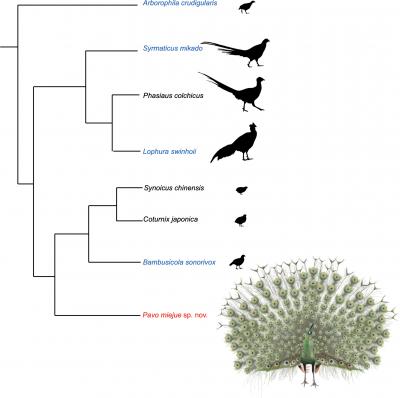
Through analyzing fossil evidence, a research team at National Taiwan University (NTU) discovered the largest endemic bird to have lived in Taiwan, naming it Pavo miejue, or extinct peafowl (滅絕孔雀). The Mikado pheasant, which is printed on the back of the NT$1,000 bank note, was previously believed to be the biggest endemic bird to Taiwan. The research team’s findings suggest that Pavo miejue lived during the Pleistocene epoch tens of thousands of years ago. It is the first endemic extinct bird species discovered and formally named in Taiwan. The study was coauthored by NTU Institute of Ecology and Evolutionary Biology professor Tsai Cheng-hsiu (蔡政修),
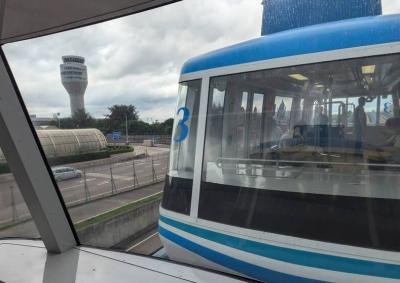
Taiwan Taoyuan International Airport is to suspend its automated Skytrain service connecting Terminal 1 and Terminal 2 starting on July 1 to facilitate connection works for the upcoming Terminal 3, the airport operator said today. Passengers and staff who need to travel between the two terminals after the suspension can instead use the Taoyuan MRT or the airport's 24-hour shuttle bus service, Taoyuan International Airport Corp said. The Taoyuan MRT Airport Line directly links the two terminals, while the shuttle buses are to operate around the clock, the company added. The Skytrain provides free transportation between the airport’s two terminals for travelers and
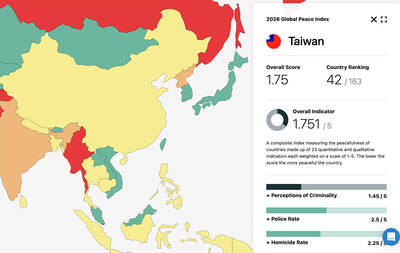
Taiwan ranked 42nd in terms of peacefulness among 163 countries, down five places from last year, according to this year’s Global Peace Index. With an overall score of 1.751, Taiwan dropped from 37th last year, the report published by the global Institute for Economics and Peace showed. The overall score measures a country’s level of peacefulness using 23 quantitative and qualitative indicators across three domains — ongoing domestic and international conflict, societal safety and security, and militarization. While Taiwan ranked 42nd worldwide, it was listed in ninth place among the 19 Asian-Pacific countries in the report, after New Zealand, Singapore, Japan, Malaysia,


 RSS
RSS