


China is facing a labor crisis as graduates are rejecting any kind of blue-collar work, even highly paid technical jobs, the Mainland Affairs Council said in a report that said stagnant social mobility and conspicuous wealth contributed to swelling the ranks of dispossessed young people in the country.
The council last month published an analysis of China’s work environment in a report written by National Chengchi University assistant professor of sociology Chiang Yi-lin (姜以琳).
Greater access to higher education in China has made it difficult to fill blue-collar job vacancies, exacerbating a poor labor outlook already challenged by the COVID-19 pandemic, international affairs and cooling economic growth, the report found.
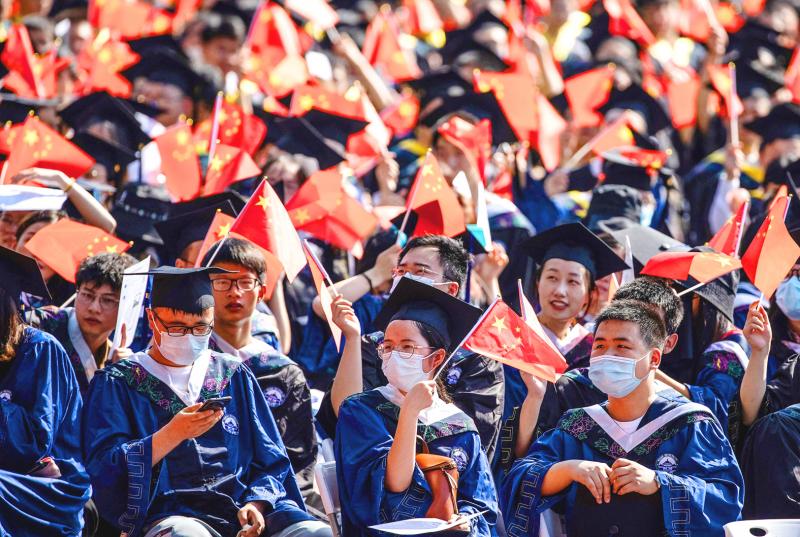
Photo: AFP
Nearly 10.76 million graduates are expected to enter the job market this autumn, setting a record that is expected to continue to rise in the years to come, it said.
Despite these record numbers, unemployment among graduates has not improved over the past decade, while the supply of professional jobs has not grown to meet demand, it said.
“Some people do not have jobs and some jobs do not have people,” the report cited academics as saying, with college graduates shunning certain jobs.
In response, researchers are calling for young people to be re-educated to instill the view that “there is no such thing as a good or bad job,” it said.
The Chinese Ministry of Education intends to solve the issue through improved vocational education, but factory work — even highly paid technical jobs — are still considered blue-collar and therefore unattractive to college graduates, the report said.
Graduates prefer white-collar jobs, not only because they are considered higher class, but also because of their shorter hours, less demanding work and potential for advancement, it said.
In contrast, factory work is often more physically demanding and requires longer hours in worse working environments, making it less attractive, despite offering higher salaries, it said.
Many young people have responded by “lying flat” (tangping, 躺平), a popular online buzzword for living simply with few desires that has raised alarm among authorities, the report said.
Although it originated in China, the “lying flat” culture has also appeared in places where social inequality is prevalent and property is difficult to buy, such as Taiwan and the US, it said.
In Taiwan, as elsewhere in East Asia, many young people are required to work overtime without sufficient compensation, the report said.
Young people worldwide are facing the same problem and responding the same way, whether they are Chinese “lying flat,” Taiwanese finding “small fortunes” or Americans refusing to buy real estate, it added.

Yangmingshan National Park authorities yesterday urged visitors to respect public spaces and obey the law after a couple was caught on a camera livestream having sex at the park’s Qingtiangang (擎天崗) earlier in the day. The Shilin Police Precinct in Taipei said it has identified a suspect and his vehicle registration number, and would summon him for questioning. The case would be handled in accordance with public indecency charges, it added. The couple entered the park at about 11pm on Thursday and began fooling around by 1am yesterday, the police said, adding that the two were unaware of the park’s all-day live

Fast food chain McDonald's is to raise prices by up to NT$5 on some products at its restaurants across Taiwan, starting on Wednesday next week, the company announced today. The prices of all extra value meals and sharing boxes are to increase by NT$5, while breakfast combos and creamy corn soup would go up by NT$3, the company said in a statement. The price of the main items of those meals, if ordered individually, would remain the same. Meanwhile, the price of a medium-sized lemon iced tea and hot cappuccino would rise by NT$3, extra dipping sauces for chicken nuggets would go up

Yangmingshan National Park’s Qingtiangang (擎天崗) nature area has gone viral after a park livestream camera observed a couple in the throes of intimate congress, which was broadcast live on YouTube, drawing large late-night crowds and sparking a backlash over noise, bright lights and disruption to wildlife habitat. The area’s livestream footage appeared to show a couple engaging in sexual activity on a picnic table in the park on Friday last week, with the uncensored footage streamed publicly online. The footage quickly spread across social media, prompting a tide of visitors to travel to the site to “check in” and recreate the

Minister of Digital Affairs Lin Yi-ching (林宜敬) yesterday cited regulatory issues and national security concerns as an expert said that Taiwan is among the few Asian regions without Starlink. Lin made the remarks on Facebook after funP Innovation Group chief executive officer Nathan Chiu (邱繼弘) on Friday said Taiwan and four other countries in Asia — China, North Korea, Afghanistan and Syria — have no access to Starlink. Starlink has become available in 166 countries worldwide, including Ukraine, Malaysia, the Philippines and Vietnam, in the six years since it became commercial, he said. While China and North Korea block Starlink, Syria is not


 RSS
RSS