


The Smart Health Card format would be added to the digital COVID-19 vaccination certificate starting today, the Central Epidemic Command Center (CECC) said yesterday, as it reported 29,849 new local COVID-19 cases and 49 deaths.
Ministry of Health and Welfare Department of Information Management Director Parng I-ming (龐一鳴), who is deputy head of the CECC’s information management division, said the ministry on May 20 joined the Vaccination Credential Initiative, so it can now issue digital COVID-19 vaccination certificates in the new format.
The option of downloading the digital vaccination certificate in Smart Health Card format would be available from 8am today, he said, adding that the format is used in countries such as Australia, Canada, Japan and the US.
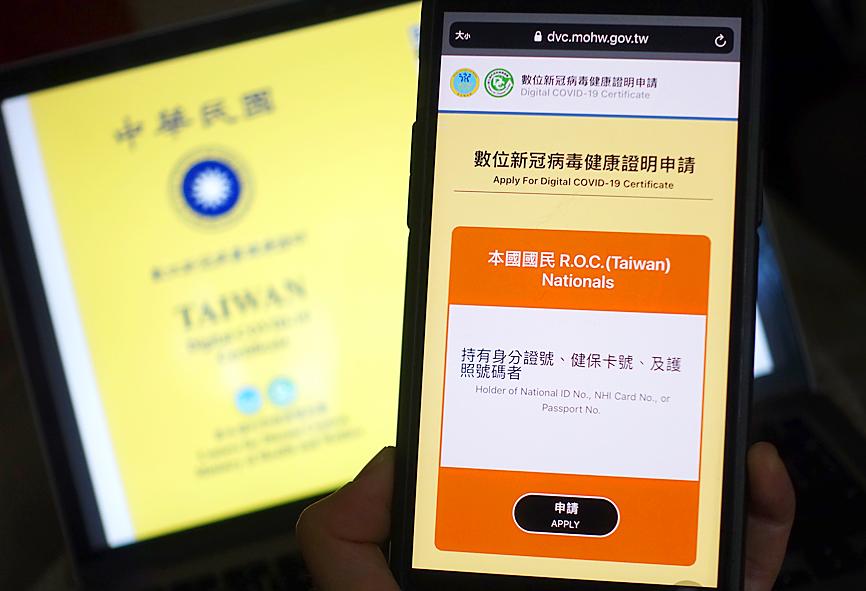
Photo: CNA
The Smart Health Card format shows more information than the previous EU Digital COVID Certificate format, so the verification process would need to be completed over the Internet, but people can apply for the certificate in either of the two formats the same way as they used to by using the digital COVID-19 certificate platform at dvc.mohw.gov.tw, Parng said.
Meanwhile, Centers for Disease Control (CDC) Deputy Director-General Chuang Jen-hsiang (莊人祥), the CECC’s spokesman, said 29,911 new COVID-19 cases were reported, including 62 imported cases.
Chuang said 133 moderate-to-severe cases and 49 deaths were also confirmed, adding that of all local cases reported this year so far, severe and moderate cases accounted for 0.2 percent and 0.25 percent respectively, while asymptomatic and mild cases accounted for 99.55 percent.
At 49, the number of deaths reported yesterday was the lowest daily figure since May 25, he said.
The number of daily deaths peaked at 210 last month, but fell to fewer than 100 by late last month, Chuang said, adding that there is a downward trend, as 60 deaths were reported on Tuesday and 49 yesterday.
The fatality rate of the wave of infections in Taiwan linked to the Omicron variant of SARS-CoV-2 is 17 cases per 10,000 people, while South Korea’s rate is 10, Japan’s is 16, Malaysia’s is 23 and Thailand’s is 39, he said, adding that Singapore’s is the lowest, at five cases per 10,000 people.
CDC Deputy Director-General Philip Lo (羅一鈞), deputy head of the CECC’s medical response division, was asked about a public health expert saying that the CECC could consider shifting its pandemic surveillance mode to an endemic surveillance mode, and that daily local case numbers could drop to below 7,000 by the end of next month.
Lo said that endemic surveillance means only monitoring key high-risk groups, so the reported daily caseload would certainly decline if the testing strategy changes.
As the center still wants to monitor the situation when the Omicron subvariants BA.4 and BA.5 enter local communities to understand how the virus is spreading and its trends, it would not yet change the surveillance mode, he said.
Lo said he thought the expert made the suggestion hoping that COVID-19 regulations would be eased, allowing hospitals to take in more patients who do not have the virus.
The CECC has been reviewing and revising the number of designated COVID-19 hospital beds every week, he added.

LOUD AND PROUD Taiwan might have taken a drubbing against Australia and Japan, but you might not know it from the enthusiasm and numbers of the fans Taiwan might not be expected to win the World Baseball Classic (WBC) but their fans are making their presence felt in Tokyo, with tens of thousands decked out in the team’s blue, blowing horns and singing songs. Taiwanese fans have packed out the Tokyo Dome for all three of their games so far and even threatened to drown out home team supporters when their team played Japan on Friday. They blew trumpets, chanted for their favorite players and had their own cheerleading squad who dance on a stage during the game. The team struggled to match that exuberance on the field, with
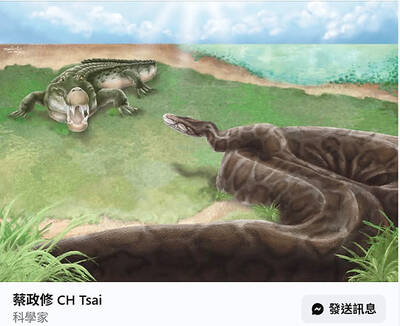
Taiwanese paleontologists have discovered fossil evidence that pythons up to 4m long inhabited Taiwan during the Pleistocene epoch, reporting their findings in the international scientific journal Historical Biology. National Taiwan University (NTU) Institute of Ecology and Evolutionary Biology associate professor Tsai Cheng-hsiu (蔡政修) led the team that discovered the largest snake fossil ever found in Taiwan. The single trunk vertebra was discovered in Tainan at the Chiting Formation, dated to between 400,000 and 800,000 years ago in the Middle Pleistocene, the paper said. The area also produced Taiwan’s first avian fossil, as well as crocodile, mammoth, saber-toothed cat and rhinoceros fossils, it said. Discoveries

Taiwanese paleontologists have discovered fossil evidence that pythons up to 4m long inhabited Taiwan during the Pleistocene epoch, reporting their findings in the international scientific journal Historical Biology. National Taiwan University (NTU) Institute of Ecology and Evolutionary Biology associate professor Tsai Cheng-hsiu (蔡政修) led the team that discovered the largest snake fossil ever found in Taiwan. A single trunk vertebra was discovered in Tainan at the Chiting Formation, dated to between 800,000 to 400,000 years ago in the Middle Pleistocene, the paper said. The area also produced Taiwan’s first avian fossil, as well as crocodile, mammoth, sabre-toothed cat and rhinoceros fossils, it said. Discoveries
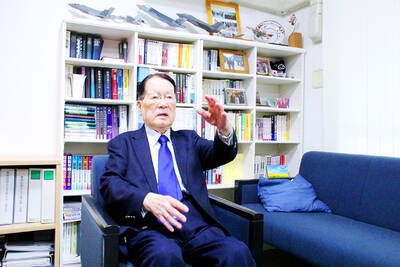
Whether Japan would help defend Taiwan in case of a cross-strait conflict would depend on the US and the extent to which Japan would be allowed to act under the US-Japan Security Treaty, former Japanese minister of defense Satoshi Morimoto said. As China has not given up on the idea of invading Taiwan by force, to what extent Japan could support US military action would hinge on Washington’s intention and its negotiation with Tokyo, Morimoto said in an interview with the Liberty Times (sister paper of the Taipei Times) yesterday. There has to be sufficient mutual recognition of how Japan could provide


 RSS
RSS