


Hong Kong author Ni Kuang (倪匡), who was known throughout the Chinese-speaking world for his Wisely (衛斯理) series of science-fiction adventure novels, died on Sunday at the age of 87.
Hong Kong media reported that Ni — the author of hundreds of novels and story collections, as well as more than 300 film scripts — had been in poor health and made only a few public appearances in the past few years.
Born in Shanghai in 1935, Ni began working at the age of 16 as a public security official in Inner Mongolia under China’s communist government.
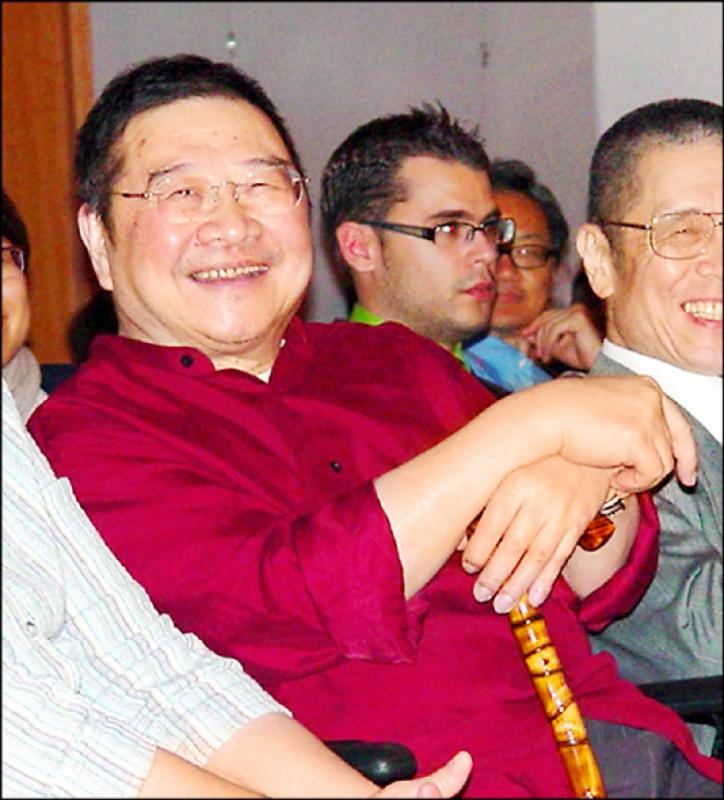
Photo: CNA
At the age of 22, he was caught dismantling a wooden bridge to use as fuel amid a shortage of heating coal, and was sent to a corrective labor camp on an isolated farm.
After learning from a friend that he might be sentenced to death, Ni fled the farm, traveling across much of China before entering Hong Kong via Macau in a journey that provided the material for his first book.
Ni shot to fame in the 1960s with his Wisely novels, which follow a protagonist of the same name as he solves mysteries, many of which involve aliens or other supernatural beings.
He later wrote several other novels, including the popular Dr Yuen (原振俠) series, and a number of wuxia (martial arts, 武俠) novels, which were subsequently adapted for television and cinema.
In the media, Ni was often mentioned together with wuxia writer Jin Yong (金庸), lyricist James Wong (黃霑) and columnist Chua Lam (蔡瀾) as one of Hong Kong’s “four great talents” in the second half of the 20th century.
Due to his early experiences, Ni remained a lifelong opponent of the Chinese Communist Party, which he said “strangely” seemed to be most popular among his wealthiest friends.
Later in life, when a friend tried to convince him to visit China and see how the party had changed, Ni said that while “they may eat mutton with a knife and fork, in their essence, they remain unchanged.”

Yangmingshan National Park authorities yesterday urged visitors to respect public spaces and obey the law after a couple was caught on a camera livestream having sex at the park’s Qingtiangang (擎天崗) earlier in the day. The Shilin Police Precinct in Taipei said it has identified a suspect and his vehicle registration number, and would summon him for questioning. The case would be handled in accordance with public indecency charges, it added. The couple entered the park at about 11pm on Thursday and began fooling around by 1am yesterday, the police said, adding that the two were unaware of the park’s all-day live
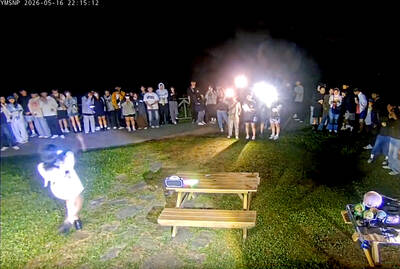
Yangmingshan National Park’s Qingtiangang (擎天崗) nature area has gone viral after a park livestream camera observed a couple in the throes of intimate congress, which was broadcast live on YouTube, drawing large late-night crowds and sparking a backlash over noise, bright lights and disruption to wildlife habitat. The area’s livestream footage appeared to show a couple engaging in sexual activity on a picnic table in the park on Friday last week, with the uncensored footage streamed publicly online. The footage quickly spread across social media, prompting a tide of visitors to travel to the site to “check in” and recreate the

Fast food chain McDonald's is to raise prices by up to NT$5 on some products at its restaurants across Taiwan, starting on Wednesday next week, the company announced today. The prices of all extra value meals and sharing boxes are to increase by NT$5, while breakfast combos and creamy corn soup would go up by NT$3, the company said in a statement. The price of the main items of those meals, if ordered individually, would remain the same. Meanwhile, the price of a medium-sized lemon iced tea and hot cappuccino would rise by NT$3, extra dipping sauces for chicken nuggets would go up

Minister of Digital Affairs Lin Yi-ching (林宜敬) yesterday cited regulatory issues and national security concerns as an expert said that Taiwan is among the few Asian regions without Starlink. Lin made the remarks on Facebook after funP Innovation Group chief executive officer Nathan Chiu (邱繼弘) on Friday said Taiwan and four other countries in Asia — China, North Korea, Afghanistan and Syria — have no access to Starlink. Starlink has become available in 166 countries worldwide, including Ukraine, Malaysia, the Philippines and Vietnam, in the six years since it became commercial, he said. While China and North Korea block Starlink, Syria is not


 RSS
RSS