


A draft law proposed by the National Communications Commission (NCC) last month, which aims to increase the accountability and transparency of large online platforms in Taiwan, is largely based on the EU’s Digital Services Act, a digital policy expert said.
The draft digital services intermediary act, approved by the NCC on Wednesday, would impose varying levels of obligations on five categories of large online platforms.
It would also establish special provisions for platforms that have more than 2.3 million domestic users — such as YouTube, Facebook, Yahoo Auctions and DCard — with fines of up to NT$10 million (US$336,191) for contraventions.
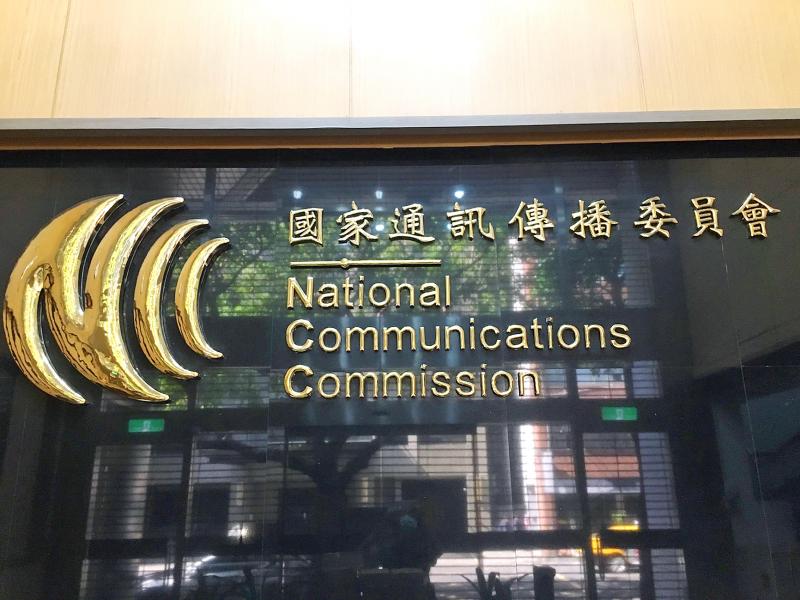
Photo: Yang Mien-chieh, Taipei Times
Chiang Ya-chi (江雅綺), director of the Smart Technology Law and Policy Research Center at National Taipei University of Technology, said on Sunday that the NCC proposal is largely modeled on the Digital Services Act promulgated by the EU earlier this year.
In addition to increasing platforms’ accountability and transparency — through requirements to disclose how algorithms select advertisements and recommendations, for instance — the proposal would also streamline the process for obtaining court orders to remove illegal content, she said.
However, Chiang cautioned that enforcing the proposal’s content regulation provisions could prove challenging due to the extreme difficulty of judging content in the “gray zone” between personal opinion and disinformation.
Katherine Chen (陳憶寧), a former NCC commissioner who now sits on Meta’s oversight board, said she considered the plan “a big step forward” for Internet regulation in Taiwan, and one that would likely encourage platforms to set up mechanisms to self-regulate.
Still, Chen questioned whether the NCC would be able to evaluate the veracity of transparency reports the proposal would require companies to submit.
There are also doubts over the NCC’s ability to regulate TikTok, which is popular among young Taiwanese amid political concerns over its Chinese ownership, Chen added.
The NCC said it could coordinate with the Mainland Affairs Council and other government agencies regarding oversight of Chinese-linked platforms such as TikTok or Xiaohongshu (also known as “Little Red Book”).
The NCC’s proposal is the latest of several instances — including its 2020 closure of the China-friendly CTi News television channel — in which the commission has engaged with contentious issues.
Taiwan People’s Party Legislator Tsai Pi-ru (蔡壁如) asked if the draft law was intended to “crack down on fake news or on dissent,” and who would oversee it.
Tsai said she was skeptical of the plan to set up an “independent foundation” to handle claims of disinformation, which she described as “giving public power to [an entity] outside the political system.”
The draft act is to be the subject of three explanatory meetings and one public hearing over the next two months before being sent to the Legislative Yuan for review.

UPGRADE: The Kang Ding-class frigate is replacing its Chaparall missiles with Tien Chien II and Hua Yang VLS, which would provide it with long-range, 360° air defense Taiwan plans to produce 1,200 to 1,376 Hai Chien II missiles (海劍二, Sea Sword II) — also known as TC-2N — to serve as the standard air defense system of the navy’s surface combatant fleet, a source said yesterday. Last week, the Hai Chien II, the naval version of the Tien Kung II missile (天劍二, Sky Sword II), completed a live-fire test in waters off the National Chungshan Institute of Science and Technology’s Jiupeng facility (九鵬) in Pingtung County’s Manjhou Township (滿州). The MIM72 Chaparral and other dated air defense missiles that currently arm Taiwanese ships have inadequate range to combat Chinese

REASONS FOR TRAVEL: An assistant professor said that proposed amendments to penalize drivers if they used drugs overseas would not deter people from traveling People who operate a motor vehicle under the influence of marijuana would have their driver’s license revoked, even if they used the substance while overseas, the Ministry of Transportation and Communications said yesterday, citing proposed amendments to the Road Traffic Management and Penalty Act (道路交通管理處罰條例). The amendments would also authorize the government to revoke the licenses of people determined to have used Category 1 or Category 2 narcotics, even if they were not operating a vehicle while under the influence of drugs, as well as ban them from taking the license test for three years, the ministry said. People aged 18 or

HEAVY WEATHER: Typhoon Jangmi is due to crash straight into the Ryukyus as airlines look to shift flights to larger aircraft or cancel flights to Okinawa entirely Taiwan’s international air carriers announced flight adjustments over the weekend as Typhoon Jangmi is forecast to hit the Ryukyu Islands today and tomorrow. The Central Weather Administration (CWA) upgraded Jangmi from a tropical storm to a typhoon at 8am yesterday, with the eye located 580km south of Naha city. It was moving north at 19kph. Today, China Airlines’ CI-120, CI-121, CI-122 and CI-123 flights between Taoyuan and Naha, Okinawa, have been canceled as well as CI-132 and CI-133 between Kaohsiung and Naha. EVA Air’s BR-112, BR-113, BR-186 and BR-185 flights between Taoyuan and Naha are also canceled. Low-cost carrier Tigerair Taiwan canceled IT-230,
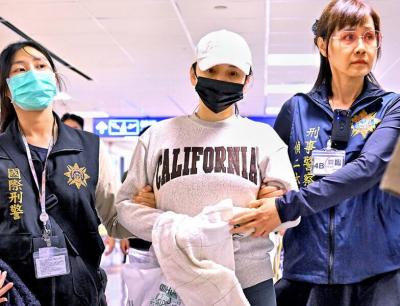
Johanne Liou (劉喬安), a Taiwanese woman who shot to unwanted fame during the Sunflower movement protests in 2014, returned to Taiwan last night after being deported from the US. She is to stand trial in Taiwan for charges involving embezzlement, fraud and drug crimes. The Criminal Investigation Bureau (CIB) said it took her into custody at Taiwan Taoyuan International Airport and would first question her before transferring her to the New Taipei District Prosecutors’ Office. She was arrested upon disembarking a flight from San Francisco that landed shortly before 7pm. Liou absconded to the US in 2019 after jumping bail


 RSS
RSS