


Taiwan East Turkestan Association president Ho Chao-tung (何朝棟) yesterday slammed former Chinese Nationalist Party (KMT) chairwoman Hung Hsiu-chu (洪秀柱), after she again denied that genocide was occurring in Xinjiang.
Writing on Facebook, Hung said that she accepted an interview with radio host Tang Hsiang-lung (唐湘龍) on Friday last week to prove that the idea of Uighur genocide is based on “three great lies of the US and West.”
Hung repeated China’s narrative about Xinjiang, saying that the demographic growth of ethnic minorities in the territory over the past few decades proved that there has been no attempt to wipe out the ethnic group.
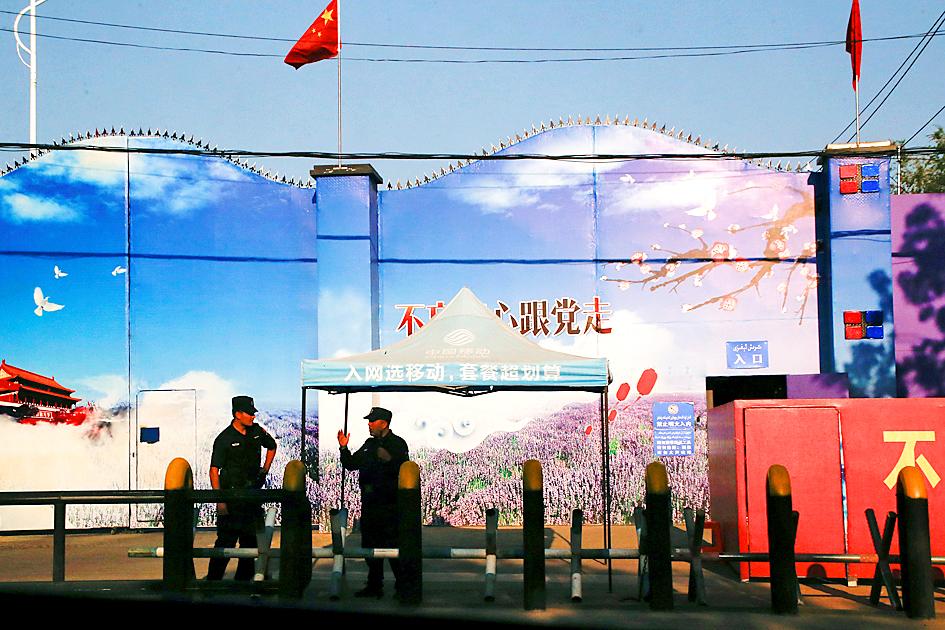
Photo: Reuters
“If there is cultural genocide, why are the road signs in Xinjiang written in Chinese and the languages of minorities?” she said. “Why do the employees in the two cotton factories I visited tell me that their wages are enough to feed their families?”
Her remarks came a month after a trove of data known as the “Xinjiang Police Files” detailing the incarceration of more than 2,800 people and widespread human rights abuses were leaked to news outlets.
Ho said that the international community has accepted the findings of the Uyghur Tribunal held in London last year and that the genocide of Uighurs and other minorities in Xinjiang is indisputable.
US Secretary of State Antony Blinken and his predecessor Mike Pompeo, as well as numerous lawmakers from the US and Europe have said that the China’s treatment of Uighurs is genocide, he said.
Hung’s credibility is suspect, given that her remarks closely follow the Chinese Communist Party’s official line on Xinjiang, he said.
Ho also criticized an invitation by China’s Taiwan Affairs Office for Taiwanese journalists to visit Xinjiang next month, saying that any tour of the territory arranged by Chinese officials would be staged to disguise the real conditions there.
Journalists that accepted the invitation would not find anything that Beijing had already concealed from UN High Commissioner for Human Rights Michelle Bachelet during her visit to the region last month, he said.
“As China offered to pay the journalists’ expenses, we can be certain that the truth will not be reported,” he said.
Taiwan Affairs Office spokesman Ma Xiaoguang (馬曉光) on Wednesday said that the office has planned a “joint cross-strait journalism event” for the Taiwanese press to tour Xinjiang.
The event was arranged by the office’s news bureau and the All-China Journalists Association, following “strong demand from Taiwanese journalists stationed in China,” he said.
The delegation of Taiwanese journalists would be allowed to tour Urumqi, Ili, Kashgar and other locations in the territory from Sunday to July 11, he said.

Considering that most countries issue more than five denominations of banknotes, the central bank has decided to redesign all five denominations, the bank said as it prepares for the first major overhaul of the banknotes in more than 24 years. Central bank Governor Yang Chin-lung (楊金龍) is expected to report to the Legislative Yuan today on the bank’s operations and the redesign’s progress. The bank in a report sent to the legislature ahead of today’s meeting said it had commissioned a survey on the public’s preferences. Survey results showed that NT$100 and NT$1,000 banknotes are the most commonly used, while NT$200 and NT$2,000

The Centers for Disease Control (CDC) yesterday reported the first case of a new COVID-19 subvariant — BA.3.2 — in a 10-year-old Singaporean girl who had a fever upon arrival in Taiwan and tested positive for the disease. The girl left Taiwan on March 20 and the case did not have a direct impact on the local community, it said. The WHO added the BA.3.2 strain to its list of Variants Under Monitoring in December last year, but this was the first imported case of the COVID-19 variant in Taiwan, CDC Deputy Director-General Lin Ming-cheng (林明誠) said. The girl arrived in Taiwan on

South Korea is planning to revise its controversial electronic arrival card, a step Taiwanese officials said prompted them to hold off on planned retaliatory measures, a South Korean media report said yesterday. A Yonhap News Agency report said that the South Korean Ministry of Foreign Affairs is planning to remove the “previous departure place” and “next destination” fields from its e-arrival card system. The plan, reached after interagency consultations, is under review and aims to simplify entry procedures and align the electronic form with the paper version, a South Korean ministry official said. The fields — which appeared only on the electronic form

The Ministry of Foreign Affairs (MOFA) is suspending retaliation measures against South Korea that were set to take effect tomorrow, after Seoul said it is updating its e-arrival system, MOFA said today. The measures were to be a new round of retaliation after Taiwan on March 1 changed South Korea's designation on government-issued alien resident certificates held by South Korean nationals to "South Korea” from the "Republic of Korea," the country’s official name. The move came after months of protests to Seoul over its listing of Taiwan as "China (Taiwan)" in dropdown menus on its new online immigration entry system. MOFA last week


 RSS
RSS