


The government should raise the electricity rate for industrial users while freezing the charge for household consumers, the New Power Party (NPP) caucus said yesterday.
“We believe the government’s priority should be to adjust the electricity price for industrial users in a more reasonable manner, but it should freeze the electricity charge for household consumers frozen,” NPP Chairwoman Chen Jiau-hua (陳椒華) said ahead of a meeting of the electricity price review committee.
Industrial users accounted for 57 percent of Taiwan’s electricity consumption last year, while households consumed less than 19 percent, Chen said, citing a report by the Bureau of Energy.
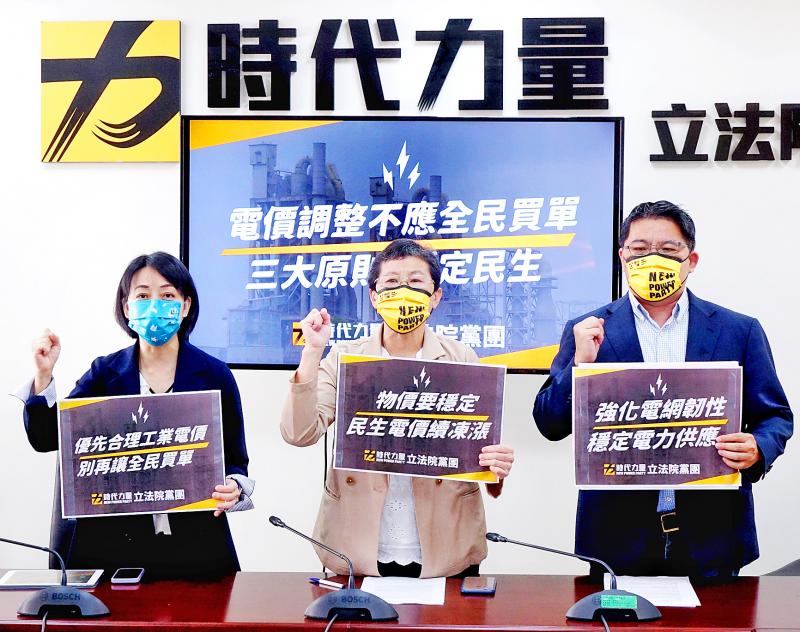
Photo: Chu Pei-hsiung, Taipei Times
“With a reasonable adjustment of electricity prices for industrial users, the government can stop subsidizing them to more accurately reflect their electricity consumption. It would also reduce the financial losses sustained by Taiwan Power Co, and spur industries to invest in technologies to conserve and manage energy,” she said.
Data from the Directorate-General of Budget, Accounting and Statistics showed that the consumer price index rose 3.39 percent last month, the largest spike in nearly 10 years, Chen said.
Although adjusting electricity prices is necessary, household consumers should not be asked to pay higher fees at the moment, as it could lead to a comprehensive increase in the prices of consumer products, she said.
NPP Legislator Claire Wang (王婉諭) said the government in 2020 charged industrial consumers NT$2.4461 per kilowatt-hour, the world’s sixth-lowest rate.
Leading business groups in Taiwan, such as Formosa Plastics Group and Far Eastern Group, have indicated that a reasonable adjustment of electricity rates would be inevitable, she said.
Taiwan would be unable to keep its global competitive edge by relying on low water and electricity fees for industrial users as international energy prices continue to rise, Wang said.
The government should help businesses mitigate the effects of an electricity price hike, and ensure that they have reliable and quality access to a more efficient power system, she said.
“The difference between the industrial electricity rate and the price of green power would be minimized with a more reasonable electricity pricing scheme, which would give businesses a greater incentive to procure green power. This would also allow renewable energy to further develop in Taiwan,” Wang said.
Taiwan’s electricity rates are cheaper than those in other countries, which often leads to record-high demand for electricity and potential energy waste, Wang said.
This would not help the nation achieve net-zero carbon emissions, she added.
Setting a more reasonable electricity price would curb energy waste and give people greater motivation to save money, she said.
NPP caucus whip Chiu Hsien-chih (邱顯智) said the government has yet to present effective long-term solutions to enhance the resilience of Taiwan’s power grid.
“After Taiwan experienced a major power outage on March 3, the government pledged to present by the end of April a NT$100 billion [US$3.4 billion] plan to upgrade the nation’s power grid,” he said. “Deputy Minister of Economic Affairs Tseng Wen-sheng [曾文生] later said the ministry would present a plan at the end of May, but we have yet to see it.”
An unstable electricity supply would not only disrupt people’s lives, but would also shake foreign investors’ confidence in Taiwan, as evidenced by American Chamber of Commerce Taiwan vice chairwoman Andrea Wu’s (吳王小珍) remarks last week, Chiu said.
“In addition to a more effective energy conservation policy, the government should amend the Energy Administration Act [能源管理法] to recognize businesses that achieve their energy conservation goals, and fine and assist those that failed to do so,” he said.

The military has spotted two Chinese warships operating in waters near Penghu County in the Taiwan Strait and sent its own naval and air forces to monitor the vessels, the Ministry of National Defense (MND) said. Beijing sends warships and warplanes into the waters and skies around Taiwan on an almost daily basis, drawing condemnation from Taipei. While the ministry offers daily updates on the locations of Chinese military aircraft, it only rarely gives details of where Chinese warships are operating, generally only when it detects aircraft carriers, as happened last week. A Chinese destroyer and a frigate entered waters to the southwest
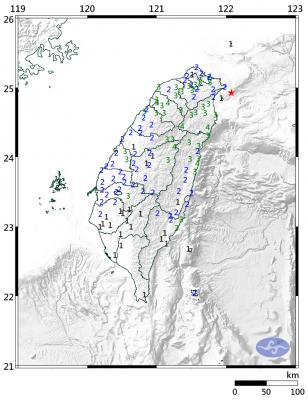
A magnitude 6.1 earthquake struck off the coast of Yilan County at 8:39pm tonight, the Central Weather Administration (CWA) said, with no immediate reports of damage or injuries. The epicenter was 38.7km east-northeast of Yilan County Hall at a focal depth of 98.3km, the CWA’s Seismological Center said. The quake’s maximum intensity, which gauges the actual physical effect of a seismic event, was a level 4 on Taiwan’s 7-tier intensity scale, the center said. That intensity level was recorded in Yilan County’s Nanao Township (南澳), Hsinchu County’s Guansi Township (關西), Nantou County’s Hehuanshan (合歡山) and Hualien County’s Yanliao (鹽寮). An intensity of 3 was

Japanese Prime Minister Sanae Takaichi’s comment last year on Tokyo’s potential reaction to a Taiwan-China conflict has forced Beijing to rewrite its invasion plans, a retired Japanese general said. Takaichi told the Diet on Nov. 7 last year that a Chinese naval blockade or military attack on Taiwan could constitute a “survival-threatening situation” for Japan, potentially allowing Tokyo to exercise its right to collective self-defense. Former Japan Ground Self-Defense Force general Kiyofumi Ogawa said in a recent speech that the remark has been interpreted as meaning Japan could intervene in the early stages of a Taiwan Strait conflict, undermining China’s previous assumptions
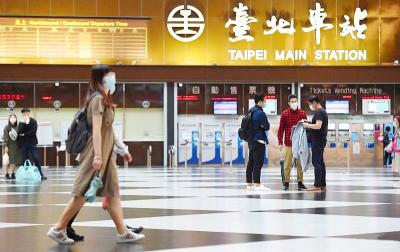
Taiwan Railways Corp (TRC) today announced that Shin Kong Mitsukoshi has been selected as the preferred bidder to operate the Taipei Railway Station shopping mall, replacing the current operator, Breeze Development Co Ltd. Among eight qualified firms that delivered presentations and were evaluated by a review committee, Shin Kong Mitsukoshi was ranked first, while Breeze was named the runner-up, the rail company said in a statement. Contract negotiations are to proceed in accordance with regulations, it said, adding that if negotiations with the top bidder fail, it could invite the second-ranked applicant to enter talks. Breeze in a statement today expressed doubts over


 RSS
RSS