


Minister of Foreign Affairs Joseph Wu (吳釗燮) on Monday pledged to donate US$500,000 to rebuild the Ukrainian town of Bucha after it was devastated by Russian troops.
Wu made the pledge during a video call with Bucha Mayor Anatoliy Fedoruk. He expressed concern for Ukrainians and said Taiwanese support Ukraine in its defense against an invasion launched by an authoritarian regime, the Ministry of Foreign Affairs said in a statement.
Wu made similar calls with the primate of the Orthodox Church of Ukraine on June 10, the mayor of Kharkiv on May 31 and the mayor of Kyiv on April 22, pledging to donate US$13.2 million in total to help Ukraine rebuild.
Wu on Monday wrote on Twitter that he had an “emotional call” with the mayor of Bucha, where “some of the worst war crimes committed by Russia against the innocent” happened, referring to the reported massacre of hundreds of civilians by invading Russian forces.
“Taiwan will continue to stand with Ukraine in its fight for sovereignty, freedom & democracy,” Wu wrote.
More than 400 bodies have been found since April 12, following the withdrawal of Russian forces from the town after a month of occupation, Fedoruk has said.
Wu on Monday reiterated that Taiwan condemns in the strongest terms the “merciless massacre of civilians,” while joining calls from the international community for an immediate investigation into the matter.
The government has shipped 582 tonnes of humanitarian aid donated by Taiwanese to Ukrainians displaced by Russia’s attack and donated more than US$40 million to help Ukrainian refugees, medical institutions and churches affected by the invasion, Wu said.
Wu told Fedoruk that Taiwan has long faced Chinese military coercion and understood “perfectly” how Ukraine felt.
Fedoruk expressed gratitude for the government’s support and assistance.
He said Ukrainians would never forgive the “brutal and barbarous” acts conducted by Russia within Ukraine and in Bucha.
Fedoruk said that Ukraine’s government and its people would always remember the staunch support of Taiwan and would make good use of every penny of the money donated by the nation.

FUKUOKA SITUATION: Japanese media reported that the pathogen is expected to be identified by the summer, while the CDC downplayed the idea that it was hMPV A “mysterious cold-like illness” reported in Japan’s Fukuoka Prefecture does not seem to be a new disease, but Japanese authorities have been asked about the situation, the Centers for Disease Control (CDC) said yesterday. The Fukuoka Prefectural Medical Association on Wednesday told a news conference that a “mystery cold” that has become a hot topic on social media is “highly likely to be caused by some kind of viral infection,” Japan’s KBC News reported. “Many people are experiencing symptoms starting with a sore throat, followed by a runny nose, phlegm and a severe cough,” KBC News reported, citing association officials. Health authorities are

Nvidia Corp CEO Jensen Huang (黃仁勳) arrived in Taiwan yesterday ahead of upcoming AI and technology events, saying he plans to meet with clients and Taiwan Semiconductor Manufacturing Co Chairman C.C. Wei (魏哲家) during his visit. After landing at Taipei Songshan Airport, Huang posed for photos with fans and handed out Yakult drinks to reporters and supporters waiting at the scene, saying he has “a lot to do” during the trip. Asked about reports that Nvidia’s planned headquarters site in Taipei’s Beitou Shilin Technology Park could break ground on May 27, Huang said that if the company holds an event, he would

The Ministry of Finance this afternoon announced the winning numbers for the March-April uniform invoice lottery. The winning number for the NT$10 million (US$318,060) special prize is 19531471, and the winning number for the NT$2 million grand prize is 85941329. Three numbers were drawn for the NT$200,000 first prize: 07225810, 20231230 and 83518781. Those with receipts matching the last seven digits of any of the first-prize numbers will win the NT$40,000 second prize, while those matching the last six digits will win the NT$10,000 third prize. Those whose receipts match the last five digits of the first-prize numbers can claim the NT$4,000 fourth prize,
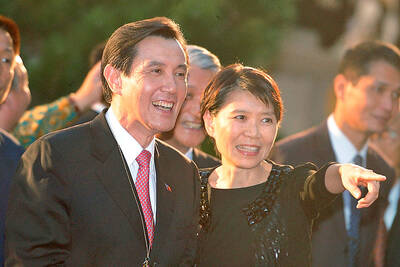
Former president Ma Ying-jeou (馬英九) yesterday expressed “shock and regret” over a statement issued by his wife without his consent, and rejected her assertion that his eldest sister, Ma Yi-nan (馬以南), would manage his medical care or act as his spokesperson amid an ongoing embezzlement probe into his foundation. Ma Ying-jeou in a statement said he was shocked by a statement by his wife, Chou Mei-ching (周美青), regarding his affairs. Ma Yi-nan “must not” be in charge of his healthcare and other personal affairs, nor can she be allowed to represent the Ma family, the former president said. He said he was also


 RSS
RSS