


Tainan’s Lee Yi-nan (李一男) on Friday kept a centuries-old family tradition alive by drawing the special “iron quench water” from an ancient well at noon on Friday. The day was Taiwan’s traditional Fifth Month Festival Day (五月節) on the lunar calendar.
Proprietor of the Chuan Li Blacksmith Shop (泉利打鐵鋪), Lee headed to his neighbor’s ancient well, which reportedly has a 200-year history dating to the Ming Dynasty, and is the only remaining “octagon well” in Tainan’s Yanshui District (鹽水), with eight-sided brickwork lining its inner wall.
Lee, 81, is a fifth-generation master blacksmith who has passed the family tradition to his son, who continues the business as its proprietor.
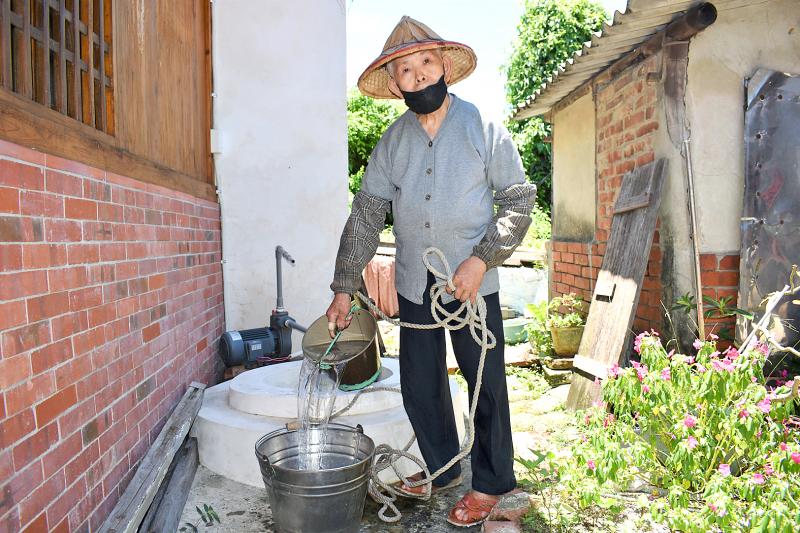
Photo: Yang Chin-cheng, Taipei Times
“We change the quench water needed to forge metals, shape steel and iron bars, and sharpen swords and knives. It is a tradition to take water from this well on this particular day, passed down from my grandfather, and probably much earlier,” Lee said.
“Our family cannot give up this tradition. We must keep the blacksmith shop and its traditions going,” Lee said. “I will pass the craft to my son for him to take over.”
Lee said that he began metalwork at age 14, learning from his father while helping in the family’s shop.
This weekend is known as the Duanwu Festival (端午節), or the Dragon Boat Festival, with traditions carried over from China.
In Taiwan, the festival begins with Fifth Month Day, which is celebrated as that start of summer — the fifth day of fifth month on the lunar calendar.
Marking the transition from spring to summer has been important in Taiwan’s agricultural society, and features the drawing of “pure yang water” from old wells at noon on this day. In traditional folklore, well water possess the highest level of positive energy at this particular time and date.
Lee stocks the metalwork shop with a year’s supply of water from the well on this day, as his ancestors did.
The water is believed to imbue the forged tools with enhanced strength and durability, Lee said.
“The water from this well is always clean, containing no impurities,” he said. “It never goes bad.”
Lee remains active in the business despite having handed the daily operations to his son, Lee Hsin-hsien (李信賢). The two continue to retain the good reputation of the traditional blacksmith shop, serving long-term local customers while receiving overseas orders for its handcrafted tools.
The shop has become a historic landmark in Tainan, located on Qiaonan Old Street, known as the first old town street of southern Taiwan, and among the earliest settlements in Tainan’s north region.
Many of the area’s landmarks and attractions are more than a century old, including the nearby Yuejin Harbor (月津港). Lee Yi-nan’s classical blacksmith shop — with its original wooden construction, furnace, wind bellow and brickwork floor — add to the area’s charm.

Considering that most countries issue more than five denominations of banknotes, the central bank has decided to redesign all five denominations, the bank said as it prepares for the first major overhaul of the banknotes in more than 24 years. Central bank Governor Yang Chin-lung (楊金龍) is expected to report to the Legislative Yuan today on the bank’s operations and the redesign’s progress. The bank in a report sent to the legislature ahead of today’s meeting said it had commissioned a survey on the public’s preferences. Survey results showed that NT$100 and NT$1,000 banknotes are the most commonly used, while NT$200 and NT$2,000

The Centers for Disease Control (CDC) yesterday reported the first case of a new COVID-19 subvariant — BA.3.2 — in a 10-year-old Singaporean girl who had a fever upon arrival in Taiwan and tested positive for the disease. The girl left Taiwan on March 20 and the case did not have a direct impact on the local community, it said. The WHO added the BA.3.2 strain to its list of Variants Under Monitoring in December last year, but this was the first imported case of the COVID-19 variant in Taiwan, CDC Deputy Director-General Lin Ming-cheng (林明誠) said. The girl arrived in Taiwan on

South Korea is planning to revise its controversial electronic arrival card, a step Taiwanese officials said prompted them to hold off on planned retaliatory measures, a South Korean media report said yesterday. A Yonhap News Agency report said that the South Korean Ministry of Foreign Affairs is planning to remove the “previous departure place” and “next destination” fields from its e-arrival card system. The plan, reached after interagency consultations, is under review and aims to simplify entry procedures and align the electronic form with the paper version, a South Korean ministry official said. The fields — which appeared only on the electronic form

The Ministry of Foreign Affairs (MOFA) is suspending retaliation measures against South Korea that were set to take effect tomorrow, after Seoul said it is updating its e-arrival system, MOFA said today. The measures were to be a new round of retaliation after Taiwan on March 1 changed South Korea's designation on government-issued alien resident certificates held by South Korean nationals to "South Korea” from the "Republic of Korea," the country’s official name. The move came after months of protests to Seoul over its listing of Taiwan as "China (Taiwan)" in dropdown menus on its new online immigration entry system. MOFA last week


 RSS
RSS