


Organizers were celebrating record attendance at the Baishatun Matsu procession, which completed a week-long journey when it returned to Gongtian Temple (拱天宮) in Miaoli County’s Tongsiao Township (通霄鎮) on Friday.
Despite restrictions during a COVID-19 outbreak, with organizers permitting registration only for people who provided evidence of having had three COVID-19 vaccine shots, 98,000 people signed up, said Hong Wen-hua (洪文華), a member of the temple’s management committee.
People who registered paid a fee and received armbands, hats, decals and other items, Hong said, adding 80,000 people registered last year.
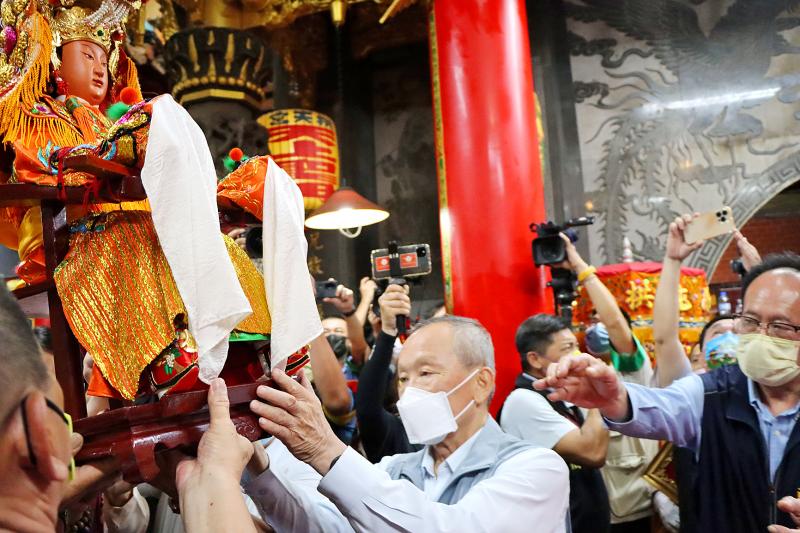
Photo: CNA
Health officials had expressed concern about such large group activities.
Miaoli County Commissioner Hsu Yao-chang (徐耀昌) attended the arrival on Friday morning, and later wrote on Facebook that he had subequently tested positive for the virus and would be isolating at home in accordance with central government guidelines.
The procession — which has no set route from year to year — started in the early morning hours of May 20 from Gongtian Temple and made its way through coastal townships to Chaotian Temple (朝天宮) in Yunlin County’s Beigang Township (北港).
As is tradition, the main palanquin carrying a statue of Matsu — a sea goddess who blesses fishers’ voyages — was carried on foot the entire way while attendants conducted ceremonial activities.
The procession on Sunday last week arrived at Chiaotian Temple, where rituals and celebratory events were held during its overnight stay, with the return journey beginning the next day.
The approximately 400km pilgrimage — Taiwan’s longest — travels through four of Taiwan’s central areas: Miaoli, Taichung, Changhua and Yunlin.
This year it lasted eight days, although it has taken as many as 12 days and as few as six.
The procession of the Dajia Matsu of Jenn Lann Temple (大甲鎮瀾宮) in Taichung has a fixed route of more than 300km. It took place last month, lasting nine days.
An exact count of the number of people involved in the Baishatun Matsu procession was not available, as some who registered participate for only a few days, while others who do not register join at the rear, Hong said.
There was great interest from across Taiwan this year, he said.
People who attend other Matsu temples registered, mainly older people, filling 63 tour buses that followed the route, he said.
Moreover, there were registrations for 6,500 vehicles, which formed a cavalcade behind the palaquin.
Due to the COVID-19 situation, some of the traditions were prohibited, including approaching the palaquin, Hong said.
A common ritual people perform is kneeling on the path of the procession to allow the palanquin to pass overhead, but people were instructed to maintain a safe distance, so that activity was not permitted, he said.
Staff dispensed alcohol spray at regular intervals and there were medical teams along the route to attend to injuries and emergencies, he said.
Many people take part not for religious reasons, but to experience an important part of Taiwanese culture.
The evolution of the procession over nearly 200 years is of interest to people who want to learn about Matsu worship at villages and towns along the coast, participants told reporters.
News reports showed people with children who said that they were carrying sleeping gear, as they would walk the entire route, camping along the road and near temples at night.
Some even did without the tents, simply carrying cardboard or foam pads to lie on in the open, reports said.
A woman told reporters that the Baishatun Matsu pilgrimage is the most unique of all Taiwan’s religious events because of its variable nature.
The procession takes different roads to Yunlin each year, with the return path not matching the route on the way south, she said, adding that there are many unscheduled stops.
“It’s unpredictable and challenging for most people who want to take in the entire journey,” she said.

The US plans to deploy thousands of drones in the Taiwan Strait in an operation called “Hellscape” to ensure that any attempt by China to invade Taiwan does not succeed, US Indo-Pacific Commander Admiral Samuel Paparo told the Washington Post. In an article published on Monday, columnist Josh Rogin quoted Paparo as saying from the sidelines of the recent Shangri-La Dialogue defense forum in Singapore that the “Hellscape” strategy would involve deploying thousands of uncrewed submarines, surface vessels and aerial vehicles around Taiwan to buy the nation, Washington and its partners time to assemble a response. The plan was devised to deter

CHINESE THREAT: Twenty-two military aircraft and vessels were detected around Taiwan over 24 hours, including a drone that flew as close as 80km to Oluanpi China’s Taiwan Affairs Office (TAO) yesterday said that the Chinese man who drove a motorboat into a strategic river mouth in Taiwan on Sunday was acting on his own and would be punished upon his return to China. However, the National Security Bureau said it would not exclude any possibilities regarding the man’s motivations, including the Chinese government’s involvement. The man has been identified as a 60-year-old former Chinese navy captain surnamed Ruan (阮). Coast guard personnel on Sunday arrested Ruan in New Taipei City’s Tamsui District (淡水) after his boat entered Tamsui River (淡水河). The boat was detected off the coast of

SHIN KONG SHENANIGANS: Eugene Wu is the father of Cynthia Wu, who was the TPP’s vice presidential candidate alongside Chairman Ko-Wen-je in January’s election Former Shin Kong Life Insurance Co chairman Eugene Wu (吳東進) and several other company executives are being investigated for alleged embezzlement and fraud resulting in corporate financial losses of about NT$150 million (US$4.63 million), New Taipei City prosecutors said yesterday. After being summoned to the New Taipei District Prosecutors’ Office for questioning, Wu was listed as among 17 suspects facing charges of aggravated breach of trust, embezzlement and breaches of the Insurance Act (保險法). Wu was released on bail of NT$100 million yesterday. The case has received much attention with Eugene Wu being the eldest son of Wu Ho-su (吳火獅), who founded Shin

REPORT: In a number of cases, Taiwanese have been detained or interrogated, the MAC said, while warning that Chinese authorities can from next month confiscate cellphones Taiwanese who are traveling to China for religious, business or other non-political purposes can all be interrogated by Chinese national security officers due to new national security laws, the Mainland Affairs Council (MAC) said in a recent report. Starting next month, Taiwanese could also be asked to hand over their mobile phones and electronic devices for national security inspections when visiting China, the council said. Beijing has introduced a series of laws that were designed to impose heavier sanctions on people who are considered enemies of the state. An amendment to China’s Anti-Espionage Law, which took effect in July last year, expanded


 RSS
RSS