


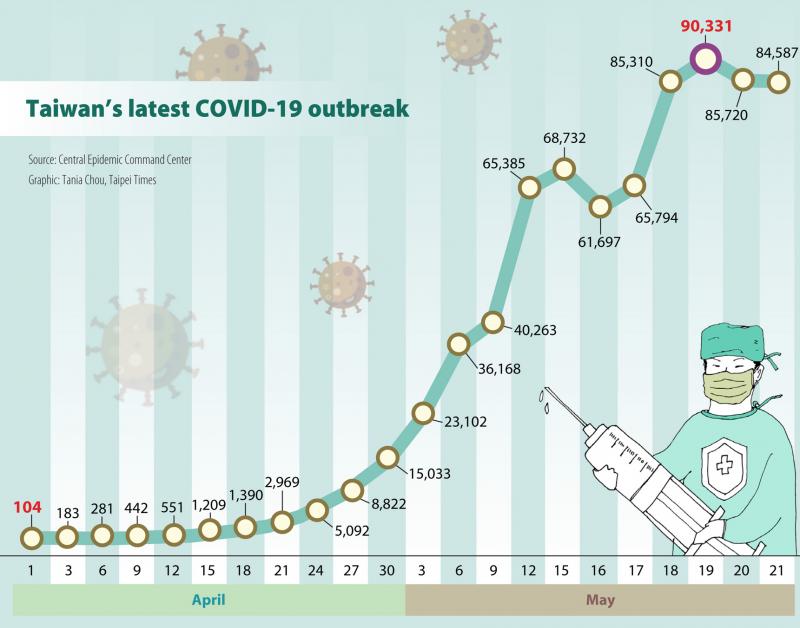
People with COVID-19 who are under home care and in need of urgent medical treatment can be accompanied by another COVID-19 case to the hospital, the Central Epidemic Command Center (CECC) said yesterday, as it reported 84,587 new local cases and 59 deaths.
Most of the asymptomatic or mild COVID-19 cases reported since late last month were put under home care — recovering at home in isolation — and have been allowed to seek emergency medical treatment.
Given that other members of one household often become infected with COVID-19 when one member tests positive, the center was being asked whether an infected member could accompany a housemate to the hospital, Minister of Health and Welfare Chen Shih-chung (陳時中), who heads the center, said yesterday.
Confirmed cases who are under home care are advised to seek medical attention through telemedicine, but if they cannot book an appointment or need emergency treatment at a hospital, they can contact a local health department in advance and go to the hospital using private transport or a disease prevention vehicle.
An infected housemate is allowed to accompany a person in need of treatment to the hospital, he said, adding that they should wear a mask throughout the trip, inform the check-in counter of their positive status and avoid conversing in the hospital.
Meanwhile, Centers for Disease Control (CDC) Director-General Chou Jih-haw (周志浩), head of the CECC’s disease surveillance division, said 84,587 new local cases and 52 imported cases were reported yesterday, and 59 deaths were confirmed.
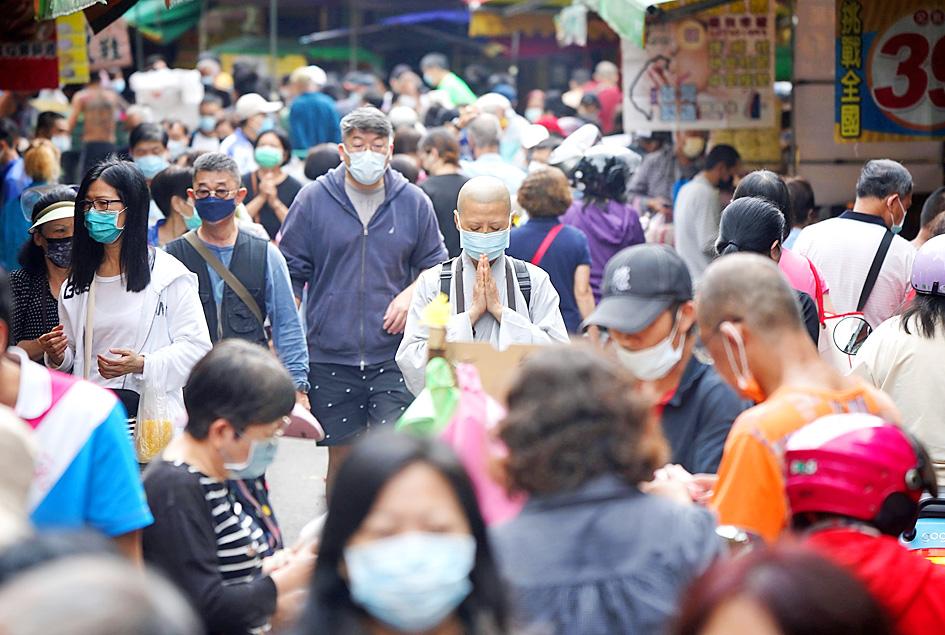
Photo: CNA
CDC Deputy Director-General Philip Lo (羅一鈞), deputy chief of the CECC’s medical response division, said 153 new moderate cases and 70 new severe cases were reported yesterday, and 12 previously moderate cases developed into severe cases.
Of the 59 deaths, 56 people had underlying health conditions, 29 were unvaccinated and 43 had not received a booster shot, he said, adding that 34 people were aged 80 or older.
There are three cases of concern among the severe cases, including a woman in her 20s who has cancer and received two doses of a vaccine; she had pneumonia and difficulty breathing for five days after infection, but has been discharged from hospital after recovering, Lo said.
Another case is a five-year-old boy who has chronic muscular disease, and was taken to an emergency room after suffering leg pain and syncope. He was found to have pneumonia, a low blood oxygen level and cerebral edema. He was intubated and transferred to a pediatric unit at another hospital.
The third case is a nine-month-old infant who does not have underlying health issues, but had a fever, severe cough and loss of vitality. He later experienced a high fever and difficulty breathing, and was taken to an emergency room, where he was put on a ventilator.
The infant has been removed from the ventilator, but remained in an intensive care unit, Lo said.

Fast food chain McDonald's is to raise prices by up to NT$5 on some products at its restaurants across Taiwan, starting on Wednesday next week, the company announced today. The prices of all extra value meals and sharing boxes are to increase by NT$5, while breakfast combos and creamy corn soup would go up by NT$3, the company said in a statement. The price of the main items of those meals, if ordered individually, would remain the same. Meanwhile, the price of a medium-sized lemon iced tea and hot cappuccino would rise by NT$3, extra dipping sauces for chicken nuggets would go up

Nvidia Corp CEO Jensen Huang (黃仁勳) arrived in Taiwan yesterday ahead of upcoming AI and technology events, saying he plans to meet with clients and Taiwan Semiconductor Manufacturing Co Chairman C.C. Wei (魏哲家) during his visit. After landing at Taipei Songshan Airport, Huang posed for photos with fans and handed out Yakult drinks to reporters and supporters waiting at the scene, saying he has “a lot to do” during the trip. Asked about reports that Nvidia’s planned headquarters site in Taipei’s Beitou Shilin Technology Park could break ground on May 27, Huang said that if the company holds an event, he would

Carrefour Taiwan is to begin using a new name from the start of July, but it cannot divulge the name until then, the chairman of the supermarket chain's parent company said today. President Chain Store Co chairman Lo Chih-hsien (羅智先) was asked by reporters after a shareholders' meeting to confirm whether the company has settled on a new name for the supermarket brand. In March, the government-registered name of two Carrefour Taiwan branches was quietly changed to "Le Chia Kang" (樂家康) in Chinese, raising speculation that has been selected as the name. Lo said that because of local regulations and contractual obligations, the

FUKUOKA SITUATION: Japanese media reported that the pathogen is expected to be identified by the summer, while the CDC downplayed the idea that it was hMPV A “mysterious cold-like illness” reported in Japan’s Fukuoka Prefecture does not seem to be a new disease, but Japanese authorities have been asked about the situation, the Centers for Disease Control (CDC) said yesterday. The Fukuoka Prefectural Medical Association on Wednesday told a news conference that a “mystery cold” that has become a hot topic on social media is “highly likely to be caused by some kind of viral infection,” Japan’s KBC News reported. “Many people are experiencing symptoms starting with a sore throat, followed by a runny nose, phlegm and a severe cough,” KBC News reported, citing association officials. Health authorities are


 RSS
RSS