


Taiwan hopes to obtain a permit to export sugar apples to Japan by the end of this year, the Bureau of Animal and Plant Health Inspection and Quarantine said on Tuesday.
The Council of Agriculture has applied for the permit as part of its efforts to diversify Taiwan’s export markets after Beijing banned imports of sugar apples, wax apples and pineapples from Taiwan, the bureau said.
Agricultural officials started to focus on Japan as a potential market after Taiwanese pineapples were received well by local consumers, while Singapore is another possible market, it said.
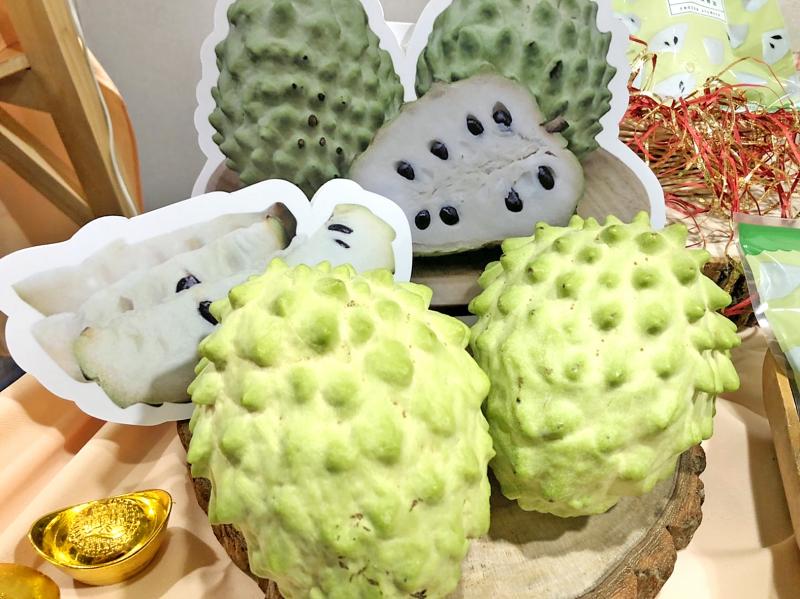
Photo: Yang Yuan-ting, Taipei Times
Taiwanese researchers have developed a proprietary flash-freezing technology especially to export sugar apples, the bureau said, adding that the technology is being released to the private sector.
The council has filed an application to export fresh and frozen sugar apples, and is awaiting approval, it said.
The bureau has sent documents regarding produce certificates and pest and disease control to its Japanese counterpart, it added.
In Japan, fresh fruits from regions affected by Oriental fruit flies must be sterilized by the country of origin before they are allowed into Japan, it said.
The council’s researchers have carried out experiments to determine whether freeze or steam sterilization worked better on sugar apples, and settled on the latter, the bureau said.
Steam sterilization would also be used for Taiwanese mangoes and lychees marked for Japan, which could eliminate the need for Japan to send officials to Taiwan to conduct inspections, it said.
Japan is an important buyer of Taiwanese mangoes, lychees, grapes, pomeloes, papayas and ponkan oranges, it said.
Taiwanese officials have been carrying out inspections of these fruits since 2020 due to COVID-19 travel restrictions between the countries, it said.
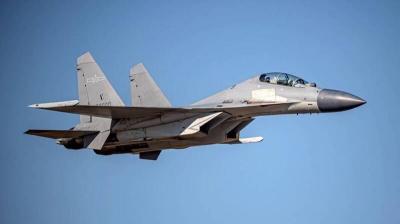
Eight Chinese naval vessels and 24 military aircraft were detected crossing the median line of the Taiwan Strait between 6am yesterday and 6am today, the Ministry of National Defense said this morning. The aircraft entered Taiwan’s northern, central, southwestern and eastern air defense identification zones, the ministry said. The armed forces responded with mission aircraft, naval vessels and shore-based missile systems to closely monitor the situation, it added. Eight naval vessels, one official ship and 36 aircraft sorties were spotted in total, the ministry said.
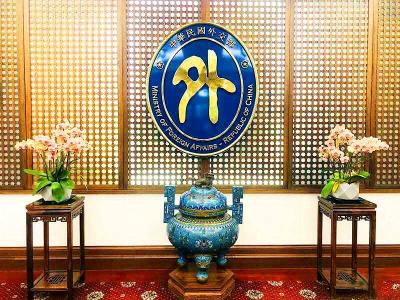
The Ministry of Foreign Affairs (MOFA) today said that if South Korea does not reply appropriately to its request to correct Taiwan’s name on its e-Arrival card system before March 31, it would take corresponding measures to alter how South Korea is labeled on the online Taiwan Arrival Card system. South Korea’s e-Arrival card system lists Taiwan as “China (Taiwan)” in the “point of departure” and “next destination” fields. The ministry said that it changed the nationality for South Koreans on Taiwan’s Alien Resident Certificates from “Korea” to “South Korea” on March 1, in a gesture of goodwill and based on the
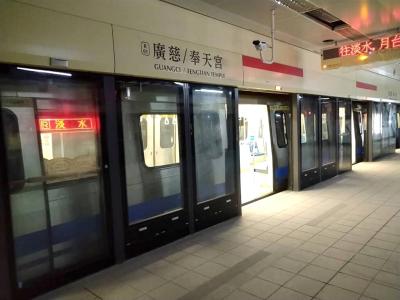
The New Taipei Metro's Sanyin Line and the eastern extension of the Taipei Metro's Tamsui-Xinyi Line (Red Line) are scheduled to begin operations in June, the National Development Council said today. The Red Line, which terminates at Xiangshan Station, would be connected by the 1.4km extension to a new eastern terminal, Guangci/Fengtian Temple Station, while the Sanyin Line would link New Taipei City's Tucheng and Yingge stations via Sanxia District (三峽). The council gave the updates at a council meeting reviewing progress on public construction projects for this year. Taiwan's annual public infrastructure budget would remain at NT$800 billion (US$25.08 billion), with NT$97.3

Taiwanese officials were shown the first of 66 F-16V fighter jets purchased by Taiwan from the United States, the Ministry of National Defense said yesterday, adding the aircraft has completed an initial flight test and is expected to be delivered later this year. A delegation led by Deputy Minister of National Defense Hsu Szu-chien (徐斯儉) visited Lockheed Martin’s F-16 C/D Block 70 (also known as F-16V) assembly line in South Carolina on March 16 to view the aircraft. The jet will undergo a final acceptance flight in the US before being delivered to Taiwan, the


 RSS
RSS