

Taipei City Councilor Lo Chih-chiang (羅智強) of the Chinese Nationalist Party (KMT) yesterday said he would resign from the council next week to seek his party’s nomination to run for mayor of Taoyuan, demonstrating his confidence in being selected by his party.
Lo, who has chosen to resign on Monday, said that the move was historic, as no elected official in Taiwan has resigned a position before winning a party’s nomination to run for another elected post.
Cheng Wen-tsan of the Democratic Progressive Party has been mayor of Taoyuan since 2014, when Taoyuan city and county were merged into a special municipality. Before that, Taoyuan was led by John Wu (吳志揚) of the KMT from 2009 to 2014 and KMT Chairman Eric Chu (朱立倫) from 2001 to 2009.
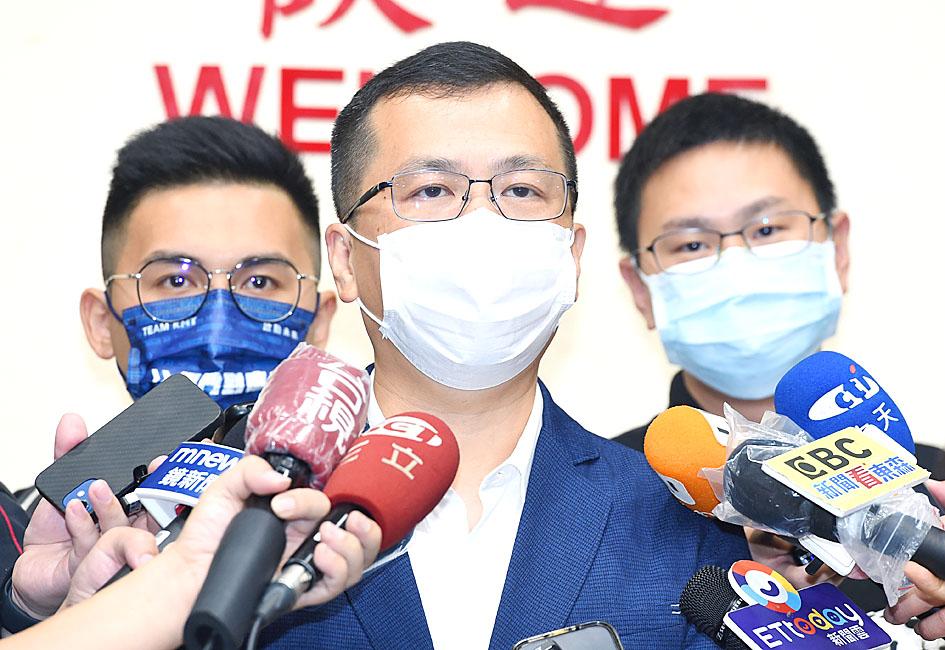
Photo: Liao Chen-huei, Taipei Times
Elected to the Taipei City Council in 2018, the 52-year-old Lo represents the city’s Wenshan (文山) and Daan (大安) districts. He served as Presidential Office spokesman for two years during former president Ma Ying-jeou’s (馬英九) second term.
Lo is reportedly lagging behind other KMT mayoral hopefuls in party polling, but the KMT leadership is said to be willing to back whichever candidate has the best chance of winning.
Lu Yu-ling (呂玉玲), a third-term KMT legislator hailing from Taoyuan, has declared her interest in the nomination, while Legislator Lu Ming-che (魯明哲) is said to be the party front-runner for the nomination.
In February, the KMT said it would select candidates for the elections in November instead of holding primaries.
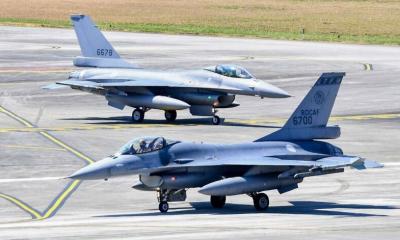
The first two F-16V Block 70 jets Taiwan purchased from the US were spotted unexpectedly turning back after departing from Hawaii yesterday, potentially further delaying delivery of the aircraft. Taiwan has purchased 66 of the F-16 C/D Block 70 jets to be deployed at Chihhang Air Base (志航基地) in Taitung County and operated by the air force's 7th Tactical Fighter Wing to defend Taiwan’s eastern region. Two single-seat jets, bearing serial No. 6727 and 6728, were spotted taking off from Hickam Field in Hawaii yesterday, observers said. Based on the precedent set during the delivery of Taiwan's older F-16 Block 20s, the new

Taiwan’s growing defense preparations might be sending a stronger signal to the US than to Beijing, highlighting the need for Taipei to tailor its deterrence efforts to different audiences, a US security academic said yesterday. Stanford University Freeman Spogli Institute for International Studies fellow Oriana Skylar Mastro made the comment during a Taipei Security Dialogue panel examining lessons Taiwan could draw from the wars in Ukraine and the Middle East. Mastro said she was impressed by Taiwan’s increased defense spending, emphasis on asymmetric capabilities and efforts to prepare society for conflict, but questioned whom those initiatives were influencing. She said when she asked
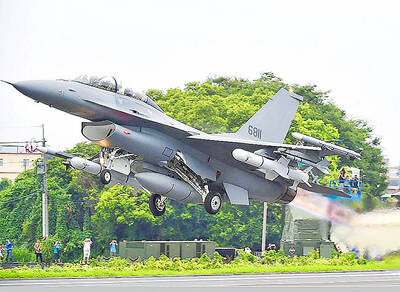
A sharp rise in compensation to be paid by air force officers who leave before completing their required service could indicate an increase in pilots leaving the military early, an analyst said on Friday, warning that the trend could worsen a shortage of experienced personnel. Chieh Chung (揭仲), a researcher at the Association for Strategic Foresight, issued the warning even though the number of volunteer military personnel is expected to increase next year. The planned headcount for volunteer military personnel, covering officers, noncommissioned officers (NCO) and enlisted soldiers, is 158,223 for next year, up 4,258 from 153,965 this year, Chieh said. The increase
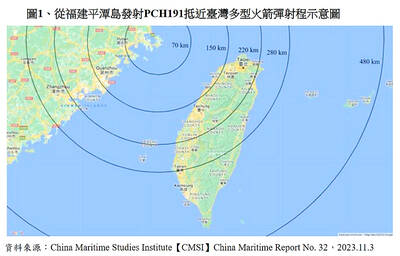
Potential improvements to munitions used by China’s long-range rocket-artillery units could extend their range to cover the entire Miyako Strait, which might give the Chinese People’s Liberation Army (PLA) the ability to secure the strategic waterway, the Mainland Affairs Council (MAC) said in a report. The PLA’s long-range rocket-artillery units deployed along the Taiwan Strait are concentrated along the coast of Fujian Province, including Changle, Pingtan and Shishi, the quarterly report on China said. The artillery brigades of the PLA’s 71st, 72nd and 73rd group armies have been deployed, with preparations for potential battlefield operations under way since August 2022, the report


 RSS
RSS