


A Control Yuan committee has recommended that three judges be impeached for their involvement with business tycoon Weng Mao-chung (翁茂鍾) while he was facing litigation in the 1990s.
The Control Yuan’s impeachment review committee on Wednesday voted unanimously to recommend the impeachment of former Supreme Administrative Court president Lin Chi-fu (林奇福), former Supreme Court chief judge Yen Nan-chuan (顏南全) and former Tainan District Court judge Su Yi-chou (蘇義洲).
The committee said in a statement that the three judges, who presided over Weng’s litigation and his appeals, were found to have had improper contact with the businessman before or after the hearings, including receiving financial benefits such as dinners and gifts.
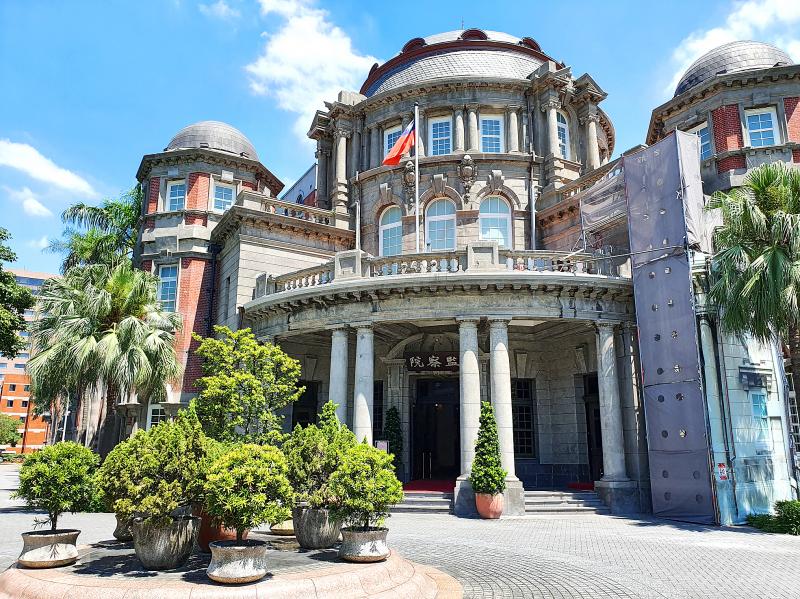
Photo: Hsieh Chun-lin, Taipei Times
“Reports on the case have led to the public to think badly of the justice system and society to doubt the independence of the judiciary... The actions of the three judges have not even met the minimum ethical standards required of judges,” the statement said.
Control Yuan members Wang Mei-yu (王美玉) and Kao Yung-cheng (高涌誠) led the committee, while Control Yuan member Wang Yu-ling (王幼玲) conducted the investigation.
If the Control Yuan approves the recommendation to impeach the judges, the matter would be forwarded to the Judicial Yuan’s Disciplinary Court, which would assess what punishment the judges should receive.
There are allegations of widespread bribe-taking, insider trading, illegal profiteering, abuse of authority, conflicts of interest and other illicit activities, as Weng first offered company stock, banquets and luxury gifts in a bid to “buy off” the judges one by one.
The Taiwan High Prosecutors’ Office last year ordered Taipei prosecutors to review a 1997 financial dispute between Weng and BNP Paribas of France, as this case triggered all of the subsequent litigation, leading to a judicial corruption scandal.

Considering that most countries issue more than five denominations of banknotes, the central bank has decided to redesign all five denominations, the bank said as it prepares for the first major overhaul of the banknotes in more than 24 years. Central bank Governor Yang Chin-lung (楊金龍) is expected to report to the Legislative Yuan today on the bank’s operations and the redesign’s progress. The bank in a report sent to the legislature ahead of today’s meeting said it had commissioned a survey on the public’s preferences. Survey results showed that NT$100 and NT$1,000 banknotes are the most commonly used, while NT$200 and NT$2,000

The Centers for Disease Control (CDC) yesterday reported the first case of a new COVID-19 subvariant — BA.3.2 — in a 10-year-old Singaporean girl who had a fever upon arrival in Taiwan and tested positive for the disease. The girl left Taiwan on March 20 and the case did not have a direct impact on the local community, it said. The WHO added the BA.3.2 strain to its list of Variants Under Monitoring in December last year, but this was the first imported case of the COVID-19 variant in Taiwan, CDC Deputy Director-General Lin Ming-cheng (林明誠) said. The girl arrived in Taiwan on

South Korea is planning to revise its controversial electronic arrival card, a step Taiwanese officials said prompted them to hold off on planned retaliatory measures, a South Korean media report said yesterday. A Yonhap News Agency report said that the South Korean Ministry of Foreign Affairs is planning to remove the “previous departure place” and “next destination” fields from its e-arrival card system. The plan, reached after interagency consultations, is under review and aims to simplify entry procedures and align the electronic form with the paper version, a South Korean ministry official said. The fields — which appeared only on the electronic form

The Ministry of Foreign Affairs (MOFA) is suspending retaliation measures against South Korea that were set to take effect tomorrow, after Seoul said it is updating its e-arrival system, MOFA said today. The measures were to be a new round of retaliation after Taiwan on March 1 changed South Korea's designation on government-issued alien resident certificates held by South Korean nationals to "South Korea” from the "Republic of Korea," the country’s official name. The move came after months of protests to Seoul over its listing of Taiwan as "China (Taiwan)" in dropdown menus on its new online immigration entry system. MOFA last week


 RSS
RSS