


The Ministry of Transportation and Communications (MOTC) could soon reach a consensus on a draft “Taiwan railway corporation” act, as there are only small differences between the version proposed by the ministry and the one proposed by the Taiwan Railway Labor Union (TRLU), Minister of Transportation and Communications Wang Kwo-tsai (王國材) told lawmakers yesterday.
The legislature’s Transportation Committee convened after more than 13,000 Taiwan Railways Administration (TRA) employees took the day off on International Workers’ Day to protest the ministry’s decision to send the bill to the legislature without reaching an agreement with the union first.
In a news conference on Sunday, Wang said he considered himself earning a passing grade for his handling of the strike, as people were still able to travel using high-speed trains, freeway and highway bus systems, and rail-replacement bus services.
Wang was invited to brief lawmakers on the committee yesterday about the ministry’s plan to address problems caused by inconsistent road surface markings, and traffic signs and signals nationwide.
However, most of the lawmakers focused on the progress the ministry has made in its negotiations with the union and whether the union would launch other strikes during the Dragon Boat Festival, Mid-Autumn Festival and Double Ten National Day long weekends, as well as the nine-in-one elections on Nov. 26.
The TRA and the union both lost in the strike, but people were the biggest losers, Wang told Democratic Progressive Party (DPP) Legislator Lee Kun-tse (李昆澤).
TRA Director-General Du Wei (杜微) on Tuesday night spoke with union members about the versions of the bill proposed by the union and the ministry, Wang said, adding that another meeting would be held today to address the differences between the two versions and speak about changes to employees’ benefits.
“There are not many major differences between the two versions,” he said, adding that the ministry and the union could reach a consensus on key issues if both sides can come to the negotiating table with an open mind.
Lee said that the transport capacity that the ministry prepared for Workers’ Day far exceeded demand.
While the ministry offered bus services to replace canceled train services, it took people four hours to travel from Hualien to Taitung by bus, which is about twice as long as it would have taken on a TRA train, Lee said.
Despite intensive media coverage of the planned strike, a small number of people did not know that nearly all of the TRA’s train services were canceled on the day of the strike, while some elderly and disabled people said they had difficulty boarding buses, Lee said.
He said that as the ministry might offer rail-replacement bus services again if train services are disrupted by a strike or a natural disaster, the ministry must refine the service, including by changing the bus routes, shortening travel times, and offering more training to service personnel to guide and assist passengers.
Chinese Nationalist Party (KMT) Legislator Hung Mong-kai (洪孟楷) said that the ministry’s goal of having the draft act pass its third reading in the legislature by the end of this month might intensify its conflict with the union, adding that the ministry should focus on proper communications with the group.
Wang told reporters on the sidelines of the meeting that union members should engage in discussions over the bill, rather than threatening to repeatedly hold strikes.
“They are sacrificing the convenience of loyal TRA passengers for their causes, which is the wrong direction to take,” Wang said. “I hope that we can open one of our meetings with union members to the media so that the public can see for themselves which side has the best argument and which side makes no sense.”
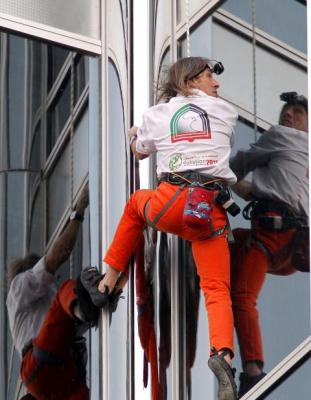
Alain Robert, known as the "French Spider-Man," praised Alex Honnold as exceptionally well-prepared after the US climber completed a free solo ascent of Taipei 101 yesterday. Robert said Honnold's ascent of the 508m-tall skyscraper in just more than one-and-a-half hours without using safety ropes or equipment was a remarkable achievement. "This is my life," he said in an interview conducted in French, adding that he liked the feeling of being "on the edge of danger." The 63-year-old Frenchman climbed Taipei 101 using ropes in December 2004, taking about four hours to reach the top. On a one-to-10 scale of difficulty, Robert said Taipei 101

Nipah virus infection is to be officially listed as a category 5 notifiable infectious disease in Taiwan in March, while clinical treatment guidelines are being formulated, the Centers for Disease Control (CDC) said yesterday. With Nipah infections being reported in other countries and considering its relatively high fatality rate, the centers on Jan. 16 announced that it would be listed as a notifiable infectious disease to bolster the nation’s systematic early warning system and increase public awareness, the CDC said. Bangladesh reported four fatal cases last year in separate districts, with three linked to raw date palm sap consumption, CDC Epidemic Intelligence
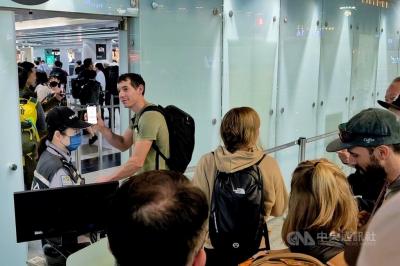
US climber Alex Honnold left Taiwan this morning a day after completing a free-solo ascent of Taipei 101, a feat that drew cheers from onlookers and gained widespread international attention. Honnold yesterday scaled the 101-story skyscraper without a rope or safety harness. The climb — the highest urban free-solo ascent ever attempted — took just more than 90 minutes and was streamed live on Netflix. It was covered by major international news outlets including CNN, the New York Times, the Guardian and the Wall Street Journal. As Honnold prepared to leave Taiwan today, he attracted a crowd when he and his wife, Sanni,

Taiwanese and US defense groups are collaborating to introduce deployable, semi-autonomous manufacturing systems for drones and components in a boost to the nation’s supply chain resilience. Taiwan’s G-Tech Optroelectronics Corp subsidiary GTOC and the US’ Aerkomm Inc on Friday announced an agreement with fellow US-based Firestorm Lab to adopt the latter’s xCell, a technology featuring 3D printers fitted in 6.1m container units. The systems enable aerial platforms and parts to be produced in high volumes from dispersed nodes capable of rapid redeployment, to minimize the risk of enemy strikes and to meet field requirements, they said. Firestorm chief technology officer Ian Muceus said


 RSS
RSS