


Foreign experts on international rights mechanisms are to participate, along with Taiwanese judicial agencies and civil society groups, in a review of two UN covenants, with the public able follow the sessions live online for the first time.
The meetings are to be held in Taipei from Monday to Friday next week, to review the nation’s implementation of the International Covenant on Civil and Political Rights (ICCPR) and the International Covenant on Economic, Social and Cultural Rights (ICESCR), Ministry of Justice officials said at a briefing yesterday.
It is the third such review since Taiwan adopted the two covenants in 2009. Reviews are scheduled every four years, but last year’s was delayed due to the COVID-19 pandemic.
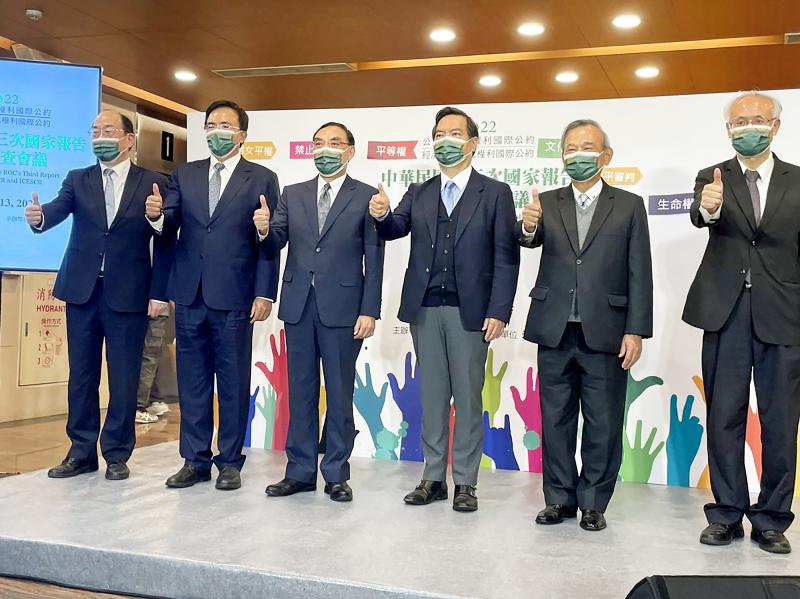
Photo: CNA
Experts from previous meetings gave positive endorsements of Taiwan’s review process, which includes the participation of civil society groups and other local stakeholders, Minister of Justice Tsai Ching-hsiang (蔡清祥) said, adding that they wanted to attend despite the COVID-19 outbreak, because the process works well and they believe other countries should emulate it.
The Ministry of Justice’s Department of Legal System and the Executive Yuan are the main organizers of this year’s “Review Meeting of ROC-Taiwan Third Report under the ICCPR and ICESCE.” They plan to broadcast the meetings live online.
“We are undertaking this review for Taiwan to improve on rights protections for all members of society, and to show the government’s commitment to implementing the two covenants and Taiwan’s determination to engage in international mechanisms,” Tsai said.
“Through this process, the world can see that Taiwan is moving in the right direction, making progress on civil and political rights, and also on economic, social and cultural rights,” he added.
Nine experts are to preside over the meetings. They have experience in international rights mechanisms, UN committees and affiliated agencies, and include an Asian indigenous rights leader and a European Court of Human Rights judge.
Performing the same roles as they did in 2017 are Manfred Nowak of Austria, a former UN special rapporteur on torture, and Eibe Riedel of Germany, a former vice chairman of the UN Committee on Economic, Social and Cultural Rights.
Nowak is to chair the ICCPR panel, while Riedel is to chair the ICESCR panel.
Others on the panels include William Schabas of Canada, who has been described as “the world expert on the law of genocide and international law,” and Indigenous Peoples Alliance of the Archipelago secretary-general Rukka Sombolinggi of Indonesia.
The other experts are from Denmark, Germany, Malaysia, New Zealand, the Philippines and South Korea, including members of the UN Committee on the Elimination of Discrimination against Women and the UN Human Rights Commission.
Ministry of Justice officials said that not all of the international experts had arrived in Taiwan as of yesterday.
The meetings would be conducted in a “bubble,” with the experts moving as a group, while other participants would maintain social distance, the officials said, adding that the experts are required to take polymerase chain reaction tests.
Officials thanked the international experts for agreeing to travel to Taiwan and to follow COVID-19 prevention measures.
The issues discussed during the 2017 review covered abolition of the death penalty, the rights of detainees, violations against laborers and migrant workers, indigenous people’s rights, the recognition of Pingpu indigenous groups, gender equality, full rights for LGBTQ people and Taiwan’s harsh policies regarding narcotics.

FUKUOKA SITUATION: Japanese media reported that the pathogen is expected to be identified by the summer, while the CDC downplayed the idea that it was hMPV A “mysterious cold-like illness” reported in Japan’s Fukuoka Prefecture does not seem to be a new disease, but Japanese authorities have been asked about the situation, the Centers for Disease Control (CDC) said yesterday. The Fukuoka Prefectural Medical Association on Wednesday told a news conference that a “mystery cold” that has become a hot topic on social media is “highly likely to be caused by some kind of viral infection,” Japan’s KBC News reported. “Many people are experiencing symptoms starting with a sore throat, followed by a runny nose, phlegm and a severe cough,” KBC News reported, citing association officials. Health authorities are

Nvidia Corp CEO Jensen Huang (黃仁勳) arrived in Taiwan yesterday ahead of upcoming AI and technology events, saying he plans to meet with clients and Taiwan Semiconductor Manufacturing Co Chairman C.C. Wei (魏哲家) during his visit. After landing at Taipei Songshan Airport, Huang posed for photos with fans and handed out Yakult drinks to reporters and supporters waiting at the scene, saying he has “a lot to do” during the trip. Asked about reports that Nvidia’s planned headquarters site in Taipei’s Beitou Shilin Technology Park could break ground on May 27, Huang said that if the company holds an event, he would

The Ministry of Finance this afternoon announced the winning numbers for the March-April uniform invoice lottery. The winning number for the NT$10 million (US$318,060) special prize is 19531471, and the winning number for the NT$2 million grand prize is 85941329. Three numbers were drawn for the NT$200,000 first prize: 07225810, 20231230 and 83518781. Those with receipts matching the last seven digits of any of the first-prize numbers will win the NT$40,000 second prize, while those matching the last six digits will win the NT$10,000 third prize. Those whose receipts match the last five digits of the first-prize numbers can claim the NT$4,000 fourth prize,
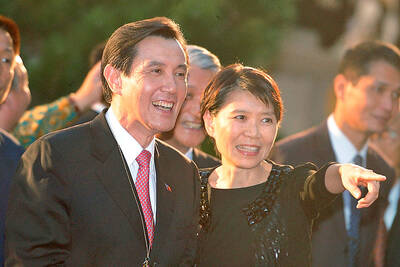
Former president Ma Ying-jeou (馬英九) yesterday expressed “shock and regret” over a statement issued by his wife without his consent, and rejected her assertion that his eldest sister, Ma Yi-nan (馬以南), would manage his medical care or act as his spokesperson amid an ongoing embezzlement probe into his foundation. Ma Ying-jeou in a statement said he was shocked by a statement by his wife, Chou Mei-ching (周美青), regarding his affairs. Ma Yi-nan “must not” be in charge of his healthcare and other personal affairs, nor can she be allowed to represent the Ma family, the former president said. He said he was also


 RSS
RSS