


A shipment of strawberries from Japan’s Tochigi Prefecture was seized at the border due to excessive levels of pesticide residue, the Taiwan Food and Drug Administration (FDA) said on Tuesday.
The shipment is the first batch of produce from a Japanese prefecture recently removed from an import ban to fail a border inspection, the agency said.
Taiwan on Feb. 21 lifted a ban on food imports from five Japanese prefectures, which was implemented following the 2011 Fukushima Dai-ichi nuclear power plant disaster. In addition to Tochigi and Fukushima, the ban included neighboring Chiba, Gunma and Ibaraki.
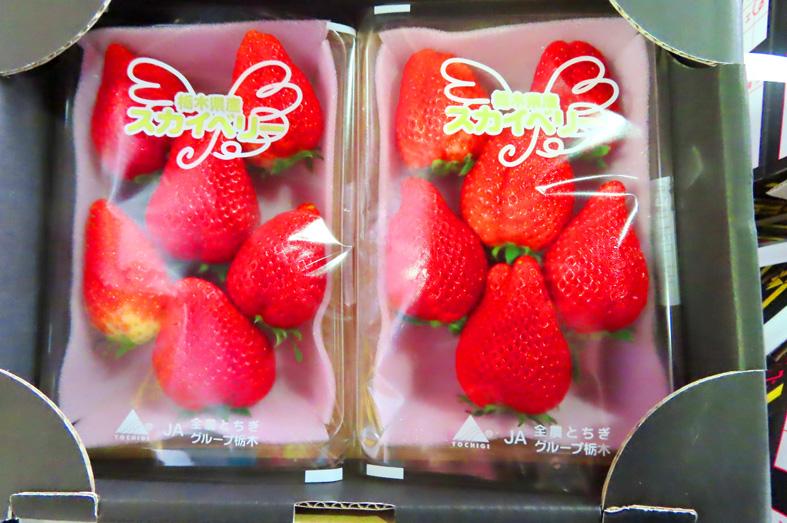
Photo courtesy of the Food and Drug Administration via CNA
FDA Food Safety Division official Lin Hsu-yang (林旭陽) said that since the ban was lifted, 19 shipments of food and agricultural produce have been imported from Gunma, Ibaraki and Tochigi, and none have been found to contain radiation contamination.
The shipment of 88.8kg of strawberries was confiscated after sample testing on March 17 found they contained the insecticide flonicamid at 0.15 parts per million (ppm), exceeding the nation’s 0.01ppm maximum residue limit, the FDA said.
The FDA began batch-by-batch inspections of strawberries imported from Japan, as excessive pesticide residue has repeatedly been detected in them.
The agency also requested that Japan provide a written explanation for the high levels of pesticide in its strawberry shipments by May 6, but has not yet received a response, Lin said.
The FDA also released a list of 11 items that failed its latest border inspections, including dried porcini mushrooms from France, ready-to-cook chicken soup packets from Malaysia, artichoke extract powder from Canada, dried galangal tubers from Vietnam, seaweed salt from Japan, Thai red tea from Thailand, green tea chutney from Myanmar, frozen oil fish roe from Fiji and a red tea product from India.
All problematic items were either returned to their country of origin or destroyed in accordance with regulations, the agency said.

Considering that most countries issue more than five denominations of banknotes, the central bank has decided to redesign all five denominations, the bank said as it prepares for the first major overhaul of the banknotes in more than 24 years. Central bank Governor Yang Chin-lung (楊金龍) is expected to report to the Legislative Yuan today on the bank’s operations and the redesign’s progress. The bank in a report sent to the legislature ahead of today’s meeting said it had commissioned a survey on the public’s preferences. Survey results showed that NT$100 and NT$1,000 banknotes are the most commonly used, while NT$200 and NT$2,000

The Centers for Disease Control (CDC) yesterday reported the first case of a new COVID-19 subvariant — BA.3.2 — in a 10-year-old Singaporean girl who had a fever upon arrival in Taiwan and tested positive for the disease. The girl left Taiwan on March 20 and the case did not have a direct impact on the local community, it said. The WHO added the BA.3.2 strain to its list of Variants Under Monitoring in December last year, but this was the first imported case of the COVID-19 variant in Taiwan, CDC Deputy Director-General Lin Ming-cheng (林明誠) said. The girl arrived in Taiwan on

South Korea is planning to revise its controversial electronic arrival card, a step Taiwanese officials said prompted them to hold off on planned retaliatory measures, a South Korean media report said yesterday. A Yonhap News Agency report said that the South Korean Ministry of Foreign Affairs is planning to remove the “previous departure place” and “next destination” fields from its e-arrival card system. The plan, reached after interagency consultations, is under review and aims to simplify entry procedures and align the electronic form with the paper version, a South Korean ministry official said. The fields — which appeared only on the electronic form

The Ministry of Foreign Affairs (MOFA) is suspending retaliation measures against South Korea that were set to take effect tomorrow, after Seoul said it is updating its e-arrival system, MOFA said today. The measures were to be a new round of retaliation after Taiwan on March 1 changed South Korea's designation on government-issued alien resident certificates held by South Korean nationals to "South Korea” from the "Republic of Korea," the country’s official name. The move came after months of protests to Seoul over its listing of Taiwan as "China (Taiwan)" in dropdown menus on its new online immigration entry system. MOFA last week


 RSS
RSS