


The High Court yesterday reduced by NT$663 million (US$22.7 million) the compensation to former Radio Corporation of America (RCA) employees who had sued the company over illnesses they say they developed due to exposure to toxic chemicals.
The court ruled that their claims lacked definitive cause-and-effect relationships between their work environment and their illnesses.
The ruling reduced the compensation for 1,112 former employees to NT$1.667 billion, down from the NT$2.33 billion that the Taipei District Court ordered RCA to pay in December 2019.
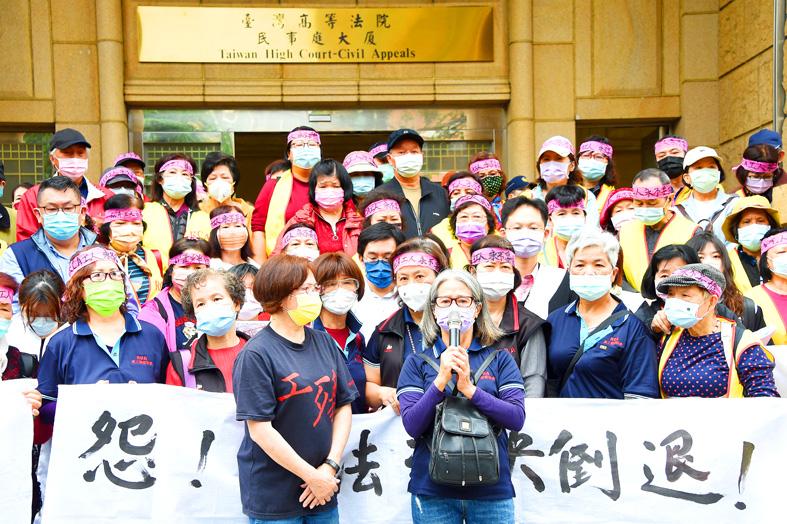
Photo: Tu Chien-jung, Taipei Times
Separate class-action lawsuits were filed against RCA, which operated in Taiwan from 1970 to 1990, on behalf of factory workers diagnosed with illnesses suspected to be from exposure to hazardous substances.
The proceedings, which began in 2002, is the largest class-action litigation in Taiwan’s history and involves the most workers seeking compensation against a business.
In the case against RCA and three affiliated companies — General Electric, Thomson Consumer Electronics (Bermuda) and Technicolor SA — the plaintiffs were divided into three groups: A for former employees who had died; B for those who had developed illnesses; and C for those who had no obvious illness.
Yesterday’s ruling was for Group B.
High Court judges cited a lack of a definitive cause-and-effect relationship linking exposure to chemicals when working at RCA factories in Hsinchu County and what was then Taoyuan County.
Data regarding chemical hazards are held by RCA and were not presented during the hearing, the judges said, adding that local water sources or other environmental factors might have been sources of chemicals that caused the illnesses.
Group representing the plaintiffs said that they are disappointed with the decision and plan to appeal.
The reduced amount is far less than the NT$7.3 billion they initially sought, the groups said.

LOUD AND PROUD Taiwan might have taken a drubbing against Australia and Japan, but you might not know it from the enthusiasm and numbers of the fans Taiwan might not be expected to win the World Baseball Classic (WBC) but their fans are making their presence felt in Tokyo, with tens of thousands decked out in the team’s blue, blowing horns and singing songs. Taiwanese fans have packed out the Tokyo Dome for all three of their games so far and even threatened to drown out home team supporters when their team played Japan on Friday. They blew trumpets, chanted for their favorite players and had their own cheerleading squad who dance on a stage during the game. The team struggled to match that exuberance on the field, with
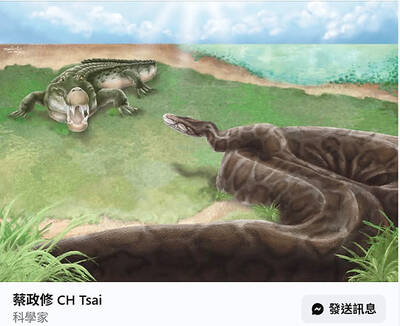
Taiwanese paleontologists have discovered fossil evidence that pythons up to 4m long inhabited Taiwan during the Pleistocene epoch, reporting their findings in the international scientific journal Historical Biology. National Taiwan University (NTU) Institute of Ecology and Evolutionary Biology associate professor Tsai Cheng-hsiu (蔡政修) led the team that discovered the largest snake fossil ever found in Taiwan. The single trunk vertebra was discovered in Tainan at the Chiting Formation, dated to between 400,000 and 800,000 years ago in the Middle Pleistocene, the paper said. The area also produced Taiwan’s first avian fossil, as well as crocodile, mammoth, saber-toothed cat and rhinoceros fossils, it said. Discoveries

Taiwanese paleontologists have discovered fossil evidence that pythons up to 4m long inhabited Taiwan during the Pleistocene epoch, reporting their findings in the international scientific journal Historical Biology. National Taiwan University (NTU) Institute of Ecology and Evolutionary Biology associate professor Tsai Cheng-hsiu (蔡政修) led the team that discovered the largest snake fossil ever found in Taiwan. A single trunk vertebra was discovered in Tainan at the Chiting Formation, dated to between 800,000 to 400,000 years ago in the Middle Pleistocene, the paper said. The area also produced Taiwan’s first avian fossil, as well as crocodile, mammoth, sabre-toothed cat and rhinoceros fossils, it said. Discoveries
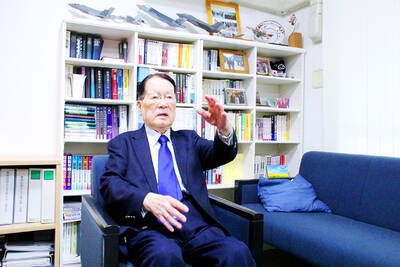
Whether Japan would help defend Taiwan in case of a cross-strait conflict would depend on the US and the extent to which Japan would be allowed to act under the US-Japan Security Treaty, former Japanese minister of defense Satoshi Morimoto said. As China has not given up on the idea of invading Taiwan by force, to what extent Japan could support US military action would hinge on Washington’s intention and its negotiation with Tokyo, Morimoto said in an interview with the Liberty Times (sister paper of the Taipei Times) yesterday. There has to be sufficient mutual recognition of how Japan could provide


 RSS
RSS