


Smoker rights groups yesterday protested outside the legislature in Taipei against a proposal to ban e-cigarettes.
Holding signs that read: “Consumers have rights, too,” “Give me the freedom to choose” and “Do not force me to smoke cigarettes,” protesters said the government should not impose a blanket prohibition against e-cigarettes and heated tobacco products (HTPs).
The government must respect the rights of smokers, they said, adding that it should offer people choices, instead of instituting an outright ban.
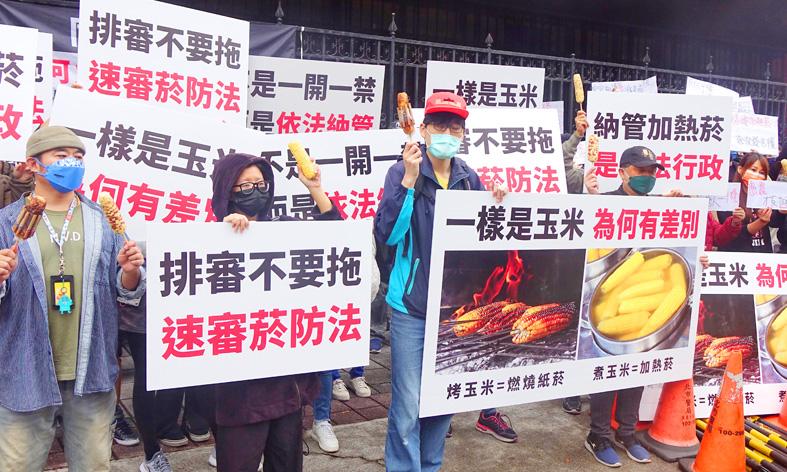
Photo: Liu Hsin-de, Taipei Times
The protest was in response to the legislature’s Social Welfare and Environmental Hygiene Committee considering changes to the Tobacco Hazards Prevention Act (菸害防制法) that would ban e-cigarettes and limit HTPs. Amendments to the Narcotics Hazard Prevention Act (毒品危害防制條例) to restrict e-cigarettes are also be considered by the Judiciary and Organic Laws and Statutes Committee.
One protester said that vaping devices, HTPs and flavored cigarettes should be regulated like regular cigarettes, with taxes and age restrictions for purchase.
“HTPs and e-cigarettes should be classified as tobacco products, just like the cigarettes sold at convenience stores,” said the protester, who asked that their name not be used. “We agree that the government should impose restrictions and rules, not permit sale to minors, no advertising, no online purchase and have health warnings.”
Separately, while discussing amendments to the Narcotics Hazard Prevention Act at the legislature, Deputy Minister of Justice Tsai Pi-chung (蔡碧仲) was asked about recent calls by advocates urging the government to permit medicinal cannabis.
Tsai said there is no plan to decriminalize cannabis, which remains classified as a category 2 narcotic.
Tsai said the judiciary is cracking down on all illegal drug use, including cannabis, and said it is illegal in Taiwan for YouTubers to post videos teaching how to grow marijuana.

Considering that most countries issue more than five denominations of banknotes, the central bank has decided to redesign all five denominations, the bank said as it prepares for the first major overhaul of the banknotes in more than 24 years. Central bank Governor Yang Chin-lung (楊金龍) is expected to report to the Legislative Yuan today on the bank’s operations and the redesign’s progress. The bank in a report sent to the legislature ahead of today’s meeting said it had commissioned a survey on the public’s preferences. Survey results showed that NT$100 and NT$1,000 banknotes are the most commonly used, while NT$200 and NT$2,000

The Centers for Disease Control (CDC) yesterday reported the first case of a new COVID-19 subvariant — BA.3.2 — in a 10-year-old Singaporean girl who had a fever upon arrival in Taiwan and tested positive for the disease. The girl left Taiwan on March 20 and the case did not have a direct impact on the local community, it said. The WHO added the BA.3.2 strain to its list of Variants Under Monitoring in December last year, but this was the first imported case of the COVID-19 variant in Taiwan, CDC Deputy Director-General Lin Ming-cheng (林明誠) said. The girl arrived in Taiwan on

South Korea is planning to revise its controversial electronic arrival card, a step Taiwanese officials said prompted them to hold off on planned retaliatory measures, a South Korean media report said yesterday. A Yonhap News Agency report said that the South Korean Ministry of Foreign Affairs is planning to remove the “previous departure place” and “next destination” fields from its e-arrival card system. The plan, reached after interagency consultations, is under review and aims to simplify entry procedures and align the electronic form with the paper version, a South Korean ministry official said. The fields — which appeared only on the electronic form

The Ministry of Foreign Affairs (MOFA) is suspending retaliation measures against South Korea that were set to take effect tomorrow, after Seoul said it is updating its e-arrival system, MOFA said today. The measures were to be a new round of retaliation after Taiwan on March 1 changed South Korea's designation on government-issued alien resident certificates held by South Korean nationals to "South Korea” from the "Republic of Korea," the country’s official name. The move came after months of protests to Seoul over its listing of Taiwan as "China (Taiwan)" in dropdown menus on its new online immigration entry system. MOFA last week


 RSS
RSS