


The Central Epidemic Command Center (CECC) yesterday relaxed the permissible transportation methods for people with COVID-19 quarantining at home, as well as people in home isolation, who require medical treatment or testing at hospitals.
Minister of Health and Welfare Chen Shih-chung (陳時中), who heads the center, said that 10 cities and counties as of yesterday had implemented the policy of isolating mild and asymptomatic cases at home.
They are Taipei, New Taipei City, Kaohsiung, Keelung and Taoyuan, as well as Changhua, Chiayi, Hualien, Lienchiang and Yilan counties, he said.
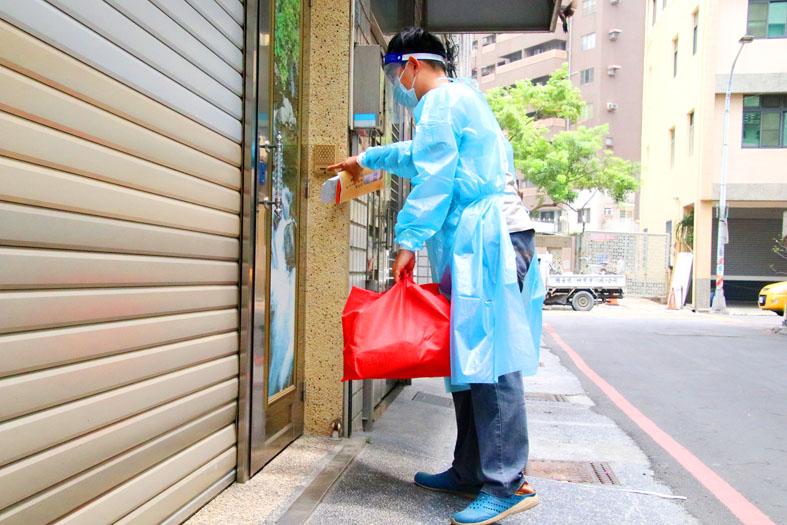
Photo: CNA
For an infected person or isolating person with an “emergency,” the principal transportation method is “calling 119” for an ambulance, Chen said, adding that it is better if people call their local health department first, as they are being monitored by a mobile phone-based “electronic fence.”
If notified first, the health department can temporarily remove the “electronic fence” so that the police are not informed that they left their home, he said.
In urgent cases, people who cannot contact the health department first would not be fined, he said.
People instructed by their health department to make a non-urgent visit to a hospital can take a disease-prevention taxi, go with a household member or make their own way there — such as by walking, driving a vehicle or riding a scooter or bicycle — as long as they do not take public transportation, Chen added.
People returning home to isolate, including those who have received medical treatment or been tested, should follow their health department’s instructions and take a disease-prevention taxi, go with a household member or return on their own, he said.
The policy change came a day after the first COVID-19 death of a young child in Taiwan — a two-year-old boy in New Taipei City.
The boy’s family had said the government was at fault for its delayed response, which included passing the case between agencies and sending an ambulance too late.
Chen said that as more people cannot leave home, delivery services for food, drugs and other daily necessities must be delivered to people’s doorsteps.
Citing reports of buildings where the management has prohibited delivery personnel from entering, Chen said that they must follow the CECC’s issued guidelines to allow delivery or other personnel to enter complexes or buildings after registering their contact details, disinfecting their hands and performing other preventive measures.
“If the building has different management rules, then the security guard or other designated personnel must be responsible for taking the delivered items to the doorstep of the isolated or quarantined individual,” he said.
Asked to elaborate on the warning signs of an “emergency case,” Centers for Disease Control Deputy Director-General Philip Lo (羅一鈞), deputy head of the CECC’s medical response division, said that at-home care guidelines for cases were revised on Tuesday.
The main warning signs of severe illness were expanded from four conditions to seven: breathlessness or difficulty breathing; continuous chest tightness or chest pain; unconsciousness; a bluish color in the skin, lips or nail beds; a rapid heart rate of more than 100 beats per minute while not having a fever (body temperature below 38°C); reduced urine output for 24 hours; or inability to eat, drink or take medication, he said.
As a specialists’ meeting was being held at the center yesterday to discuss topics including warning signs in children, the meeting’s final recommendations would also be added to the guidelines, Lo said.
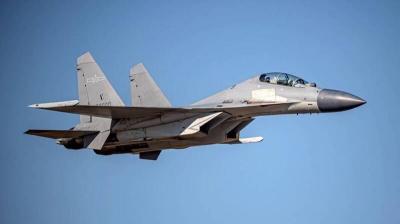
Eight Chinese naval vessels and 24 military aircraft were detected crossing the median line of the Taiwan Strait between 6am yesterday and 6am today, the Ministry of National Defense said this morning. The aircraft entered Taiwan’s northern, central, southwestern and eastern air defense identification zones, the ministry said. The armed forces responded with mission aircraft, naval vessels and shore-based missile systems to closely monitor the situation, it added. Eight naval vessels, one official ship and 36 aircraft sorties were spotted in total, the ministry said.
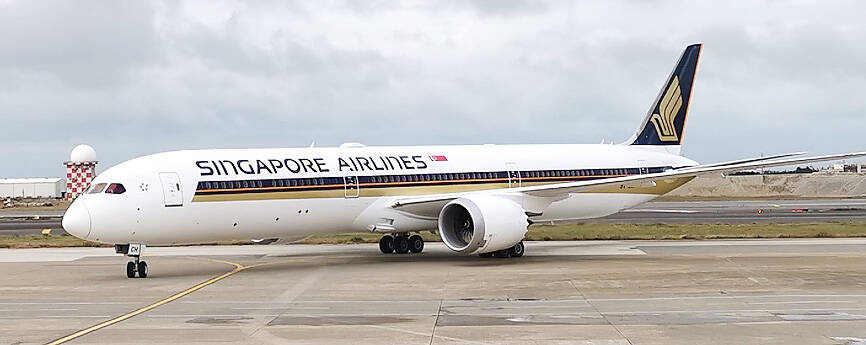
INCREASED CAPACITY: The flights on Mondays, Wednesdays, Fridays and Sundays would leave Singapore in the morning and Taipei in the afternoon Singapore Airlines is adding four supplementary flights to Taipei per week until May to meet increased tourist and business travel demand, the carrier said on Friday. The addition would raise the number of weekly flights it operates to Taipei to 18, Singapore Airlines Taiwan general manager Timothy Ouyang (歐陽漢源) said. The airline has recorded a steady rise in tourist and business travel to and from Taipei, and aims to provide more flexible travel arrangements for passengers, said Ouyang, who assumed the post in July last year. From now until Saturday next week, four additional flights would depart from Singapore on Monday, Wednesday, Friday
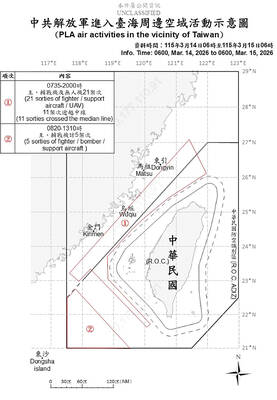
The Ministry of National Defense yesterday reported the return of large-scale Chinese air force activities after their unexplained absence for more than two weeks, which had prompted speculation regarding Beijing’s motives. China usually sends fighter jets, drones and other military aircraft around the nation on a daily basis. Interruptions to such routine are generally caused by bad weather. The Ministry of National Defense said it had detected 26 Chinese military aircraft in the Taiwan Strait over the previous 24 hours. It last reported that many aircraft on Feb. 25, when it spotted 30 aircraft, saying Beijing was carrying out another “joint combat

Taiwan successfully defended its women’s 540 kilogram title and won its first-ever men’s 640 kg title at the 2026 World Indoor Tug of War Championships in Taipei yesterday. In the women’s event, Taiwan’s eight-person squad reached the final following a round-robin preliminary round and semifinals featuring teams from Ukraine, Japan, Thailand, Vietnam, the Basque Country and South Korea. In the finals, they swept the Basque team 2-0, giving the team composed mainly of National Taiwan Normal University students and graduates its second championship in a row, and its fourth in five years. Team captain


 RSS
RSS