


A nearly 80-year-old headstone with an inscription in English discovered in Taipei, which experts said could indicate the final resting place of a prisoner of war (POW) imprisoned by Japan in Taiwan during World War II, has been stolen before it could be properly analyzed.
The Taipei City Government on Jan. 28 ordered the relocation of 30 graves by April 30 as part of a road expansion plan in the hills near Lane 137, Fude Street in Xinyi District (信義).
Visitors to the area then discovered a headstone with English lettering, pictures of which were posted on the Ancient Tomb Detectives Facebook page on March 31.
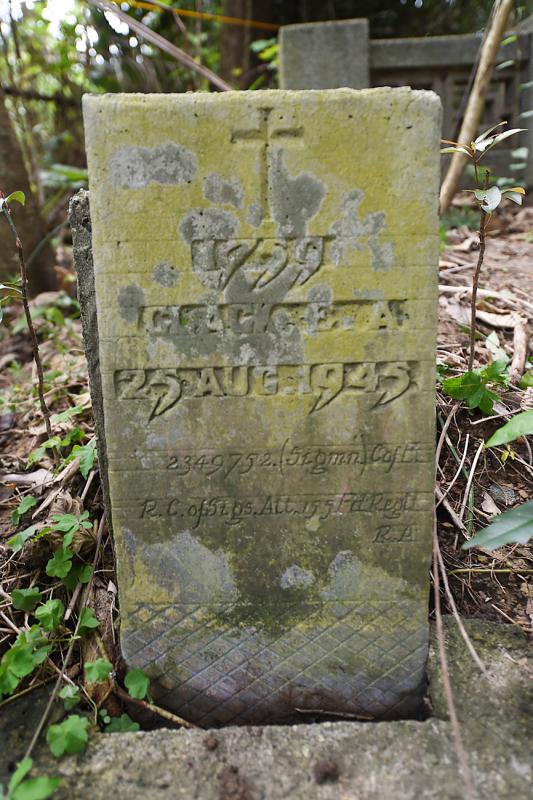
Photo: CNA
Photographs taken by visitors and military historian Chang Wei-bin (張維斌) show that the name on the headstone could be either “Clack, Eric Arthur,” or “Clack, Erec Arthur,” while the date of death is Aug. 25, 1945.
The grave could have been for a British soldier who was captured and sent to Japan-occupied Taiwan as a prisoner of war during World War II, Chang said.
There are two other headstones with what appear to be English inscriptions, but they are too badly weathered to make out the names or date of death, Chang added.
As cement was a valuable material during World War II, it is unlikely it would have been used to make headstones for POWs, unless they were Allied servicemen who died at the end of the war, cultural heritage conservationist Hsiao Wen-chieh (蕭文杰) said.
The city’s Department of Cultural Affairs had planned to send experts from its Cultural Heritage Division to determine the historical background and cultural value of the headstone yesterday.
However, the Ancient Tomb Detectives reported on Saturday that it had been stolen.
Lai Yu-wen (賴郁雯), head of the Cultural Heritage Division, on Sunday said that the cultural value of headstones can only be determined on location, but information and data provided by the general public would still be submitted to experts for analysis.
If it is determined that the headstone belonged to a World War II POW, it would be the first such finding in the city, she said.
The theft has been reported to the police and the city’s Mortuary Services Office, which was put in charge of relocating the graves and has been instructed to suspend all relocation work, Lai added.
Citing Article 15 of the Cultural Heritage Preservation Act (文化資產保存法), Taipei City Councilor Hsu Chia-pei (許家蓓) of the Democratic Progressive Party said that the city’s cultural affairs department should have conducted a cultural heritage evaluation of the site much earlier.
Taipei’s New Construction Office, Mortuary Services Office and Department of Cultural Affairs would be held accountable if the theft is found to have been caused by a failure to follow proper protocol or poor communication between the departments, she said.

Yangmingshan National Park authorities yesterday urged visitors to respect public spaces and obey the law after a couple was caught on a camera livestream having sex at the park’s Qingtiangang (擎天崗) earlier in the day. The Shilin Police Precinct in Taipei said it has identified a suspect and his vehicle registration number, and would summon him for questioning. The case would be handled in accordance with public indecency charges, it added. The couple entered the park at about 11pm on Thursday and began fooling around by 1am yesterday, the police said, adding that the two were unaware of the park’s all-day live

Fast food chain McDonald's is to raise prices by up to NT$5 on some products at its restaurants across Taiwan, starting on Wednesday next week, the company announced today. The prices of all extra value meals and sharing boxes are to increase by NT$5, while breakfast combos and creamy corn soup would go up by NT$3, the company said in a statement. The price of the main items of those meals, if ordered individually, would remain the same. Meanwhile, the price of a medium-sized lemon iced tea and hot cappuccino would rise by NT$3, extra dipping sauces for chicken nuggets would go up
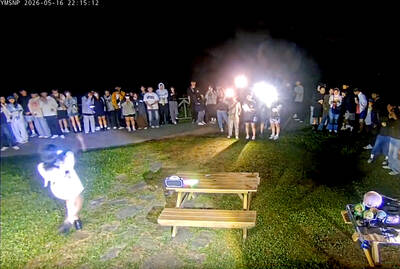
Yangmingshan National Park’s Qingtiangang (擎天崗) nature area has gone viral after a park livestream camera observed a couple in the throes of intimate congress, which was broadcast live on YouTube, drawing large late-night crowds and sparking a backlash over noise, bright lights and disruption to wildlife habitat. The area’s livestream footage appeared to show a couple engaging in sexual activity on a picnic table in the park on Friday last week, with the uncensored footage streamed publicly online. The footage quickly spread across social media, prompting a tide of visitors to travel to the site to “check in” and recreate the

Minister of Digital Affairs Lin Yi-ching (林宜敬) yesterday cited regulatory issues and national security concerns as an expert said that Taiwan is among the few Asian regions without Starlink. Lin made the remarks on Facebook after funP Innovation Group chief executive officer Nathan Chiu (邱繼弘) on Friday said Taiwan and four other countries in Asia — China, North Korea, Afghanistan and Syria — have no access to Starlink. Starlink has become available in 166 countries worldwide, including Ukraine, Malaysia, the Philippines and Vietnam, in the six years since it became commercial, he said. While China and North Korea block Starlink, Syria is not


 RSS
RSS