


Chinese distant-water fishing fleets have been illegally fishing in waters of developing nations, abusing migrant workers on vessels and targeting endangered marine species, the latest report published by the London-based Environmental Justice Foundation said.
“These state-subsidized vessels are ravaging the ocean, committing human rights abuses and driving environmental injustice, all while hiding behind complex onshore corporate structures preventing those responsible from being held to account. These findings highlight the overarching failure of the Chinese government to effectively control and regulate its distant-water fleet, but also reveal a wider international problem: the shocking lack of transparency across the sector,” foundation CEO Steve Trent said in a statement.
“As well as China controlling its fleet, any nation importing fish caught by Chinese vessels should be demanding full transparency along the whole supply chain. That is the only way we can be sure that we, as consumers, don’t end up eating slave-caught fish and driving the destruction of our ocean,” he added.
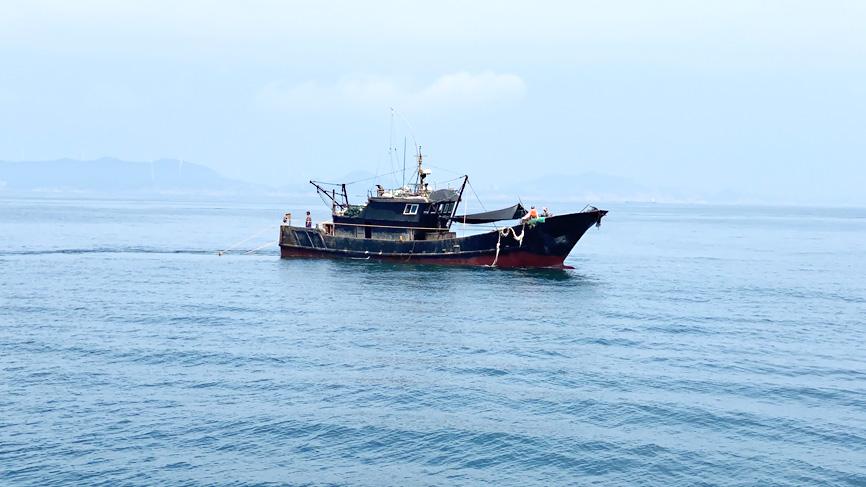
Photo courtesy of the Coast Guard Administration via CNA
An investigation was conducted by cross-referencing data from the Chinese government from 2019 and 2020 with records of illegal fishing and testimonies from 116 crew members aboard 88 Chinese fishing vessels.
Ninety-five percent of the crew members told the foundation that they saw sharks thrown overboard to die after being finned on their vessels, while 34 percent of them reported that protected species such as turtles and seals were also killed.
Smartphone footage obtained by the foundation also showed seals being clubbed to death and beheaded, it said.
About one-fifth of the crew members said that dolphins were routinely slaughtered as bait for sharks, the foundation said.
“It did not matter whether the shark was big or small, even babies inside the sharks’ belly ------ we took them all. I guess you could call it a ‘devil vessel,’ because it really took everything,” one crew member told the foundation.
Beijing funded these destructive fishing practices by offering state subsidies, which have been estimated to total about US$1.8 billion, the foundation said.
Migrant workers on the vessels told the foundation that they were physically and verbally abused by Chinese captains and senior crew members, had insufficient supplies of food and water, and were forced to work grueling hours.
Eighty-five percent reported abusive working and living conditions, while 58 percent said they had witnessed or experienced physical violence, the foundation said, adding that nearly all of the crew members said they experienced some form of debt bondage, or had their passports or other documents confiscated.
The investigation also examined the Chinese fleet’s complex onshore corporate structures.
About 90 percent of Ghana’s industrial trawl fishing fleet is suspected to be owned by Chinese corporations, which use local companies to register their vessels as Ghanaian, the report said.
Many of the vessels have been repeatedly associated with illegal fishing, it added.
“Where the fish caught by the fleet ends up is also shrouded by opacity, making it difficult or impossible to trace supply chains,” the foundation said. “However, what is known is that a number of Chinese distant-water vessels are licensed to export to Europe, and China is the US’ largest seafood trading partner.”
The Chinese fleet has become a substantial presence in many developing countries and regions that have limited capacity for monitoring fishing vessels, yet are heavily dependent on fishing for local food security and livelihoods, the report said.
Africa is home to 78.5 percent of Chinese government-approved fisheries, it said.
In western Africa, the Chinese bottom trawl fishing fleet catches an estimated 2.35 million tonnes of seafood per year, valued at more than US$5 billion, or about half of China’s total distant-water catch, the report said.

Considering that most countries issue more than five denominations of banknotes, the central bank has decided to redesign all five denominations, the bank said as it prepares for the first major overhaul of the banknotes in more than 24 years. Central bank Governor Yang Chin-lung (楊金龍) is expected to report to the Legislative Yuan today on the bank’s operations and the redesign’s progress. The bank in a report sent to the legislature ahead of today’s meeting said it had commissioned a survey on the public’s preferences. Survey results showed that NT$100 and NT$1,000 banknotes are the most commonly used, while NT$200 and NT$2,000

The Centers for Disease Control (CDC) yesterday reported the first case of a new COVID-19 subvariant — BA.3.2 — in a 10-year-old Singaporean girl who had a fever upon arrival in Taiwan and tested positive for the disease. The girl left Taiwan on March 20 and the case did not have a direct impact on the local community, it said. The WHO added the BA.3.2 strain to its list of Variants Under Monitoring in December last year, but this was the first imported case of the COVID-19 variant in Taiwan, CDC Deputy Director-General Lin Ming-cheng (林明誠) said. The girl arrived in Taiwan on

South Korea is planning to revise its controversial electronic arrival card, a step Taiwanese officials said prompted them to hold off on planned retaliatory measures, a South Korean media report said yesterday. A Yonhap News Agency report said that the South Korean Ministry of Foreign Affairs is planning to remove the “previous departure place” and “next destination” fields from its e-arrival card system. The plan, reached after interagency consultations, is under review and aims to simplify entry procedures and align the electronic form with the paper version, a South Korean ministry official said. The fields — which appeared only on the electronic form

The Ministry of Foreign Affairs (MOFA) is suspending retaliation measures against South Korea that were set to take effect tomorrow, after Seoul said it is updating its e-arrival system, MOFA said today. The measures were to be a new round of retaliation after Taiwan on March 1 changed South Korea's designation on government-issued alien resident certificates held by South Korean nationals to "South Korea” from the "Republic of Korea," the country’s official name. The move came after months of protests to Seoul over its listing of Taiwan as "China (Taiwan)" in dropdown menus on its new online immigration entry system. MOFA last week


 RSS
RSS