

While the government’s proposed strategies to reduce carbon emissions generally align with those of the UN, government agencies have set relatively conservative targets to achieve the nation’s goal of achieving net zero carbon emissions by 2050, an Academia Sinica researcher said yesterday.
The UN’s Intergovernmental Panel on Climate Change (IPCC) on Monday released the third part of its Sixth Assessment Report.
Local experts were yesterday invited to comment on the report at a news conference hosted by the Science Media Center Taiwan.
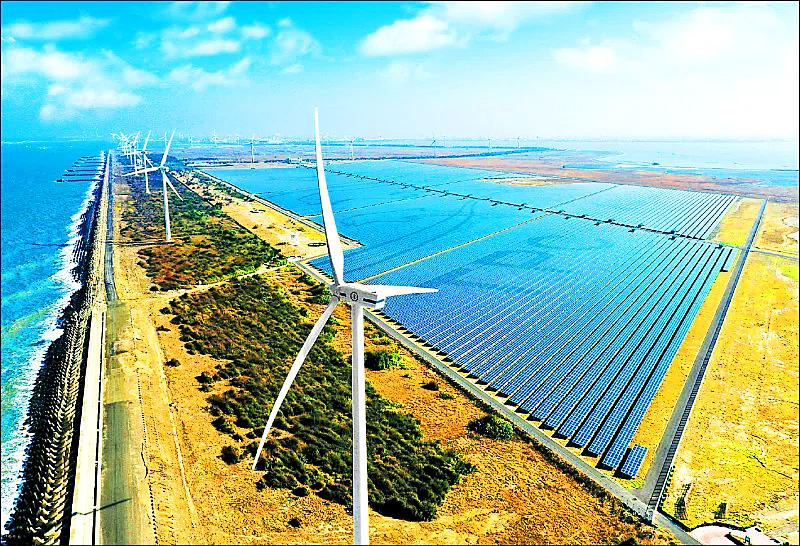
Photo courtesy of Taiwan Power Co
Alan Lin (林子倫), deputy executive director of the Executive Yuan’s Office of Energy and Carbon Reduction, told the news conference that a proposed amendment to the Greenhouse Gas Reduction and Management Act (溫室氣體減量及管理法) is under review at the Executive Yuan and could be deliberated this legislative session.
“The amendment, while offering a regulatory mechanism, is only a part of a complete legal framework. Government agencies regulating transportation, energy and architecture also need to have laws in place to collectively reduce carbon emission,” Lin said.
The National Development Council (NDC) at the end of last month proposed a path to achieving net zero carbon emissions by 2050, which would involve the transformation of the energy and technology sectors, as well as people’s lives, Lin said.
“The council’s proposed strategies to manage the demand side are generally aligned with those in the IPCC presentation, but we might at the end of this year adjust the council’s goal for 2030, which is to cut carbon emissions by 20 percent,” Lin said, adding that many experts have said the goal needs to be changed.
Shaw Daigee (蕭代基), an adjunct research fellow at Academia Sinica’s Institute of Economics, affirmed the NDC’s strategies to reduce carbon emissions, saying that it is a rather “bold and aggressive” policy.
However, the targets set by government agencies are far more conservative, he said.
“This issue has to be addressed this year, or there is no way Taiwan could cut carbon emissions by half by 2030 and achieve net zero emissions by 2050,” Shaw said, adding that the targets set by some agencies might even hold back the government’s efforts.
Taiwan can contribute more in terms of carbon sinks in forests, which the NDC failed to highlight in its report, he said, adding that the report did not mention levying a carbon tax.
A carbon sink refers to any reservoir, natural or otherwise, that accumulates and stores some carbon-containing chemical compound for an indefinite period and thereby lowers the concentration of carbon dioxide in the atmosphere.
The IPCC said that reducing carbon emissions would have only a minimal effect on the economy, contrary to what conventional wisdom says.
“Reducing carbon emissions could actually have a positive effect on the economy, as it would lead to revenue from carbon tax and a fairer income distribution system,” Shaw said.
Chao Chia-wei (趙家緯), adjunct assistant professor at National Taiwan University’s International Degree Program in Climate Change and Sustainable Development, said that Taiwan should derive 60 to 70 percent of its power supply from renewable energy sources, with many international studies indicating that 60 to 70 percent of global power supply would come from wind and solar energy.
There should be supporting government measures in the development of power storage facilities and power grids, he said.
The government should proactively promote the use of zero-carbon construction materials, as it would raise retail prices by less than 1 percent, he said.
Cheng Tsu-jui (鄭祖睿), assistant professor at National Cheng Kung University’s Department of Transport and Communication Management, said that the government should stipulate zero-carbon strategies for cargo logistics services, in addition to elevating the penetration rate of electric vehicles and motorcycles.
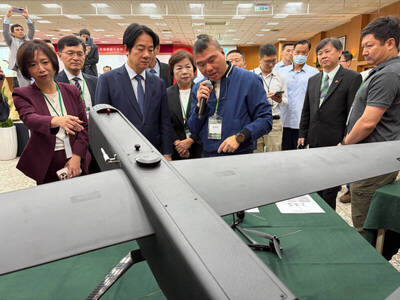
Two executives of drone supplier Jiin Ming Industry Co (錦明實業) have been detained and held incommunicado over the company's alleged use of prohibited China-made chips and camera lenses in drones supplied under recent military contracts, the Taoyuan District Prosecutors' Office said today. In a statement, prosecutors said they raided the offices of Jiin Ming — headquartered in Taoyuan — as well as those of its subsidiaries and its suppliers on Thursday last week. The raids followed a report that the company had breached its procurement contracts by putting the prohibited components into drones delivered to the military. During the raids, prosecutors summoned
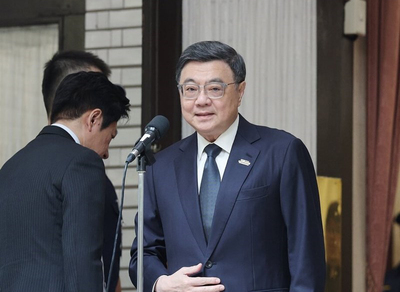
The government would continue monitoring online rumors that a pneumonic plague outbreak has spread from Russia into China and could enhance existing quarantine measures, Premier Cho Jung-tai (卓榮泰) said today. During a legislative meeting, Democratic Progressive Party Legislator Wang Ting-yu (王定宇) said rumors were circulating that the disease had spread across several Chinese provinces. He asked Cho whether the government was prepared to prevent the disease from spreading to Taiwan, given the frequent exchanges between Taiwan and China, and how concerned the government was about the alleged outbreak. The Ministry of Health and Welfare implemented border quarantine measures after briefing the Executive Yuan

South Korean boy band BigBang drew 120,000 fans to three concerts at Taipei Dome from Friday through yesterday, as the band thanked them for their support over their 20-year career. The Taipei Dome concerts were part of BigBang's "2026-2027 World Tour XX: Cosmos." Friday's concert was BigBang's first performance in Taiwan in 11 years. During the encore, group leader G-Dragon (GD) shouted "I love you" in Chinese and said he was especially happy to perform in Taiwan with bandmates Taeyang and Daesung. "Taipei, I'm very grateful to you all," GD said in Chinese, asking fans to wait for the band's return. Daesung thanked
A Chinese People's Liberation Army (PLA) Navy aircraft carrier group was being monitored after entering the western Pacific, the Ministry of National Defense said today, after Beijing yesterday criticized Taiwan for using a water cannon against a Chinese fishing boat near the Pratas Islands (Dongsha Islands, 東沙群島). A Chinese naval task group led by the aircraft carrier Liaoning (遼寧) yesterday sailed to the western Pacific for training, Chinese state-run Xinhua news agency quoted the PLA Navy as saying. “The drill is part of the annual routine training plan aimed at testing and improving the troops’ combat readiness and enhancing their ability to


 RSS
RSS