


People should carry mobile phones as well as satellite communication devices to ensure their safety when hiking in the mountains, the National Communications Commission (NCC) said at the weekend.
Safety issues facing Taiwan’s growing mountaineering enthusiasts came under scrutiny following the death of former Pegatron Corp vice president Tsai Chin-kuo (蔡進國).
Tsai was reported missing on Sunday last week after he went hiking alone the day before in the Manyueyuan National Forest Recreation Area (滿月圓森林遊樂區) of New Taipei City’s Sansia District (三峽). The altitudes of mountains in the area range from 300m to 1,728m above sea level.
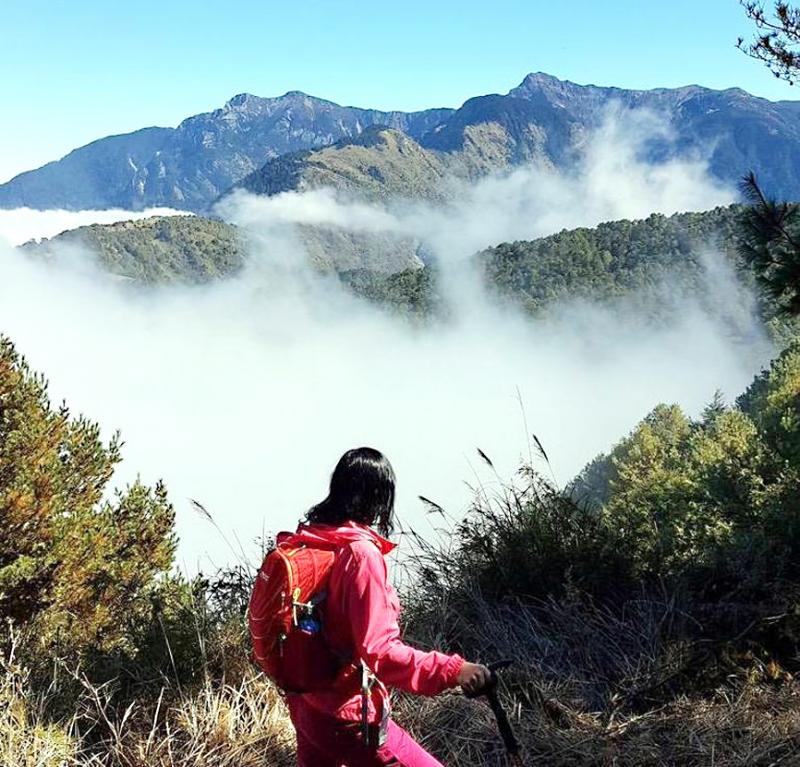
Photo courtesy of Yushan National Park Headquarters
Rescuers from the New Taipei City Fire Department located Tsai’s body in a river valley, about 50m to 80m below the trail, on Thursday last week.
Tsai’s family told police that he had left a message saying that he wanted to hike alone toward the Mayueyuan Hiking Trail, but the location in which his body was found showed that he might have chosen the wrong path, a police investigation showed.
Tsai might have slipped off the slope due to days of rain in the mountainous areas, rescuers said.
A post-mortem examination found that the cause of death was fracture of the cervical spine and left clavicle.
Taiwan’s telecoms have been asked to enhance reception signals in the mountainous areas as part of the Executive Yuan’s policy to further open forests and mountains to civilians, which was implemented in 2019, the NCC said in a statement.
Hikers can call “112” when encountering an emergency situation in a telecom service coverage area, the commission said, adding that they should then press “0” to report an incident or press “9” if they need rescue.
“However, if an emergency occurs in an area where there is no reception, they would need to depend on satellite signals,” the commission said.
Local telecoms have already offered personal locator beacons or satellite phones for lease, the commission said.
Personal locator beacons enable users to continue sending distress signals to satellites, allowing rescuers to identify the location of the person in need of emergency assistance, the commission said.
“In addition to helping rescuers identify the locations of the callers, a satellite phone allows callers to speak directly with rescuers,” it said.
Mountaineering enthusiasts are advised to carry mobile phones and satellite communication devices to ensure their personal safety, it said.
“The Executive Yuan recently released several frequency spectrums to be used for satellite communication services. We hope that telecoms can use the spectrums to develop low-earth orbit satellite services or a wider variety of emergency communication services,” the commission said.
A Taiwanese hiker wrote in a climbers’ Facebook forum that the government should allow civilians to use the “inReach” system developed by Garmin Ltd, as the network regularly sends the locations of hikers directly to the satellite.
However, regulations only allow telecoms to offer the “inReach” network, meaning it must be leased from a telecom provider.
Chunghwa Telecom offers the Thuraya Mobile Satellite Communications and International Maritime Satellite services for lease, NCC Vice Chairman Wong Po-tsung (翁柏宗) said.
“Any new satellite communication service is subject to the Telecommunications Management Act (電信管理法), as it might involve national security, communication surveillance and other issues,” Wong said.
A satellite service could be launched in Taiwan if the commission’s review could be secured, he added.
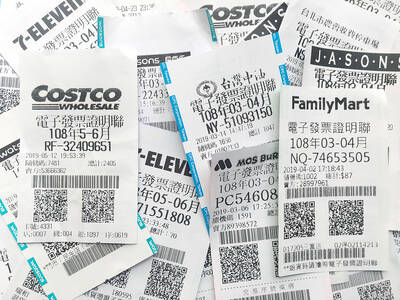
A NT$39 receipt for two bottles of tea at a FamilyMart was among the NT$10 million (US $312,969) special prize winners in the January-February uniform invoice lottery. FamilyMart said that two NT$10 million-winning receipts were issued at its stores, as well as two NT$2 million grand prizes and three NT$200,000 first prizes. The two NT$10 million receipts were issued at stores in Pingtung County and Yilan County’s Dongshan Township (冬山). One winner spent just NT$39 on two bottles of tea, while another spent NT$80 on water, tea and coffee, the company said. Meanwhile, 7-Eleven reported three NT$10 million winners — in New Taipei

Considering that most countries issue more than five denominations of banknotes, the central bank has decided to redesign all five denominations, the bank said as it prepares for the first major overhaul of the banknotes in more than 24 years. Central bank Governor Yang Chin-lung (楊金龍) is expected to report to the Legislative Yuan today on the bank’s operations and the redesign’s progress. The bank in a report sent to the legislature ahead of today’s meeting said it had commissioned a survey on the public’s preferences. Survey results showed that NT$100 and NT$1,000 banknotes are the most commonly used, while NT$200 and NT$2,000

The Centers for Disease Control (CDC) yesterday reported the first case of a new COVID-19 subvariant — BA.3.2 — in a 10-year-old Singaporean girl who had a fever upon arrival in Taiwan and tested positive for the disease. The girl left Taiwan on March 20 and the case did not have a direct impact on the local community, it said. The WHO added the BA.3.2 strain to its list of Variants Under Monitoring in December last year, but this was the first imported case of the COVID-19 variant in Taiwan, CDC Deputy Director-General Lin Ming-cheng (林明誠) said. The girl arrived in Taiwan on

ANNUAL EVENT: Two massive Pokemon balloons are to be set up in Daan Park, with an event zone operating from 10am to 6pm This year’s Taipei Floral Picnic is to be held at Daan Park today and tomorrow, featuring an exclusive Pokemon Go event, a themed food market, a coffee rave picnic area and stage performances, the Taipei Department of Information and Tourism said yesterday. Two massive Pokemon balloons are to be set up in the park as attractions, with an exclusive event zone operating from 10am to 6pm, it said. Participants who complete designated tasks on-site would have a chance to receive limited-edition souvenirs, it added. People could also try the newly launched game Pokemon Pokopia in the trial area, the department said. Three PokeStops are


 RSS
RSS